
Global Research & Marketing Consultants

Author name: Mahnoor Malik

Third-Party Risk Management: The Growing Cybersecurity Threat Hidden in Your Supply Chain

The Invisible Perimeter: Why Your Supply Chain is the New Battleground In today’s hyper-connected business environment, an organization’s cybersecurity posture is inextricably linked to that of its vendors, suppliers, and partners. The traditional security perimeter has evaporated, giving rise to a complex web of third-party relationships that often operate with privileged access to your critical […]

Third-Party Risk Management: The Growing Cybersecurity Threat Hidden in Your Supply Chain Read More »

Zero Trust Architecture in Practice: Moving Beyond Buzzwords to Enterprise Implementation

In today’s threat landscape, perimeter-based security models are no longer sufficient. Modern enterprises operate in hybrid environments—spanning cloud, on-premises infrastructure, SaaS applications, remote workforces, and third-party integrations. This expanded attack surface demands a fundamental shift in security philosophy. Zero Trust Architecture (ZTA) is often discussed in strategic cybersecurity conversations, but many organizations still struggle to

Zero Trust Architecture in Practice: Moving Beyond Buzzwords to Enterprise Implementation Read More »

Ransomware Resilience in 2026: Why Recovery Planning Matters More Than Prevention Alone

Cyber Resilience Has Become the New Competitive Advantage For years, enterprise cybersecurity strategies focused on a single objective: prevent attackers from entering the network. Organizations invested heavily in firewalls, endpoint protection, intrusion detection systems, employee awareness training, and sophisticated threat intelligence platforms. While these investments remain essential, the cyber threat landscape of 2026 has made

Ransomware Resilience in 2026: Why Recovery Planning Matters More Than Prevention Alone Read More »

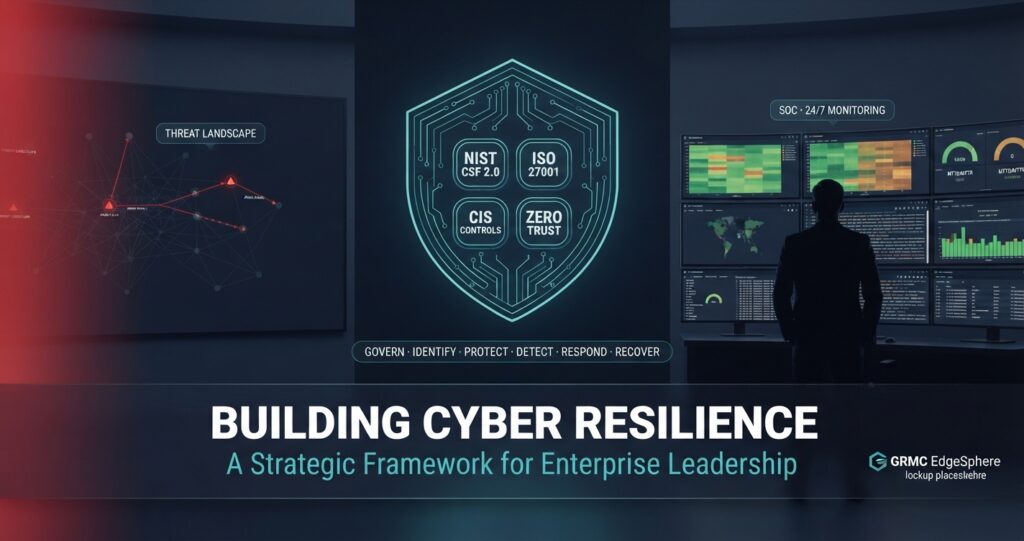
Cybersecurity as a Business Risk: What Boards and Executives Need to Measure Beyond Compliance

Compliance Is Not Cybersecurity For many organizations, cybersecurity discussions in the boardroom revolve around compliance requirements, audit findings, regulatory obligations, and certification status. While compliance frameworks such as ISO 27001, NIST Cybersecurity Framework (CSF), PCI DSS, HIPAA, and industry-specific regulations remain important, they represent only the minimum baseline for security governance. Today’s threat landscape has

Cybersecurity as a Business Risk: What Boards and Executives Need to Measure Beyond Compliance Read More »

Executive Guide to Generative AI Governance: Balancing Innovation, Risk, and Business Outcomes

Why Generative AI Governance Has Become a Boardroom Priority Generative AI is rapidly transforming how organizations operate, innovate, and compete. From intelligent customer service and automated content generation to software development assistance and enterprise knowledge management, AI is creating new opportunities for efficiency and growth. However, as organizations accelerate AI adoption, executives face a critical

Executive Guide to Generative AI Governance: Balancing Innovation, Risk, and Business Outcomes Read More »

Building an AI Transformation Roadmap: A Strategic Framework for Enterprise Adoption

Introduction: Why AI Transformation Requires a Roadmap, Not Experimentation Artificial Intelligence (AI) and automation are no longer experimental technologies reserved for innovation labs. They are now core enterprise capabilities influencing operational efficiency, customer experience, cost structure, and long-term competitiveness. However, many organizations still approach AI in a fragmented way—running isolated pilots, adopting tools without integration,

Building an AI Transformation Roadmap: A Strategic Framework for Enterprise Adoption Read More »

AI-Powered Customer Experience: Reducing Service Costs While Improving Customer Satisfaction

Introduction: Customer Experience is Now a Cost and Revenue Equation Customer experience (CX) is no longer just a branding or service function—it is a core business driver directly linked to revenue retention, operational cost, and competitive differentiation. For CEOs, CIOs, and digital leaders, the challenge is no longer whether to invest in AI-powered customer experience,

AI-Powered Customer Experience: Reducing Service Costs While Improving Customer Satisfaction Read More »

The Rise of Autonomous Business Processes: Practical Applications of Agentic AI Across Industries

Introduction Artificial Intelligence has evolved rapidly over the past decade. While early AI implementations focused primarily on analytics, automation, and predictive insights, a new generation of AI systems is reshaping how organizations operate. Known as Agentic AI, these systems are enabling businesses to move beyond task automation toward autonomous business processes capable of making decisions,

The Rise of Autonomous Business Processes: Practical Applications of Agentic AI Across Industries Read More »

Predictive Analytics for Business Leaders: Turning Historical Data into Competitive Advantage

Introduction In today’s rapidly evolving business environment, organizations generate more data than ever before. Every customer interaction, transaction, operational process, and digital touchpoint creates valuable information that can be leveraged for strategic decision-making. Yet many organizations continue to rely on historical reports that explain what happened yesterday rather than understanding what is likely to happen

Predictive Analytics for Business Leaders: Turning Historical Data into Competitive Advantage Read More »

Why Many AI Projects Fail After the Pilot Phase and How Enterprises Can Scale Successfully

Artificial Intelligence (AI) has moved beyond experimentation and become a strategic priority for organizations worldwide. From predictive analytics and intelligent automation to customer service enhancement and operational optimization, enterprises are investing heavily in AI-driven initiatives to gain competitive advantages. Yet despite significant investments, many organizations encounter a frustrating reality: successful AI pilots often fail to

Why Many AI Projects Fail After the Pilot Phase and How Enterprises Can Scale Successfully Read More »