

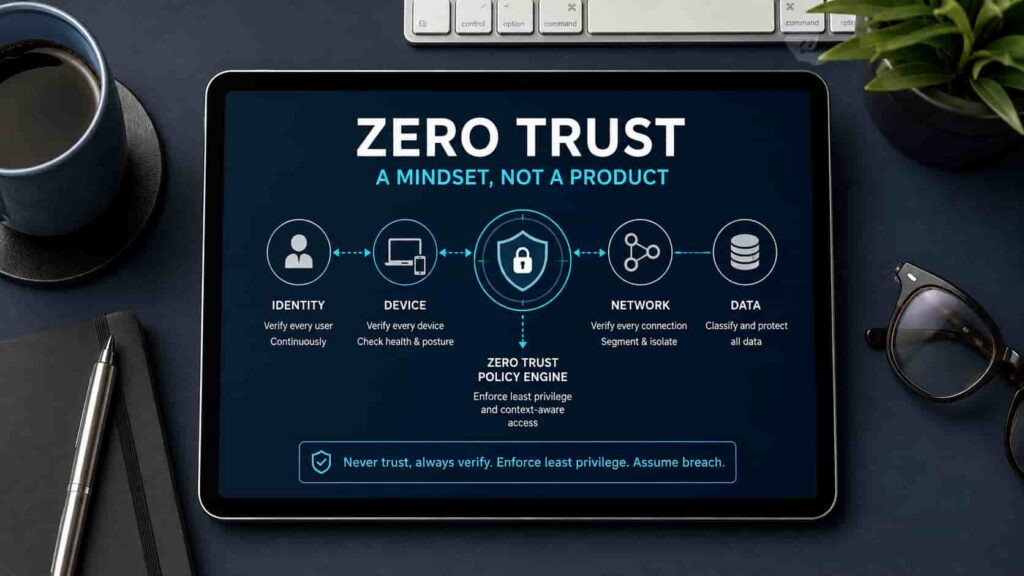
For years, the cybersecurity industry has been captivated by the term “Zero Trust.” It’s been marketed as a silver-bullet product, a new firewall to install, or a comprehensive architecture that requires a complete rip-and-replace of your existing infrastructure. This perception has led many organizations to delay their journey, believing the cost, complexity, and disruption are insurmountable.
This is a dangerous misconception.
As a global leader in strategic consulting and cybersecurity advisory, GRMC EdgeSphere asserts that Zero Trust is not a product; it is a strategic mindset built on a simple, powerful principle: “Never trust, always verify.”. It is a fundamental shift from a location-based security model (trusting everything inside the network perimeter) to an identity- and asset-centric model that assumes a breach is inevitable.
The good news for CEOs, CISOs, and IT Directors is that a successful Zero Trust journey does not require a full operational overhaul. It requires a strategic, phased approach that can be implemented incrementally, delivering immediate security gains while building toward a comprehensive, resilient posture. This guide provides a pragmatic roadmap for beginning that journey today, aligning with leading frameworks like NIST, ISO 27001, and the CIS Controls.
The Business Case: Why the “Mindset” Matters Now
The traditional perimeter-based security model is obsolete. The proliferation of cloud services, remote and hybrid workforces, and interconnected supply chains has dissolved the corporate network boundary. In this new reality, relying on a firewall to keep threats out is no longer sufficient. The most significant risks now stem from compromised identities—valid credentials misused by attackers who bypass perimeter defenses entirely. In sectors like finance and healthcare, where stolen credentials are a primary attack vector, a Zero Trust approach is not just a technical enhancement but a critical business imperative.
By adopting the Zero Trust mindset, you are not buying a product; you are making a strategic decision to:
- Reduce Business Risk: Minimize the impact of a breach by limiting lateral movement.
- Protect Critical Assets: Secure your most sensitive data and applications, whether they reside on-premises, in the cloud, or in hybrid environments.
- Enhance Compliance: Meet rigorous regulatory demands under frameworks like PCI DSS v4.0, HIPAA, and ISO 27001, which explicitly require robust access controls and least-privilege principles.
Starting Your Journey: A Pragmatic, Phased Approach
The journey to Zero Trust is not a project with a definitive end date; it is a continuous process of improvement. The goal is not architectural perfection but pragmatic, measurable risk reduction. We recommend a phased approach grounded in the Zero Trust Adoption Framework, with a focus on an incremental and strategic start.
Phase 1: Define Strategy and Align Leadership
The first step is not technical; it is strategic. The C-Suite must champion Zero Trust as a shared business responsibility aligned with the organization’s core objectives.
- Action: Conduct a tabletop exercise to identify your organization’s top risks, whether they are data breaches, ransomware, or compliance failures.
- Action: Frame security as an enabler of business goals—like secure digital transformation or market expansion—rather than just a cost center.
Phase 2: Plan and Prioritize Quick Wins
You don’t need to boil the ocean. Begin by focusing on “quick wins” and basic security hygiene. According to Microsoft, basic hygiene measures can stop 98% of attacks.
- Action: Start with a project to inventory your digital estate, focusing on identifying your most critical assets—the “crown jewels” you need to protect first.
- Action: Prioritize privileged access, as high-value accounts are the attacker’s primary target. Separate privileged and standard accounts and consider implementing Just-In-Time (JIT) access for administrative privileges.
Phase 3: Ready and Adopt – The First Technical Steps
This is where you begin implementing controls. A practical starting point is to extend existing controls and focus on core Zero Trust principles across key technology pillars: Identities, Endpoints, Networks, and Data.
Extending Zero Trust On-Premises
One of the most effective, low-disruption ways to start is by extending your Zero Trust principles to your on-premises environment. Instead of assuming that a device is safe once it connects to the corporate network, treat the office network as an untrusted space, just like a public Wi-Fi.
- How It Works: Use a ZTNA policy enforcement point to broker access to on-premises applications. Users connect to the network, but their access is determined by their identity, device posture, and the specific application they request—not their IP address.
- The Benefit: This eliminates the risk of lateral movement, prevents internal reconnaissance, and provides the same security posture for users in the office as it does for those working remotely.
Phase 4: Govern, Manage, and Mature
Zero Trust is a journey of continuous improvement. Once you have implemented initial controls, you must establish a cycle of governance and management.
- Action: Implement continuous monitoring to detect anomalies and track progress against your security goals.
- Action: Use metrics like “mean time to recover” or “percentage of compliant devices” to measure your success and report progress to the board.
- Action: Leverage the learnings from your quick wins to tackle the next phase: applying Zero Trust principles to legacy systems, which may need to be isolated and secured behind strict access controls rather than being fully replaced.
Conclusion: The Future of Security is Incremental and Adaptive
Zero Trust is not a destination you arrive at after a costly migration; it is the security posture for the modern, distributed enterprise. For organizations in critical infrastructure, finance, healthcare, and government, the question is not “if” but “how” to start.
GRMC EdgeSphere is uniquely positioned to guide you on this journey. Our expertise in aligning with global standards like ISO 27001 and NIST ensures that every step we take together is secure, resilient, and strategically sound. We help you prioritize, implement, and measure a Zero Trust strategy that protects your business today and scales for the challenges of tomorrow.
Ready to Take the First Step?
Contact GRMC EdgeSphere to schedule a Zero Trust readiness assessment. Let’s turn the mindset into a reality, one strategic step at a time.