

🌍 Introduction
In every industry, there are businesses that consistently outperform their competitors—not because they have larger budgets or more resources, but because they identify opportunities that others fail to recognize.
Many organizations focus their strategic planning on existing customers, current competitors, and historical performance. While these insights are valuable, they often overlook one of the most important drivers of long-term success: the opportunity gap.
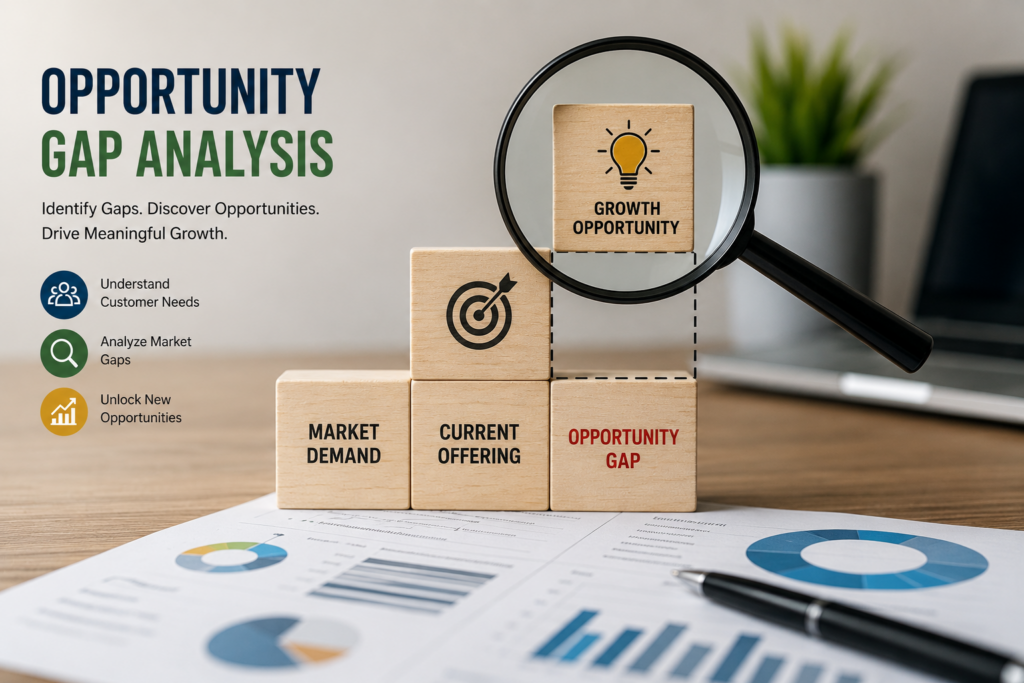
An opportunity gap exists when there is a disconnect between what customers need and what the market currently provides. These gaps may appear in underserved customer segments, unmet product expectations, inefficient service delivery, emerging technologies, pricing strategies, geographic markets, or changing consumer behaviors.
Identifying these hidden opportunities requires more than intuition. It demands structured market research, competitive intelligence, customer insights, and business analytics.
This is where Opportunity Gap Analysis becomes a powerful strategic framework.
Rather than asking, “How can we compete better?”, organizations begin asking more strategic questions:
- Which customer needs remain unmet?
- Where are competitors underperforming?
- Which industries are changing fastest?
- What opportunities are emerging before they become mainstream?
- How can we create new value instead of competing only on price?
By answering these questions with evidence rather than assumptions, organizations can uncover new revenue streams, strengthen market positioning, and make better investment decisions.
For business leaders, investors, government agencies, enterprise organizations, and innovation teams, Opportunity Gap Analysis provides a roadmap for identifying sustainable growth opportunities while reducing strategic uncertainty.
📊 Industry Overview
Today’s business environment is characterized by rapid technological advancement, changing customer expectations, economic uncertainty, and increasing global competition.
Organizations are generating more data than ever before, yet many continue making strategic decisions based primarily on historical performance.
The challenge is not the availability of information—it is identifying which insights reveal future opportunities.
Customer behaviors evolve quickly. New competitors enter markets with innovative business models. Regulatory changes reshape industries. Emerging technologies create entirely new customer expectations.
Organizations that rely solely on traditional market analysis often respond after these changes have already influenced the market.
Opportunity Gap Analysis shifts the focus from reacting to market change toward proactively discovering areas where demand exceeds current supply or where customer expectations remain unfulfilled.
This methodology combines qualitative research, quantitative analysis, competitive intelligence, trend forecasting, and customer journey evaluation to identify opportunities with the greatest strategic value.
⚠️ Key Challenges
📉 Growth Often Stalls Despite Strong Performance
Many successful organizations eventually reach a plateau where traditional growth strategies deliver diminishing returns.
Without identifying new market opportunities, expansion becomes increasingly difficult.
🔍 Hidden Customer Needs Remain Unidentified
Customers frequently adapt to market limitations rather than expressing unmet needs directly.
Organizations that fail to investigate these hidden expectations may overlook valuable innovation opportunities.
🌐 Competitive Markets Increase Pressure
As industries become more competitive, differentiating products and services becomes increasingly challenging.
Businesses that continue competing only on price risk reducing profitability over time.
📊 Internal Perspectives Can Limit Innovation
Leadership teams often rely heavily on internal experience and operational data.
While valuable, internal perspectives alone may fail to capture changing customer expectations or external market dynamics.
⏳ Emerging Opportunities Have Short Windows
Market opportunities rarely remain exclusive for long.
Organizations that identify them early often establish stronger competitive positions before markets become crowded.
📈 Market Research Insights
👥 Customer Frustrations Often Reveal Innovation Opportunities
Areas where customers experience delays, complexity, limited choices, or inconsistent service frequently indicate opportunities for new products, improved services, or better customer experiences.
📊 Competitive Weaknesses Can Become Market Advantages
Every competitor has limitations.
Analyzing customer reviews, industry feedback, pricing models, and service quality often reveals areas where organizations can differentiate themselves.
🌍 Adjacent Markets Create New Growth Paths
Organizations frequently discover opportunities by expanding into related industries, customer segments, or geographic regions where their existing capabilities provide a competitive advantage.
📈 Trend Analysis Supports Long-Term Planning
Monitoring demographic changes, technological innovation, investment activity, and regulatory developments enables organizations to identify future opportunities before demand reaches its peak.
🤝 Combining Multiple Research Sources Produces Better Decisions
The most reliable strategic insights come from integrating customer research, competitor analysis, operational data, economic indicators, and industry intelligence rather than relying on a single information source.
🛠️ Practical Recommendations
🔍 Evaluate Unmet Customer Needs
Conduct surveys, interviews, focus groups, and behavioral research to understand where customer expectations exceed current market offerings.
📊 Analyze Competitor Limitations
Assess competitor strengths, weaknesses, customer satisfaction, pricing strategies, and service delivery to identify potential market gaps.
🌐 Monitor Emerging Industries
Explore adjacent sectors, new technologies, changing regulations, and evolving business models that may create future opportunities.
👥 Segment Customers More Precisely
Different customer groups often have unique needs.
Develop detailed customer segments based on industry, geography, behavior, purchasing patterns, and organizational objectives.
📈 Prioritize Opportunities by Business Impact
Evaluate each identified opportunity according to market size, profitability, implementation complexity, competitive intensity, and alignment with organizational capabilities.
📋 Create Continuous Opportunity Monitoring Programs
Market opportunities evolve continuously.
Establish ongoing market intelligence programs that identify new trends, customer expectations, and competitive developments before they become mainstream.
🤝 How GRMC Can Help
GRMC EdgeSphere enables organizations to identify and evaluate high-value business opportunities through advanced market research, competitive intelligence, and strategic advisory services.
📊 Opportunity Discovery Research
We identify emerging customer needs, underserved markets, and future growth opportunities using evidence-based market research.
🔍 Competitive Intelligence
Our analysts evaluate competitor strategies, market positioning, pricing models, and customer experiences to uncover opportunities for differentiation.
👥 Customer Insight Programs
GRMC delivers in-depth research into customer behaviors, expectations, motivations, and purchasing decisions that support strategic innovation.
🌍 Business Intelligence Solutions
We combine internal performance data with external market intelligence to provide executives with actionable insights for strategic planning.
📈 Growth Strategy Advisory
Our consultants transform research findings into practical expansion strategies that improve competitiveness, accelerate innovation, and support sustainable business growth.
🚀 Conclusion
Long-term business success depends not only on responding to change but also on recognizing opportunities before competitors do.
Opportunity Gap Analysis provides organizations with a structured framework for discovering unmet customer needs, evaluating competitive weaknesses, identifying emerging trends, and uncovering new sources of sustainable growth.
By combining comprehensive market research, customer intelligence, business analytics, and strategic consulting, organizations can make confident investment decisions, strengthen market positioning, and create meaningful competitive advantages.
GRMC EdgeSphere empowers businesses to transform overlooked market opportunities into measurable growth through data-driven insights, strategic intelligence, and evidence-based decision-making.