

🌍 Introduction
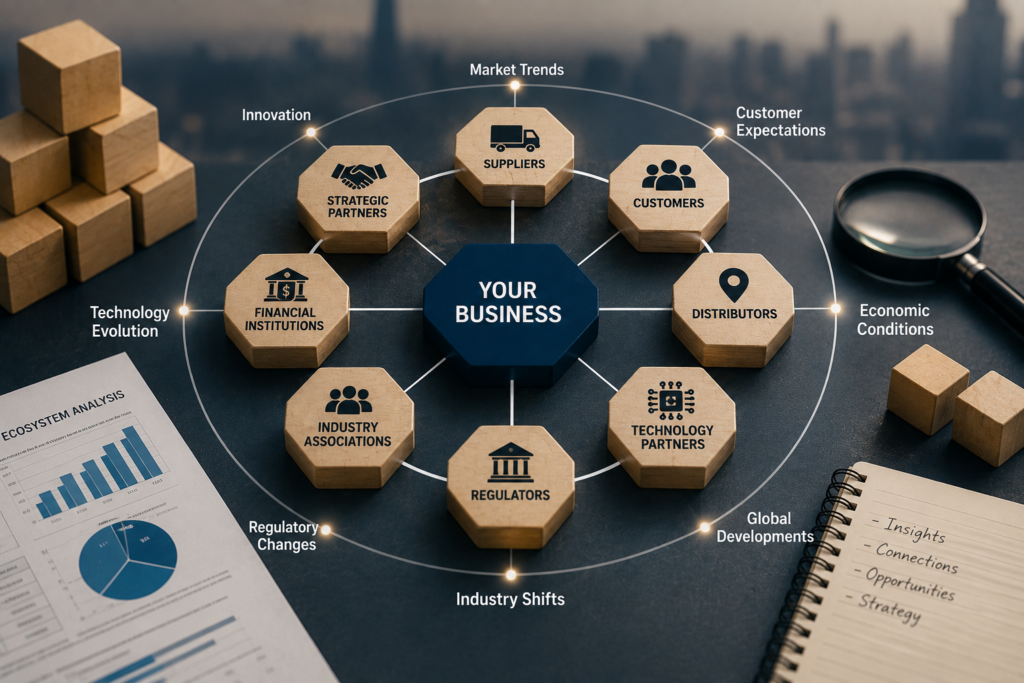
Many organizations evaluate their performance by monitoring customers, competitors, sales figures, and financial results. While these indicators are important, they represent only part of the broader business environment. Markets are influenced by a complex network of suppliers, technology providers, regulators, strategic partners, investors, distributors, industry associations, and emerging innovators.
Organizations that understand this wider ecosystem are often better prepared to identify new opportunities, anticipate risks, and adapt to change before their competitors.
This comprehensive approach is known as Business Ecosystem Intelligence.
Business Ecosystem Intelligence is a strategic market research methodology that analyzes the relationships and interactions between every stakeholder influencing an organization’s market. Rather than viewing the business as an isolated entity, this approach recognizes that long-term success depends on understanding how external forces shape customer demand, operational resilience, competitive positioning, and future growth.
For CEOs, business owners, government agencies, investors, CIOs, CTOs, and enterprise leaders, Business Ecosystem Intelligence provides a broader perspective that supports smarter strategic decisions and sustainable business expansion.
📊 Industry Overview
Today’s organizations operate within increasingly interconnected business environments.
Digital transformation has accelerated collaboration between suppliers, technology companies, logistics providers, financial institutions, regulators, and global markets. At the same time, customer expectations continue to evolve rapidly, influenced by technological innovation, economic uncertainty, sustainability initiatives, and changing industry standards.
A disruption affecting one part of the ecosystem—such as a supply chain issue, regulatory update, technological breakthrough, or geopolitical event—can quickly impact multiple industries.
Organizations that focus exclusively on internal performance metrics often recognize these changes too late.
Business Ecosystem Intelligence enables organizations to continuously monitor the wider business environment, identify strategic dependencies, and understand how changes in one area may influence overall organizational performance.
This broader perspective supports resilience, innovation, and long-term competitiveness.
⚠️ Key Challenges
🌐 Limited Visibility Beyond Internal Operations
Many organizations have detailed knowledge of their own operations but limited understanding of external factors that influence business performance.
📉 Increasing Market Interdependence
Modern organizations depend on complex networks of suppliers, technology partners, logistics providers, financial institutions, and service providers.
Disruptions affecting any of these stakeholders may create operational challenges.
🔍 Emerging Competitors Often Come from Adjacent Industries
Innovation frequently comes from outside traditional competitive boundaries.
Organizations that monitor only direct competitors may overlook disruptive entrants introducing new technologies or business models.
⚖️ Regulatory and Economic Uncertainty
Changing regulations, international trade policies, environmental standards, and economic conditions can reshape industries with little warning.
Organizations require continuous intelligence to remain agile.
👥 Changing Customer Expectations
Customer preferences increasingly reflect broader societal trends, including digital experiences, sustainability, transparency, personalization, and service quality.
Understanding these expectations requires research beyond traditional customer satisfaction surveys.
📈 Market Research Insights
📊 Strong Ecosystems Strengthen Business Performance
Organizations with resilient supplier relationships, collaborative partnerships, and diversified operational networks are generally better positioned to manage uncertainty.
🌍 Innovation Often Emerges Through Collaboration
Strategic partnerships between businesses, technology providers, research institutions, and industry organizations frequently generate new products, services, and market opportunities.
👥 Customers Evaluate Entire Value Chains
Modern customers increasingly consider factors such as ethical sourcing, environmental responsibility, cybersecurity, product quality, and service reliability when making purchasing decisions.
📈 Ecosystem Monitoring Improves Risk Management
Tracking developments across suppliers, regulators, technology providers, and adjacent industries enables organizations to identify potential risks before they significantly affect operations.
🤝 Business Intelligence Supports Long-Term Strategic Planning
Integrating ecosystem intelligence with market research, competitive analysis, customer insights, and operational data enables organizations to make more informed investment decisions.
🛠️ Practical Recommendations
🔍 Map the Complete Business Ecosystem
Identify suppliers, strategic partners, distributors, technology providers, financial institutions, regulators, research organizations, and industry associations that influence organizational performance.
📊 Evaluate Strategic Dependencies
Assess how operational success depends on external stakeholders and identify opportunities to strengthen resilience through diversification or collaboration.
👥 Monitor Emerging Technologies
Track technological developments that may influence customer expectations, operational efficiency, competitive positioning, or industry transformation.
🌐 Strengthen Strategic Partnerships
Develop long-term relationships with organizations that contribute to innovation, operational excellence, and sustainable growth.
📈 Integrate Ecosystem Intelligence into Strategic Planning
Ensure executive decision-making incorporates external market intelligence alongside internal operational metrics.
📋 Review Ecosystem Changes Continuously
Business ecosystems evolve constantly.
Regular monitoring of stakeholder activities, regulatory developments, industry investments, and market trends enables organizations to respond proactively.
🤝 How GRMC Can Help
GRMC EdgeSphere supports organizations through comprehensive ecosystem analysis, market intelligence, business research, and strategic advisory services.
📊 Business Ecosystem Research
We analyze stakeholder relationships, industry structures, and market dynamics to identify strategic opportunities and emerging risks.
🔍 Competitive & Industry Intelligence
Our specialists evaluate competitor strategies, ecosystem developments, technological innovation, and market evolution.
👥 Customer & Stakeholder Insights
GRMC delivers evidence-based research into customer expectations, stakeholder priorities, and market behavior that supports executive decision-making.
🌍 Business Intelligence & Analytics
We combine operational performance, external market intelligence, economic indicators, and ecosystem analysis to provide comprehensive business insights.
📈 Strategic Advisory
Our consultants help organizations translate ecosystem intelligence into actionable strategies that improve resilience, innovation, competitiveness, and sustainable growth.
🚀 Conclusion
Organizations no longer compete in isolation—they compete as part of interconnected business ecosystems.
Understanding the relationships between customers, suppliers, technology providers, regulators, investors, and strategic partners enables organizations to identify opportunities, anticipate disruption, and strengthen long-term competitiveness.
Business Ecosystem Intelligence transforms fragmented market information into strategic insight, allowing leaders to make informed decisions based on the complete business environment rather than isolated data.
GRMC EdgeSphere empowers organizations to build stronger, more resilient businesses through comprehensive market research, ecosystem intelligence, business analytics, and strategic consulting—helping enterprises navigate complexity with confidence and create sustainable competitive advantage.