

For many enterprise leaders, the decision to automate is framed as a future investment—a line item for next year’s budget, contingent upon “proving the business case” or waiting for technology to mature. This is a costly miscalculation. In 2026, the question is no longer about the cost of automation but about the escalating cost of inaction.
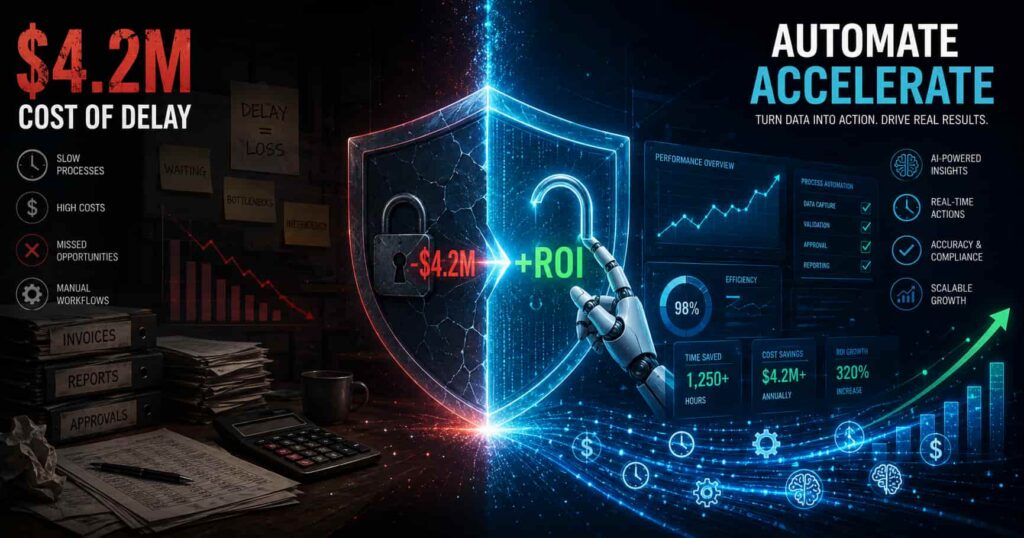
A common industry benchmark suggests that organizations delaying digital process transformation face an average opportunity loss of approximately $4.2 million annually in wasted operational expenditure, lost revenue opportunities, and eroded competitive positioning[citation:1]. This figure is not hype; it is a conservative estimate of the “tax” levied on organizations that cling to manual, fragmented workflows.
At GRMC EdgeSphere, we view automation not as a technology replacement but as a strategic capability. It is the mechanism by which insights (from market research, data analytics, and business intelligence) are translated into tangible business outcomes. This article outlines the components of this $4.2 million mistake and provides a framework for reclaiming that value.
The Anatomy of the $4.2 Million Loss
The cost of delaying automation is often invisible because it is embedded in operational friction. Here is how the inefficiency accumulates:
- Operational Inefficiency (The Labor Gap)
- The Issue: Manual data entry, report generation, and cross-system reconciliation consume countless hours that could be dedicated to strategy and innovation.
- The Impact: This leads to slower time-to-market, reactive decision-making, and an over-reliance on human memory rather than systematic processes.
- The Connection: When an organization postpones automation, it effectively accepts a fixed operational cost that competitors are rapidly reducing.
- The “Good Enough” Data Problem
- The Issue: Teams often rely on delayed or incomplete data because they lack the automated pipelines to ingest and structure real-time intelligence.
- The Impact: Strategic errors compound when decisions are made on stale information. For instance, market entry strategies or brand health studies lose relevance if the data takes weeks to synthesize.
- The Connection: Automation is the bridge between raw data (surveys, competitive analysis, social feeds) and actionable intelligence.
- Talent Misallocation
- The Issue: Highly skilled professionals spend significant time on low-value administrative tasks, leading to decreased job satisfaction and higher turnover.
- The Impact: The cost of talent churn and the lost potential of underutilized experts often exceeds the cost of implementing automated solutions.
- The Connection: Automation frees human capital to focus on high-value analysis, innovation, and client engagement.
The Strategic Imperative: Agentic AI and Intelligent Automation
The conversation in 2026 has evolved from basic Robotic Process Automation (RPA) to Agentic AI—autonomous systems that not only execute tasks but also adapt, learn, and optimize workflows with minimal human intervention[citation:2].
From Insight to Action:
At GRMC EdgeSphere, we help organizations transition from static reporting to dynamic, automated action. Our approach integrates:
- AI-Powered Consumer Behavior Analysis: Moving beyond descriptive analytics to predictive and prescriptive insights[citation:3].
- Automated Global SaaS Consulting: Streamlining how organizations deploy and manage software solutions across international markets.
- Cybersecurity as an Automation Enabler: Automated threat monitoring and compliance reporting reduce risk and ensure resilience[citation:2].
Practical Enterprise Example:
A multinational retail client faced delays in market entry due to the manual synthesis of consumer data and logistics reports. By implementing an automated business intelligence pipeline, they reduced report generation time by 75%, enabling them to launch a new product line three months ahead of schedule. This acceleration directly contributed to a significant increase in first-year revenue, effectively proving that the initial investment was not a cost but a revenue accelerator.
The ROI Framework: Calculating Your Automation Value
To understand your own “cost of delay,” consider the following framework:
- Identify the Friction Points: Map the end-to-end lifecycle of your key processes. Where do manual hand-offs occur? Where are the bottlenecks in data flow?
- Quantify the Impact: Calculate the cost of delays, errors, and rework. What is the opportunity cost of slow decision-making?
- Evaluate the Automation Potential: Determine which processes are rule-based, repetitive, and data-intensive. These are prime candidates for automation.
Why Choosing the Right Partner Matters
The technology itself is only one component of the solution. The true value is realized through a partner that understands the convergence of market research, strategy, and technology. As a recognized global market research and consulting firm, GRMC combines deep industry knowledge with technical expertise. We are certified in leading security frameworks (ISO 27001, NIST) and hold industry-recognized credentials (CISSP, PMP), ensuring that your automation journey is both secure and strategically sound[citation:2].
Our EdgeSphere platform embodies this philosophy, bridging Insight (market research and analytics), Innovation (AI and automation), and Impact (business growth)[citation:1].
Conclusion: Reclaiming the $4.2 Million
The decision to delay process automation is effectively a decision to subsidize inefficiency. In a globally competitive landscape, organizations that fail to integrate AI-driven process automation risk falling behind. The $4.2 million figure serves as a wake-up call, but it also represents an opportunity.
At GRMC EdgeSphere, we believe in a human-centered design for digital transformation. Automation should not replace human judgment; it should amplify it. It is the tool that empowers your team to focus on strategic growth, innovation, and client impact.
The time to act is now. The cost of waiting is clear.
Disclaimer: The $4.2 million figure referenced in this article is based on industry analysis and common benchmarks to illustrate the financial impact of delayed automation. Actual costs will vary based on organization size, industry, and specific operational processes.