
🌍 Introduction
Every organization generates vast amounts of data. Sales reports, customer feedback, financial records, operational metrics, website analytics, market trends, and competitive insights are produced every day. Yet despite having access to more information than ever before, many business leaders still struggle to make timely, confident, and evidence-based decisions.
The challenge is not a lack of data—it is the ability to transform that data into meaningful intelligence.
Too often, executives receive reports filled with numbers but lacking context. Departments work with separate datasets, creating information silos that make it difficult to gain a complete picture of business performance. As markets become more competitive and change more rapidly, relying on intuition alone is no longer enough.
This is where Strategic Decision Intelligence becomes a competitive advantage.
Strategic Decision Intelligence is the practice of integrating market research, business intelligence, predictive analytics, customer insights, financial analysis, and competitive intelligence into a unified decision-making framework. Instead of simply reporting what has happened, it helps organizations understand why it happened, what is likely to happen next, and which actions will create the greatest business value.
For CEOs, Managing Directors, CIOs, investors, government organizations, and enterprise leaders, Strategic Decision Intelligence provides the confidence to make informed decisions that support innovation, resilience, and sustainable growth.
📊 Industry Overview
Modern organizations operate in increasingly dynamic business environments. Customer expectations evolve quickly, technological innovation accelerates market disruption, and global economic conditions influence investment decisions across every industry.
At the same time, organizations collect data from numerous sources, including:
- Customer relationship management (CRM) platforms
- Enterprise resource planning (ERP) systems
- Financial reporting tools
- Digital marketing platforms
- Customer satisfaction surveys
- Social media analytics
- Market research studies
- Industry reports
- Supply chain systems
- Operational performance dashboards
While these systems generate valuable information, they often exist independently, making it difficult for leadership teams to connect insights across departments.
Strategic Decision Intelligence bridges these gaps by combining diverse sources of information into a single, business-focused view that supports faster and more effective decision-making.
Organizations that adopt this approach are better positioned to identify growth opportunities, manage risk, optimize investments, and respond proactively to market change.
⚠️ Key Challenges
📉 Information Silos
Departments frequently manage their own data independently, resulting in fragmented insights and inconsistent decision-making.
🔍 Data Without Context
Large volumes of information are valuable only when interpreted within the context of business objectives, market conditions, and customer behavior.
🌐 Rapid Market Changes
Economic fluctuations, regulatory developments, technological innovation, and changing consumer expectations require organizations to make decisions more quickly than ever before.
👥 Conflicting Performance Indicators
Different business units often prioritize different metrics, making it difficult for executives to determine which indicators should guide strategic decisions.
⏳ Delayed Decision-Making
When leaders spend excessive time gathering, validating, and interpreting information, valuable business opportunities may already have passed.
📈 Market Research & Business Intelligence Insights
📊 Integrated Intelligence Improves Strategic Planning
Organizations that combine market research, customer insights, operational performance, and financial data develop a more complete understanding of business performance and future opportunities.
👥 Customer-Centric Decisions Deliver Better Results
Decision frameworks that incorporate customer behavior, satisfaction, and evolving expectations are more likely to support sustainable growth than strategies based solely on internal performance metrics.
🌍 Competitive Intelligence Strengthens Market Position
Understanding competitor investments, pricing strategies, innovation initiatives, and market expansion activities enables organizations to anticipate industry shifts and refine their own strategies.
📈 Predictive Analytics Supports Proactive Leadership
Historical data explains previous performance, but predictive analytics helps organizations prepare for future market conditions and customer demand.
🤝 Executive Dashboards Improve Organizational Alignment
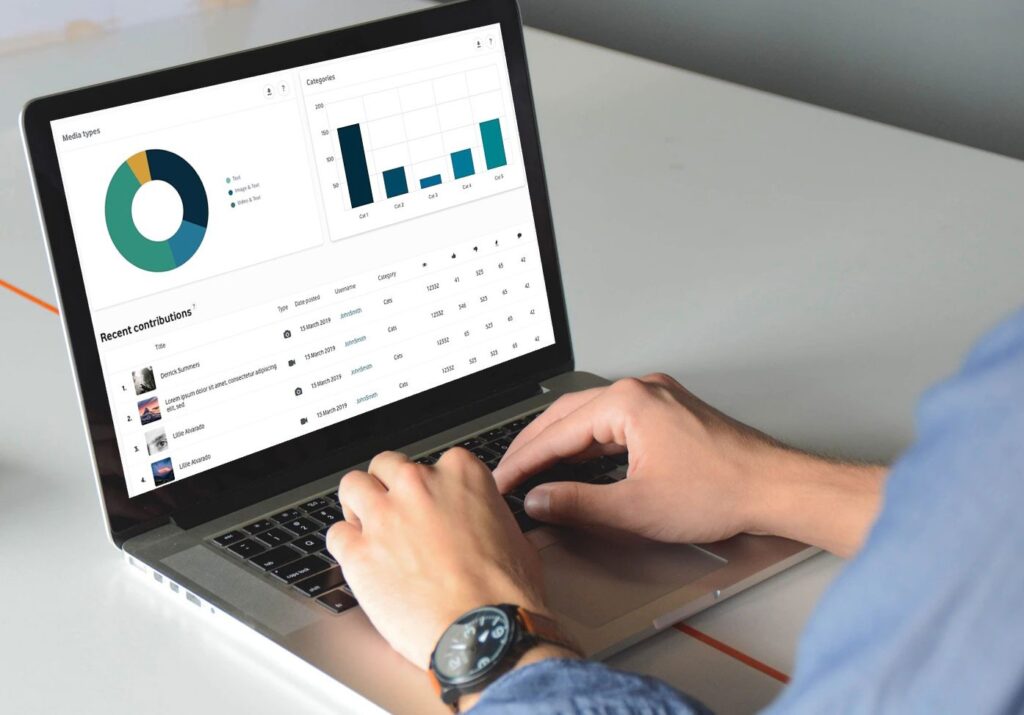
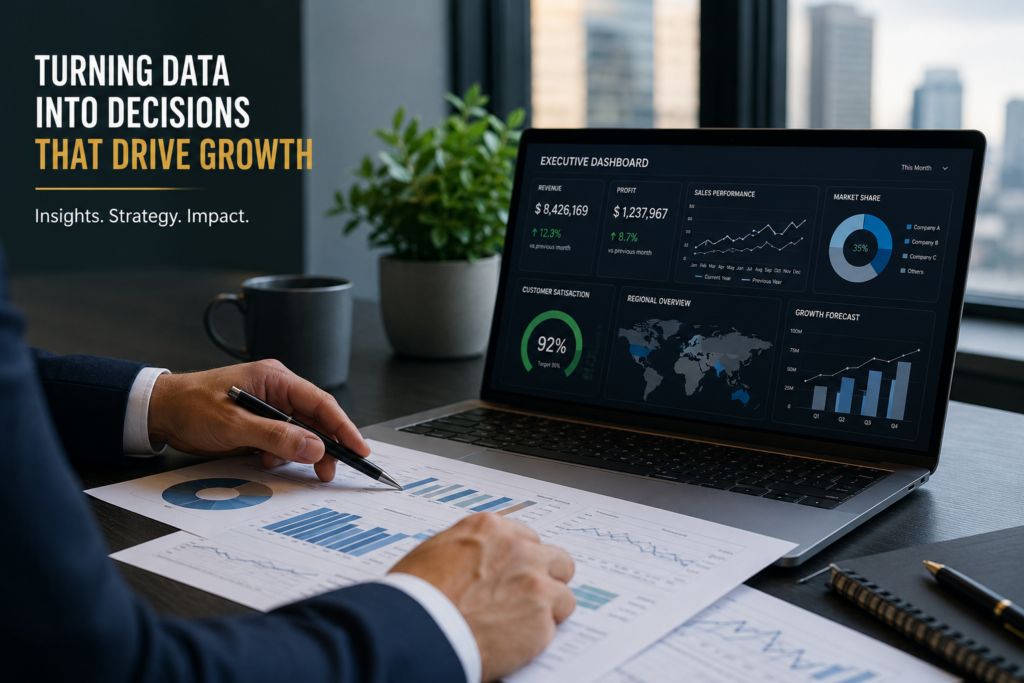
Well-designed executive dashboards provide leadership teams with consistent, real-time visibility into critical business indicators, enabling faster collaboration and more informed decision-making.
🛠️ Practical Recommendations
🔍 Integrate Multiple Data Sources
Combine operational data, customer research, financial metrics, competitive intelligence, and external market indicators to create a comprehensive business intelligence ecosystem.
📊 Define Executive Key Performance Indicators (KPIs)
Identify the metrics that most directly influence strategic objectives and ensure leadership teams consistently monitor these indicators.
👥 Establish Cross-Functional Decision Processes
Encourage collaboration between marketing, finance, operations, technology, sales, and executive leadership when evaluating strategic opportunities.
🌐 Invest in Predictive Analytics
Use forecasting models to identify future trends, anticipate customer needs, and evaluate potential business scenarios before making major investments.
📈 Create Interactive Executive Dashboards
Provide leaders with accessible, real-time dashboards that present actionable insights rather than isolated data points.
📋 Review Strategic Intelligence Regularly
Business conditions change continuously. Schedule recurring reviews of market intelligence, customer research, operational performance, and competitive developments to maintain strategic agility.
🤝 How GRMC Can Help
GRMC EdgeSphere enables organizations to transform complex business data into actionable strategic intelligence through advanced market research, business analytics, and executive advisory services.
📊 Business Intelligence Solutions
We integrate internal operational data with external market intelligence to provide executives with a complete view of business performance.
🔍 Market Research & Competitive Analysis
Our specialists deliver evidence-based insights into customer behavior, market trends, industry dynamics, and competitive positioning.
👥 Executive Decision Support
GRMC develops tailored intelligence frameworks that help leadership teams make faster, more confident strategic decisions.
🌍 Data Analytics & Performance Reporting
We design executive dashboards and analytical models that convert complex information into clear business insights.
📈 Strategic Advisory
Our consultants work closely with organizations to align intelligence, analytics, and research with long-term business objectives, helping leaders improve resilience, innovation, and growth.
🚀 Conclusion
In today’s data-driven economy, organizations that make better decisions gain a lasting competitive advantage.
Strategic Decision Intelligence goes beyond reporting by transforming information into actionable insights that support confident leadership, proactive planning, and measurable business outcomes.
By combining market research, business intelligence, predictive analytics, customer insights, and competitive analysis, organizations can reduce uncertainty, identify new opportunities, optimize investments, and strengthen long-term performance.
GRMC EdgeSphere empowers enterprises to convert business data into strategic action through comprehensive research, advanced analytics, and executive advisory services—helping organizations make smarter decisions in an increasingly complex global marketplace.