

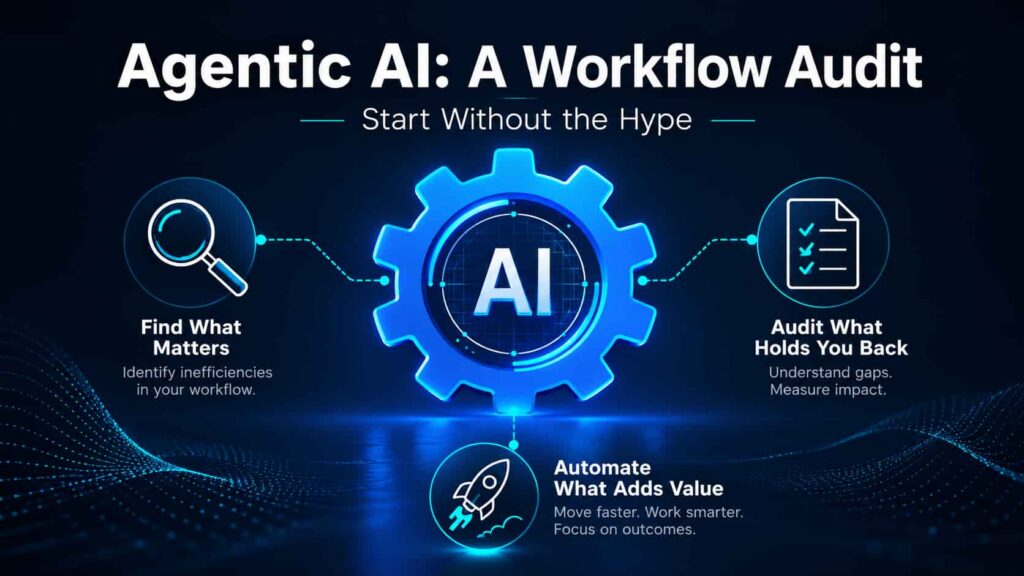
The business landscape in 2026 is saturated with the promise of Artificial Intelligence (AI). For every CEO, CTO, and Innovation Leader, the pressure is palpable: “We need an AI strategy.” Yet, amidst the flurry of boardroom discussions, a critical distinction has emerged between those who will realize genuine return on investment and those who will merely chase a technological mirage.
The reality is that the fundamental value of enterprise AI lies not in a magical algorithm, but in a rigorous examination of your organization’s workflow. Agentic AI, which promises to execute tasks and make decisions autonomously, represents a profound opportunity. However, its potential is predicated on a straightforward, albeit challenging, premise: you cannot effectively automate a process that is not already optimized.
This is the essence of the “workflow audit.” Success in the age of AI is not about implementing the most advanced model; it is about achieving the highest operational clarity. At GRMC EdgeSphere, we guide organizations beyond the hype to focus on the mechanics of transformation.
The Reality of Business Value in Agentic AI
Agentic AI systems are designed to manage and execute complex workflows with minimal human intervention [citation:1]. This move from generative AI—which creates content—to agentic AI—which takes action—marks a significant shift in capability. Yet, the most advanced autonomous systems are still dependent on the quality of the “rails” provided to them. These rails are defined by your business processes.
To move beyond the hype, decision-makers must assess the business value from three critical perspectives: ROI, Scalability, and Competitive Advantage.
1. Return on Investment (ROI): Auditing for Efficiencies
The most significant source of ROI from AI is often not revenue generation but cost avoidance through the reduction of process friction. Think of a multinational corporation handling invoice processing. A basic AI model might be able to extract data from an invoice, but a truly agentic system can verify inventory, cross-check purchase orders, approve payments, and update financial records—all without human oversight.
Yet, if the underlying process has inconsistent data formats, manual approval bottlenecks, or unclear escalation paths, the AI will inherit these flaws. It will simply fail faster. The workflow audit identifies these inefficiencies before they are encoded into a system, ensuring that the AI is automating an optimized state rather than a broken one. The ROI is realized by eliminating the inherent delays of the previous manual process.
2. Efficiency and Scalability: Moving from “Doing” to “Directing”
The true efficiency gain of agentic AI is freeing human capital for higher-order tasks. It transforms employees from being “doers” to “directors.” This is where the human-centered design approach, championed by leading global market research companies, becomes essential [citation:1].
For example, consider a customer service department that handles thousands of queries daily. An agentic AI could autonomously resolve routine requests, such as password resets or order status updates. More critically, it can detect sentiment and intent, escalating complex or high-value issues to human agents. This allows human team members to focus on relationship building and complex problem-solving, directly impacting employee satisfaction and retention. Efficiency, in this context, means a more engaged and effective workforce.
3. Competitive Advantage: The Race for Data-Driven Execution
In a hyper-competitive global market, speed is the ultimate differentiator. Organizations that can analyze data and act upon it in real-time will naturally outperform those that rely on slower, legacy decision-making processes. The workflow audit helps businesses understand how data flows through their organization and where bottlenecks occur.
Agentic AI excels at monitoring business intelligence dashboards, identifying market shifts, and recommending or executing tactical changes [citation:1]. Imagine a logistics company using AI to automatically reroute supply chains in response to weather disruptions or port closures. This capability provides a significant competitive advantage that goes far beyond the capability of a static planning document.
A Practical Framework for Starting Your AI Journey
The path to adopting agentic AI is not a simple purchase of a new software solution. It is a program of organizational change. Here is a practical, step-by-step framework to begin without the hype.
Phase 1: The Comprehensive Workflow Audit
This is the foundational phase. Before evaluating any technology, you must audit your current state. This involves:
- Mapping the End-to-End Process: Select one specific business process. It could be “Client Onboarding,” “Supplier Payment,” or “Lead Qualification.” Document every step of the current workflow, including all data touchpoints and manual interventions.
- Identifying Friction Points: Look for data silos, redundant tasks, inconsistent data entry, and unclear decision rules. These are the “cracks” that will be amplified by AI.
- Data Integrity Assessment: Assess the quality of the data used within the workflow. Is it structured? Is it clean? Is it accessible? An AI is only as good as the data it is trained on. Ensuring data integrity is a non-negotiable prerequisite.
Phase 2: Strategic Alignment and Goal Definition
Once you understand the “as-is” process, you can define the “to-be” process. At this stage, you must define clear success metrics.
- Define Success KPIs: Set clear, measurable targets. For the “Invoice Processing” example, a KPI could be, “Reduce manual data entry by 90% in the first quarter.”
- Select the “Right” Use Case: Start with a process that is high-volume, rules-based, and has a clear, measurable return on investment. This “low-hanging fruit” provides early wins and builds organizational confidence.
Phase 3: Pilot, Measure, and Iterate
The move from a proof of concept to a production system is where many initiatives fail. Adopt a continuous improvement methodology.
- Start with a Pilot: Run a controlled pilot of the agentic AI on the selected process. Monitor performance against your defined KPIs.
- Human-in-the-Loop Design: In the early stages, it’s crucial to have a “human-in-the-loop” to review and correct the AI’s decisions. This provides a mechanism for continuous learning and improvement for the AI model.
- Scale Gradually: As confidence in the system grows, expand its responsibilities and integrate it with other enterprise systems.
Conclusion: From Hype to Reality
Agentic AI represents a monumental leap forward in enterprise automation. It promises to unlock unprecedented levels of efficiency, scalability, and competitive advantage. However, this potential is realized only through a disciplined, strategic approach. The “magic” is not in the machine; it is in the meticulous work of understanding and optimizing your workflows.
At GRMC EdgeSphere, we help organizations navigate this journey. Our approach is to bridge insight and innovation, combining the rigor of market research with the power of AI-driven solutions to deliver sustainable impact.
Are you ready to move from the hype to a tangible transformation?
Contact GRMC EdgeSphere today to schedule a workflow audit and discover how to build a practical AI strategy for your enterprise. Let’s start a conversation.