

Introduction
Artificial Intelligence has evolved rapidly over the past decade. While early AI implementations focused primarily on analytics, automation, and predictive insights, a new generation of AI systems is reshaping how organizations operate. Known as Agentic AI, these systems are enabling businesses to move beyond task automation toward autonomous business processes capable of making decisions, coordinating actions, and continuously optimizing outcomes.
For enterprise leaders, the significance of Agentic AI extends beyond technology innovation. It represents a strategic opportunity to improve operational efficiency, accelerate decision-making, reduce costs, and create scalable business models that can adapt to rapidly changing market conditions.
As organizations face increasing pressure to do more with fewer resources, autonomous business processes are emerging as a practical pathway toward digital transformation and sustainable competitive advantage.
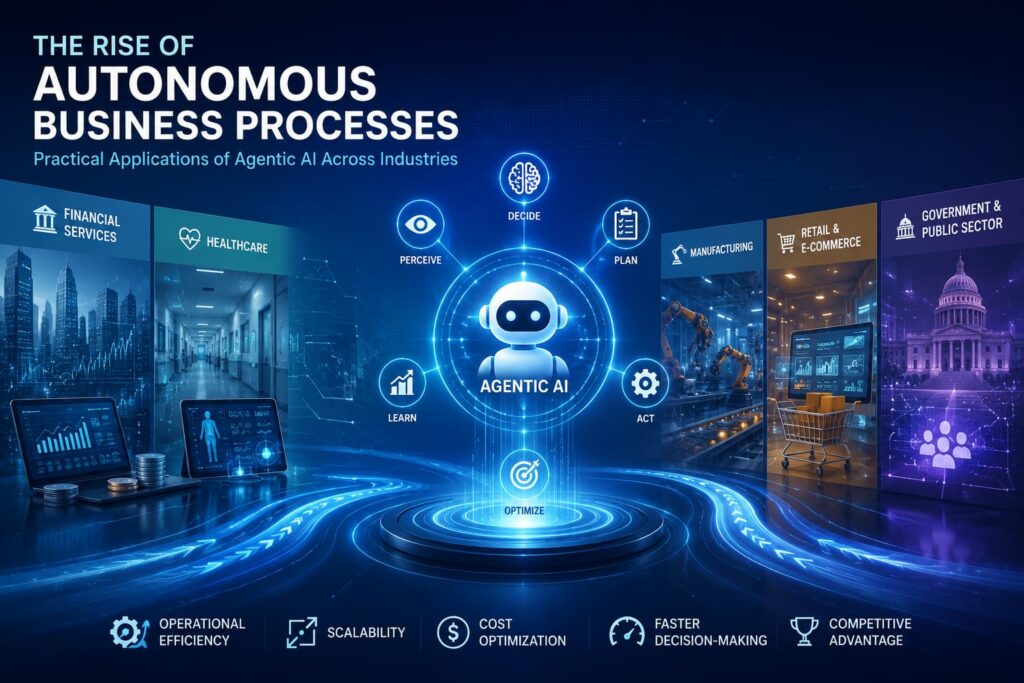
What Is Agentic AI?
Agentic AI refers to intelligent systems that can independently pursue goals, make contextual decisions, execute actions, and collaborate with other systems with minimal human intervention.
Unlike traditional automation, which follows predefined rules and workflows, Agentic AI systems can:
- Analyze complex situations
- Determine optimal actions
- Execute tasks across multiple systems
- Learn from outcomes
- Adapt to changing business environments
In essence, Agentic AI functions more like a digital workforce member than a software tool.
For example, a traditional automation system may generate a report every Monday. An Agentic AI system can identify emerging business risks, gather relevant data from multiple sources, generate recommendations, schedule stakeholder meetings, and trigger corrective actions automatically.
This shift from automation to autonomy represents a significant advancement in enterprise operations.
Why Autonomous Business Processes Matter
Organizations have invested heavily in technologies such as ERP platforms, CRM systems, robotic process automation (RPA), workflow engines, and business intelligence tools. While these technologies improve efficiency, many processes still require significant human oversight.
Autonomous business processes address this challenge by enabling end-to-end process execution with minimal manual intervention.
Key business benefits include:
Improved Operational Efficiency
Autonomous systems can operate continuously without delays caused by manual approvals, handoffs, or scheduling constraints. This significantly reduces process cycle times and improves overall productivity.
Enhanced Scalability
As organizations grow, operational complexity increases. Agentic AI allows businesses to scale operations without proportional increases in workforce costs.
Faster Decision-Making
By continuously analyzing data and responding in real time, AI agents can execute decisions much faster than traditional workflows.
Cost Optimization
Reducing repetitive manual work lowers operational expenses while enabling employees to focus on higher-value strategic activities.
Increased Business Agility
Organizations can respond more quickly to market changes, customer demands, regulatory updates, and supply chain disruptions.
Practical Applications Across Industries
The value of Agentic AI becomes most apparent when examining real-world business applications.
Financial Services
Financial institutions process vast volumes of transactions, customer interactions, compliance requirements, and risk assessments.
Agentic AI can autonomously:
- Monitor transactions for fraud detection
- Investigate suspicious activities
- Generate compliance reports
- Manage customer onboarding workflows
- Assess lending risks
- Recommend portfolio adjustments
For example, an AI agent monitoring transaction patterns can identify anomalies, gather supporting evidence, initiate investigations, and escalate only high-risk cases to human analysts.
This reduces investigation time while improving risk management effectiveness.
Healthcare
Healthcare organizations face growing administrative burdens alongside increasing demands for patient care.
Agentic AI can support:
- Appointment scheduling optimization
- Insurance verification
- Medical record management
- Patient communication
- Resource allocation
- Clinical workflow coordination
A healthcare provider could deploy AI agents that automatically coordinate appointments, verify insurance eligibility, notify patients, update electronic health records, and optimize physician schedules.
The result is improved patient experience and greater operational efficiency without increasing administrative staffing levels.
Manufacturing
Manufacturers are increasingly adopting smart factories and connected operations.
Agentic AI can autonomously:
- Monitor equipment performance
- Predict maintenance requirements
- Optimize production schedules
- Manage inventory levels
- Coordinate supply chain activities
Consider a manufacturing facility where AI agents continuously monitor machine performance data. When a potential equipment failure is detected, the system can automatically order replacement parts, schedule maintenance windows, adjust production schedules, and notify relevant stakeholders.
This minimizes downtime and improves asset utilization.
Retail and E-Commerce
Retailers operate in highly competitive environments where customer expectations continue to rise.
Agentic AI can help organizations:
- Optimize pricing strategies
- Manage inventory replenishment
- Personalize customer experiences
- Automate customer support
- Forecast demand patterns
An AI-driven retail operation may autonomously adjust pricing based on market conditions, competitor activity, inventory levels, and customer demand, ensuring profitability while maintaining competitiveness.
Government and Public Sector
Government organizations often manage complex service delivery processes involving multiple departments and stakeholders.
Agentic AI can improve:
- Citizen service delivery
- Permit processing
- Case management
- Regulatory compliance
- Resource allocation
For example, AI agents could manage permit applications by collecting required documentation, validating submissions, identifying missing information, coordinating reviews, and providing real-time status updates to applicants.
This reduces processing times while improving service quality.
Agentic AI and the Future of Enterprise Operations
The long-term impact of Agentic AI extends beyond individual process improvements.
Organizations are beginning to develop networks of specialized AI agents that collaborate across departments and business functions.
Imagine a scenario where:
- A sales agent identifies increased demand.
- A forecasting agent updates demand projections.
- A procurement agent orders additional materials.
- A finance agent evaluates budget implications.
- A logistics agent adjusts distribution plans.
Each agent operates independently while contributing to a shared business objective.
This interconnected ecosystem creates a highly responsive and adaptive enterprise capable of operating at a scale and speed that traditional workflows cannot match.
Key Considerations for Implementation
Despite its potential, Agentic AI is not a plug-and-play solution.
Successful implementation requires careful planning, governance, and alignment with business objectives.
Start with High-Value Use Cases
Organizations should prioritize processes that are:
- Repetitive
- Data-driven
- Time-intensive
- Prone to human bottlenecks
These areas often deliver the fastest return on investment.
Maintain Human Oversight
Autonomous processes should augment human expertise rather than replace critical decision-makers.
Organizations should establish clear governance frameworks that define:
- Decision boundaries
- Escalation protocols
- Risk controls
- Compliance requirements
Focus on Integration
Agentic AI delivers maximum value when integrated with existing enterprise systems such as:
- ERP platforms
- CRM systems
- Supply chain solutions
- Data warehouses
- Business intelligence tools
Strong integration enables AI agents to access the information necessary for informed decision-making.
Prioritize Security and Compliance
As AI systems gain greater operational autonomy, organizations must ensure:
- Data privacy protection
- Regulatory compliance
- Access control management
- Auditability
- Transparency
Governance frameworks should evolve alongside AI adoption strategies.
Measuring ROI from Agentic AI
Business leaders increasingly require clear evidence of value before investing in emerging technologies.
Key performance indicators may include:
- Process cycle time reduction
- Operational cost savings
- Employee productivity gains
- Customer satisfaction improvements
- Error rate reduction
- Revenue growth opportunities
Organizations that approach Agentic AI strategically often find that benefits extend beyond efficiency gains. Improved decision quality, faster responsiveness, and enhanced customer experiences contribute to long-term competitive advantage.
The most successful implementations focus on measurable business outcomes rather than technology adoption for its own sake.
Conclusion
Agentic AI represents the next stage in the evolution of enterprise automation. By enabling autonomous business processes, organizations can move beyond isolated task automation and create intelligent operational ecosystems capable of adapting, learning, and executing with minimal human intervention.
From financial services and healthcare to manufacturing, retail, and government sectors, practical applications are already demonstrating significant improvements in efficiency, scalability, and decision-making speed.
However, realizing these benefits requires a disciplined approach focused on governance, integration, security, and business value creation.
For organizations pursuing digital transformation, the question is no longer whether AI will influence business operations, but how quickly autonomous processes can be deployed to create sustainable competitive advantage.
Enterprises that successfully harness Agentic AI today will be better positioned to operate with greater agility, resilience, and efficiency in tomorrow’s increasingly digital economy.