

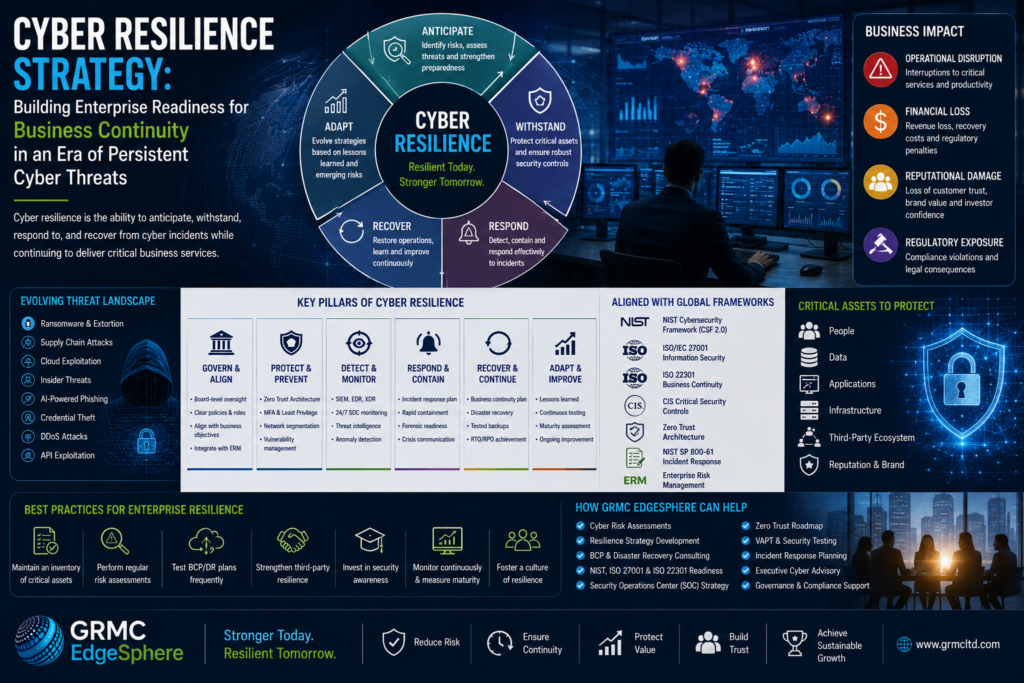
Cybersecurity is no longer measured solely by an organization’s ability to prevent attacks. In today’s threat landscape, the question is not if a cyber incident will occur, but when. As ransomware, supply chain compromises, insider threats, cloud misconfigurations, and AI-powered attacks continue to evolve, organizations must prepare to withstand, respond to, and recover from cyber incidents with minimal disruption.
This is the foundation of Cyber Resilience—an enterprise-wide strategy that combines cybersecurity, business continuity, disaster recovery, risk management, governance, and operational resilience into a unified framework.
For CEOs, Boards of Directors, CIOs, CTOs, CISOs, and government leaders, cyber resilience has become a strategic business capability rather than a purely technical objective. It protects revenue, maintains customer trust, ensures regulatory compliance, and enables organizations to continue operating during and after cyber incidents.
This article explores the modern cyber resilience landscape, business implications, enterprise risks, recommended controls, best practices, and how organizations can build resilience using globally recognized frameworks such as NIST Cybersecurity Framework (CSF 2.0), ISO/IEC 27001, ISO 22301, CIS Controls, and Zero Trust Architecture.
The Evolving Cyber Threat Landscape
Today’s organizations face an increasingly sophisticated and persistent range of cyber threats, including:
- Ransomware and double-extortion attacks
- Business Email Compromise (BEC)
- Cloud infrastructure attacks
- Supply chain compromises
- Insider threats
- Distributed Denial-of-Service (DDoS) attacks
- Credential theft
- API exploitation
- AI-assisted phishing campaigns
- Critical infrastructure attacks
These threats are no longer isolated IT events—they directly affect business operations, financial performance, customer confidence, and regulatory compliance.
The growing dependence on cloud services, remote workforces, connected devices, and third-party vendors has significantly expanded the enterprise attack surface, making cyber resilience an essential business requirement.
Business Impact of Cyber Incidents
A major cyber incident can disrupt every aspect of an organization.
Operational Disruption
Cyberattacks can halt critical business processes, interrupt customer services, delay manufacturing, disrupt logistics, and impact healthcare delivery or government services.
Financial Consequences
Organizations may face:
- Revenue loss
- Incident response expenses
- Recovery and restoration costs
- Regulatory penalties
- Legal fees
- Increased cyber insurance premiums
Reputational Damage
Loss of customer trust and investor confidence can have long-term consequences that extend far beyond the initial incident.
Regulatory Exposure
Organizations operating under regulations such as GDPR, HIPAA, PCI DSS, and national cybersecurity laws must demonstrate adequate resilience capabilities and timely incident response.
Enterprise Cyber Resilience Risk Analysis
A comprehensive resilience strategy evaluates risks across multiple domains.
Governance Risk
- Lack of executive oversight
- Undefined cyber resilience strategy
- Poor policy enforcement
Operational Risk
- Inadequate business continuity planning
- Weak disaster recovery capabilities
- Single points of failure
Technology Risk
- Legacy systems
- Unpatched vulnerabilities
- Inadequate monitoring
- Poor network segmentation
Human Risk
- Phishing susceptibility
- Insider threats
- Limited security awareness
Third-Party Risk
- Vendor outages
- Cloud service disruptions
- Supply chain compromises
Recommended Controls
1. Develop an Enterprise Cyber Resilience Strategy
Cyber resilience should align with overall business objectives and enterprise risk management.
The strategy should define:
- Critical business services
- Recovery priorities
- Risk appetite
- Executive governance
- Roles and responsibilities
2. Strengthen Business Continuity and Disaster Recovery
Organizations should maintain tested Business Continuity Plans (BCP) and Disaster Recovery (DR) plans that include:
- Recovery Time Objectives (RTO)
- Recovery Point Objectives (RPO)
- Alternate operating procedures
- Crisis communication plans
- Regular simulation exercises
3. Implement Zero Trust Architecture
Adopt a “Never Trust, Always Verify” approach by implementing:
- Least privilege access
- Multi-Factor Authentication (MFA)
- Continuous identity verification
- Micro-segmentation
- Device trust validation
Zero Trust limits attacker movement and reduces the impact of compromised accounts.
4. Enhance Detection and Response Capabilities
Deploy advanced monitoring solutions such as:
- Security Information and Event Management (SIEM)
- Security Operations Center (SOC)
- Endpoint Detection and Response (EDR)
- Extended Detection and Response (XDR)
- Threat Intelligence Platforms
Continuous monitoring enables rapid identification and containment of cyber threats.
5. Protect Critical Data
Implement:
- Data classification
- Encryption at rest and in transit
- Immutable backups
- Data Loss Prevention (DLP)
- Secure recovery testing
Regularly verify that backups can be restored successfully during a crisis.
6. Conduct Regular Cyber Exercises
Tabletop exercises, penetration testing, red team assessments, and crisis simulations help validate preparedness and improve coordination among executive leadership, IT, legal, communications, and operations teams.
Best Practices for Enterprise Cyber Resilience
Organizations should:
- Establish board-level oversight for cyber resilience.
- Integrate cybersecurity into enterprise risk management.
- Maintain an accurate inventory of critical assets.
- Perform regular cyber risk assessments.
- Continuously monitor security events.
- Test business continuity and disaster recovery plans.
- Strengthen third-party resilience requirements.
- Invest in employee security awareness.
- Measure resilience maturity using recognized frameworks.
- Foster a culture of continuous improvement.
Relevant Frameworks
An effective cyber resilience program should align with internationally recognized standards, including:
- NIST Cybersecurity Framework (CSF 2.0)
- ISO/IEC 27001 – Information Security Management
- ISO 22301 – Business Continuity Management
- CIS Critical Security Controls
- Zero Trust Architecture
- NIST SP 800-61 – Incident Response
- Enterprise Risk Management (ERM)
These frameworks provide structured guidance for building resilient, secure, and recoverable organizations.
How GRMC EdgeSphere Can Help
GRMC EdgeSphere partners with organizations to design and implement enterprise cyber resilience programs that strengthen security, support regulatory compliance, and ensure business continuity.
Our services include:
- Enterprise Cyber Risk Assessments
- Cyber Resilience Strategy Development
- Business Continuity & Disaster Recovery Consulting
- ISO/IEC 27001 & ISO 22301 Readiness
- NIST CSF Gap Assessments
- Security Operations Center (SOC) Strategy
- Zero Trust Roadmap Development
- Vulnerability Assessment & Penetration Testing (VAPT)
- Incident Response Planning
- Executive Cybersecurity Advisory
By combining cybersecurity expertise, business intelligence, governance, and digital transformation consulting, GRMC EdgeSphere helps organizations build resilient security programs that support sustainable growth and operational excellence.
Conclusion
Cyber resilience is no longer an optional enhancement—it is a core business capability. Organizations that prepare for disruption, strengthen their detection and response capabilities, and align cybersecurity with business continuity are better equipped to withstand today’s evolving threat landscape.
By adopting internationally recognized frameworks, investing in resilient technologies, and embedding cybersecurity into executive decision-making, enterprises can minimize operational disruption, protect stakeholder trust, and ensure long-term business success in an increasingly connected world.
Cyber resilience is ultimately about enabling organizations not only to defend against cyber threats but also to recover stronger, adapt faster, and continue delivering value regardless of the challenges they face.