

🌍 Introduction
The traditional corporate network is changing.
Employees work from different locations, applications are hosted in the cloud, contractors connect remotely, customers access digital platforms, and automated systems increasingly interact with business applications. As organizations become more distributed, the idea of protecting a clearly defined corporate perimeter is becoming less practical.
At the center of this changing environment is identity.
Every employee, administrator, contractor, service account, application, and increasingly AI-powered system may require access to organizational resources. If an identity is compromised, attackers may be able to move through legitimate systems without immediately triggering the types of alarms associated with traditional malware.
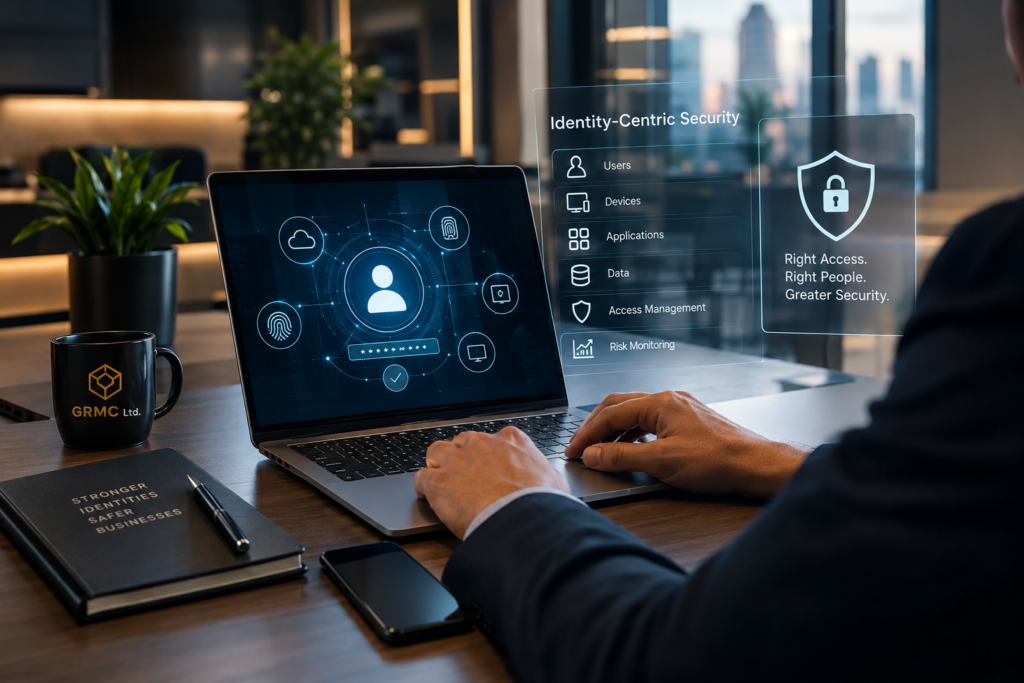
This has made Identity-Centric Cybersecurity an increasingly important part of modern enterprise security.
Identity-centric cybersecurity focuses on continuously verifying who or what is requesting access, what resources they should be allowed to access, whether their behavior is consistent with their normal activity, and whether that access should continue.
Instead of asking only “Is our network protected?”, organizations need to ask:
- Who has access to our critical systems?
- Are users receiving more privileges than they actually need?
- Can compromised accounts be detected quickly?
- Which identities represent the greatest business risk?
- How should privileged accounts be protected?
- Are inactive accounts still creating exposure?
- How can organizations secure employees, applications, service accounts, and AI agents together?
For CEOs, CIOs, CISOs, CTOs, government leaders, and enterprise technology executives, identity security is no longer simply an IT function. It is becoming a fundamental component of business resilience.
📊 Industry Overview
Organizations now manage an increasingly complicated identity environment.
A typical enterprise may have employees accessing cloud applications, administrators managing infrastructure, suppliers connecting to selected systems, applications exchanging data through APIs, automated services performing background tasks, and customers authenticating through digital platforms.
Each identity creates a potential access pathway.
The challenge is that legitimate access can be abused.
An attacker who obtains valid credentials may not need to bypass a firewall or deploy traditional malware immediately. They may attempt to use legitimate authentication mechanisms to access applications and data.
This makes identity protection particularly important.
Modern identity security increasingly involves multiple layers of control, including strong authentication, least-privilege access, privileged access management, behavioral monitoring, access reviews, automated provisioning and deprovisioning, and continuous verification.
The objective is not simply to determine whether someone has a valid username and password.
The objective is to determine whether the current access request makes sense within the broader context.
⚠️ Key Challenges
🔑 Credential-Based Attacks
Passwords and stolen authentication information remain attractive targets for cybercriminals.
A compromised credential can provide an attacker with an entry point that appears legitimate.
👥 Excessive User Privileges
Employees and administrators sometimes accumulate permissions over time as their responsibilities change.
This creates unnecessary access that can increase the impact of a compromised account.
🏢 Privileged Account Exposure
Administrative accounts can provide access to critical infrastructure, sensitive information, security controls, and business applications.
Compromising these identities can therefore create significant organizational risk.
🔄 Orphaned and Inactive Accounts
Employees leave organizations, contractors complete projects, and responsibilities change.
If associated accounts are not disabled or adjusted promptly, unnecessary access may remain available.
🤖 Machine and Service Identities
Modern organizations increasingly rely on applications, APIs, automated services, and AI agents.
These non-human identities can have extensive permissions and may be difficult to monitor using traditional employee-focused security processes.
📈 Cybersecurity Insights
🔐 Identity Has Become a Critical Security Boundary
As employees and applications access resources from different locations and devices, identity increasingly determines whether access should be permitted.
Protecting identities can therefore be just as important as protecting network infrastructure.
📊 Least Privilege Reduces Potential Damage
An account should have only the permissions required to perform its legitimate responsibilities.
If an identity becomes compromised, limiting its privileges can reduce the attacker’s ability to move deeper into the environment.
🔍 Context Matters More Than Authentication Alone
Authentication answers an important question:
Who are you?
Modern cybersecurity also needs to consider:
What are you trying to access?
From where?
At what time?
Using which device?
Does this behavior match previous activity?
Combining these signals can improve the organization’s ability to identify suspicious access.
👑 Privileged Access Requires Additional Protection
Administrative identities should receive stronger security controls than ordinary accounts.
Organizations should carefully manage privileged credentials, limit administrative access, monitor privileged activity, and regularly review permissions.
🤖 Non-Human Identities Need Governance
Service accounts, applications, APIs, bots, and AI agents can increasingly perform actions within enterprise environments.
Organizations should know what these identities can access, why they require that access, and whether their permissions remain appropriate.
🧠 From Static Access to Continuous Verification
Traditional access models often operate around a relatively simple concept:
Authenticate → Grant Access → Continue Working
Modern identity security moves toward a more dynamic model:
Verify → Evaluate Context → Grant Appropriate Access → Monitor → Reassess
This distinction is important.
A user’s situation can change after authentication.
For example, an employee may normally access a financial application during business hours from a recognized device. If the same account suddenly attempts to access sensitive information from an unfamiliar environment and begins downloading unusually large amounts of data, the organization should be able to recognize that the context has changed.
Identity-centric cybersecurity helps organizations move toward this continuous evaluation model.
The goal is not to make legitimate work difficult.
The goal is to make access appropriate to the situation.
🛠️ Practical Recommendations
📋 Build a Complete Identity Inventory
Organizations should maintain visibility into employees, contractors, administrators, service accounts, applications, APIs, and other identities with access to business systems.
You cannot effectively protect identities that you cannot identify.
🔐 Strengthen Authentication
Use strong authentication mechanisms appropriate to the risk level of the application and account.
High-value and privileged identities should receive stronger protection than low-risk access.
👥 Apply Least-Privilege Principles
Review user permissions and remove unnecessary access.
Permissions should reflect current responsibilities rather than historical job roles.
🔍 Protect Privileged Accounts
Separate administrative activities from ordinary user activities where appropriate.
Use dedicated controls for privileged credentials and monitor high-risk administrative actions.
🔄 Automate Joiner, Mover, and Leaver Processes
When employees join, change roles, or leave an organization, access should be updated quickly.
Automation can reduce the risk of outdated permissions remaining active.
📊 Conduct Regular Access Reviews
Managers and system owners should periodically verify whether users still require their existing permissions.
These reviews can reveal excessive, unnecessary, or forgotten access.
🤖 Manage Machine Identities
Create governance processes for service accounts, APIs, applications, and automated systems.
Each identity should have a defined owner, purpose, access scope, and lifecycle.
🚨 Monitor Identity Behavior
Look for unusual authentication patterns, unexpected privilege changes, abnormal access locations, unusual data activity, and other indicators that could suggest account compromise.
💡 A Practical Example
Consider an organization where an employee normally accesses internal applications during standard working hours.
One day, the employee’s credentials are compromised.
An attacker successfully authenticates using the legitimate credentials.
A traditional security system focused primarily on malware detection may not immediately recognize the problem because the attacker has authenticated successfully.
An identity-centric security environment can evaluate additional signals.
The login may originate from an unusual location. The device may not match previous activity. The account may suddenly attempt to access applications it rarely uses. Privileges may be requested that are inconsistent with the employee’s normal responsibilities.
Instead of treating authentication as the end of the security process, the organization can treat it as the beginning of continuous evaluation.
Depending on the risk level, additional verification can be requested, access can be restricted, or security teams can be alerted.
This approach can help reduce the opportunity for attackers to turn stolen credentials into a larger business compromise.
🔄 Identity Security and Zero Trust
Identity-centric cybersecurity aligns closely with the principles of Zero Trust.
Zero Trust does not assume that access should automatically be trusted simply because a request originates from inside a corporate environment or because a user successfully authenticated earlier.
Instead, access should be continuously evaluated according to identity, device, application, resource, context, and risk.
For organizations implementing Zero Trust, identity becomes a central component of the architecture.
However, successful implementation requires more than deploying an identity platform.
It requires organizations to understand:
- Which resources are most important
- Which identities can access them
- Why access is required
- Which actions represent high risk
- How access should change when circumstances change
This makes identity governance an important part of the broader cybersecurity strategy.
📈 Measuring Identity Security Maturity
Organizations need measurable indicators to determine whether identity security is improving.
Useful metrics can include:
- Percentage of users protected by strong authentication
- Number of privileged accounts
- Number of inactive accounts
- Time required to remove access after employee departure
- Percentage of systems covered by access reviews
- Number of excessive permissions identified
- Number of unmanaged service accounts
- Time required to detect suspicious authentication
- Number of high-risk identity events investigated
These measurements allow executives to understand identity risk from a business perspective rather than viewing it solely as a technical issue.
🤝 How GRMC Ltd. Can Help
GRMC Ltd. helps organizations strengthen cybersecurity strategies around identity, access, risk, and digital transformation.
🔐 Identity & Access Strategy
We help organizations evaluate identity environments and establish security strategies aligned with business requirements and risk priorities.
🔍 Cyber Risk Assessment
Our specialists identify weaknesses associated with excessive privileges, unmanaged identities, privileged accounts, and access processes.
📊 Security Governance
GRMC Ltd. supports organizations in developing governance structures for identity lifecycle management, access reviews, privileged access, and security accountability.
🤖 Modern Digital Identity
As organizations adopt cloud services, APIs, automation, and AI agents, we help businesses consider identity security across both human and non-human access.
🌍 Executive Cybersecurity Advisory
We help leadership teams understand how identity-related weaknesses can affect operational resilience, regulatory exposure, customer trust, and business continuity.
🚀 Conclusion
The modern enterprise no longer has a single, clearly defined cybersecurity perimeter.
Employees work remotely. Applications operate in the cloud. Partners connect digitally. Automated systems communicate through APIs. AI agents are beginning to perform increasingly sophisticated business activities.
In this environment, identity becomes one of the most important security boundaries an organization controls.
Identity-Centric Cybersecurity enables organizations to move beyond static access controls toward continuous verification, least privilege, behavioral awareness, and stronger governance.
The objective is not simply to prevent unauthorized users from entering.
It is to ensure that every identity has appropriate access, every privilege has a business purpose, and unusual behavior can be recognized before it becomes a major security incident.
Organizations that make identity security a strategic priority can strengthen their Zero Trust initiatives, reduce exposure from compromised credentials, improve access governance, and build greater resilience across their digital ecosystems.
GRMC Ltd. helps organizations strengthen identity-centric cybersecurity through risk assessment, governance, access strategy, and enterprise security consulting—helping businesses create a more secure foundation for modern digital operations.