

Market Entry Strategy & Business Intelligence
The Gulf Cooperation Council (GCC) is no longer just an emerging market; it is the epicenter of global economic diversification and technological sovereignty. As we move through 2026, the labor markets and corporate ecosystems of Saudi Arabia, the United Arab Emirates (UAE), Qatar, and the broader GCC are transitioning from visionary planning phases—such as the official government portal and UAE’s NextGen FDI—to aggressive, tangible execution.
For business owners, CEOs, executives, and enterprise leaders planning an international expansion, standard approaches will no longer suffice. Relying on outdated demographics or generic playbooks guarantees failure. Instead, successful expansion requires a robust Market Entry Strategy powered by real-time Business Intelligence.
As a senior consultant at GRMC EdgeSphere (Global Research & Marketing Consultants Ltd.), I have witnessed firsthand how data-driven precision separates thriving enterprises from costly missteps. Here is an industry expert’s guide to entering and dominating international markets today.
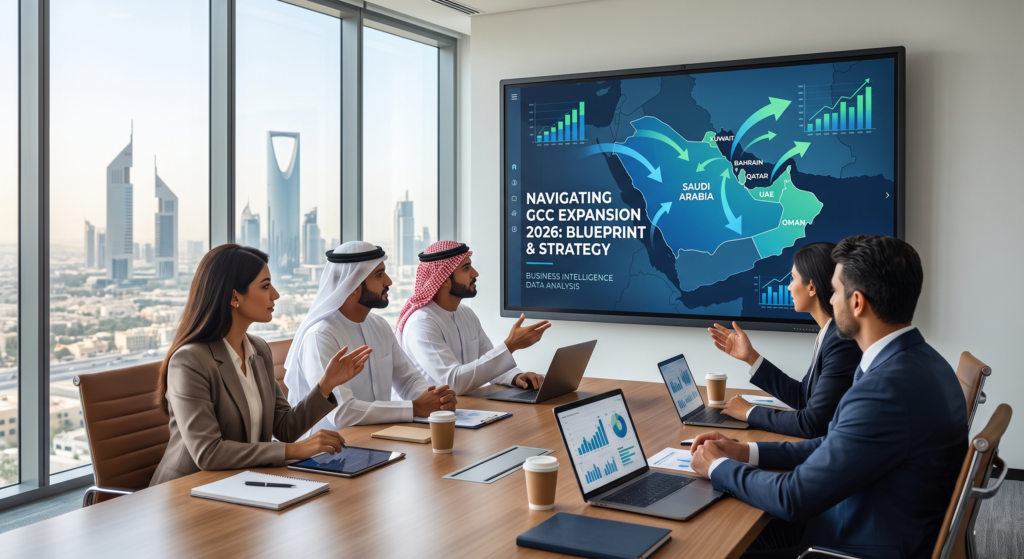
The 2026 Industry Overview: The “Sovereign Multiplier”
Unlike previous economic cycles inextricably linked to crude oil volatility, the 2026 macroeconomic environment is characterized by a deliberate and accelerated decoupling. The new era is defined by the “Sovereign Multiplier”—a massive push for technological sovereignty, digital self-reliance, and advanced structural security.
Regional governments are no longer content with simply renting cloud capacity or importing generic technologies from abroad. They are building proprietary artificial intelligence models, operationalizing large-scale domestic data centers, and heavily investing in smart cities, genomics, and fintech. For example, the regional digital transformation market is surging and is projected by industry analysts to reach USD 171.0 Billion by 2034.
This monumental shift presents unprecedented opportunities for foreign investors, but it demands that new entrants bring high-value capabilities. A modern Market Entry Strategy must align with this reality, positioning your enterprise as a partner in local innovation and capacity-building, rather than merely a foreign vendor looking for quick revenue.
This monumental shift presents unprecedented opportunities for foreign investors, but it demands that new entrants bring high-value capabilities. A modern Market Entry Strategy must align with this reality, positioning your enterprise as a partner in local innovation and capacity-building, rather than merely a foreign vendor looking for quick revenue.
Key Challenges for New Entrants
Entering the GCC requires navigating a complex, rapidly evolving landscape. While the financial incentives and tax-friendly free zones are highly attractive, decision-makers must account for several structural hurdles before committing capital:
1. Data Sovereignty and Cybersecurity Mandates
The concentration of massive computing power has elevated cybersecurity to a top national security priority. Both Saudi Arabia (via the National Cybersecurity Authority) and the UAE enforce strict data localization laws. Your Business Intelligence architecture must be built around local compliance. Treating data residency as an IT afterthought is a fatal error; it must be a core pillar of your entry strategy.
2. Localization vs. Literal Translation
In 2026, localization isn’t just about translating your website into Arabic; it requires profound cultural immersion. GCC audiences expect brand narratives tailored to regional values, incorporating bilingual AI agents and context-aware consumer interactions. A generic, one-size-fits-all global strategy will fail to build the necessary trust. You must integrate local nuance into every touchpoint of your customer experience.
3. Talent Competition and Nationalization Programs
The demand signal for labor has fundamentally shifted. Governments mandate specific quotas for hiring local citizens (such as Emiratization in the UAE and Saudization in KSA). Furthermore, the market demands sophisticated professionals capable of managing AI workflows, data analytics, and complex strategic consulting. Securing top-tier talent is highly competitive and requires a robust local HR strategy.

Market Research Insights: What the Data Shows
At GRMC EdgeSphere, our continuous Market Research highlights three critical shifts reshaping how business is conducted in the Gulf and broader international markets:
| Trend | Business Impact | Strategic Response |
| Real-Time AI Frameworks | Static reporting is obsolete; enterprises demand predictive, low-latency insights. | Invest in cloud-based, real-time Business Intelligence tools early in your setup. |
| Retail Media Networks | E-commerce platforms leverage first-party data to target shoppers instantly. | Shift marketing budgets toward high-intent point-of-purchase digital ad placements. |
| Shift to High-Value KPO | Basic business process outsourcing is declining; Knowledge Process Outsourcing is booming. | Offer specialized, tech-driven services rather than basic administrative support. |
Key insight: By 2026, over 80% of newly established Global Capability Centers (GCCs) in the region are actively scaling Generative AI deployments. If your operational model lacks an AI-native architecture, your competitive edge is severely compromised.
Practical Recommendations for Decision-Makers
To translate these insights into a highly effective Market Entry Strategy, business leaders should adhere to the following ordered framework. Skipping steps or misordering them often results in severe regulatory penalties and operational delays.
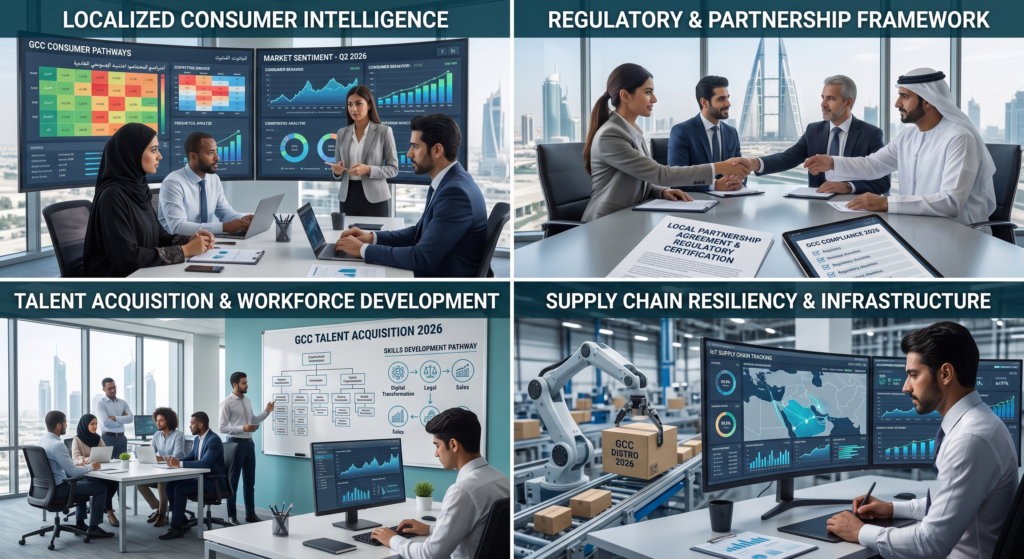
1.Conduct Hyper-Local Market Research:
Before registering an entity, utilize advanced Business Intelligence tools to map competitor saturation, assess local demand, and understand specific regional pricing elasticity. Consumer behavior in Riyadh differs vastly from that in Dubai, Manama, or Doha.
2.Determine the Optimal Legal Structure:Mainland vs. Free Zone.
Evaluate whether to establish a 100% foreign-owned entity in a Free Zone (ideal for tech, consulting, and export businesses) or a Mainland Company (often necessary for B2G contracts and direct local retail distribution). Align this choice directly with your 5-year revenue model.
3.Embed Compliance from Day One:
Integrate cybersecurity protocols, Corporate Tax and VAT compliance, and local labor mandates into your operational blueprint before your first hire. Reactive compliance is drastically more expensive than proactive structuring.
4.Establish Strategic Local Partnerships:
Leverage trusted local sponsors, legal advisors, and joint ventures. Despite rapid digitization, the GCC business culture remains heavily built on relationships, trust, and face-to-face engagements.
The 12-Month Expansion Roadmap
Successful entry into the GCC isn’t an overnight endeavor. Our historical data at GRMC EdgeSphere shows that a structured, phased approach significantly reduces capital burn and accelerates time-to-profit.
Phase 1: Intelligence Gathering
Months 1-3
Conducting comprehensive Market Research, feasibility studies, and competitor analysis. This phase culminates in the finalization of the Market Entry Strategy and the selection of the corporate legal structure.
Phase 2: Entity Incorporation & Compliance
Months 4-6
Navigating governmental approvals, securing necessary licenses, establishing local bank accounts, and ensuring the IT infrastructure meets all national cybersecurity and data residency laws.
Phase 3: Talent Acquisition & Localization
Months 7-9
Executing the local hiring strategy in compliance with nationalization quotas. Concurrently, adapting marketing materials, product interfaces, and sales funnels to deeply resonate with the local culture.
Phase 4: Launch & BI Integration
Months 10-12
Official market launch. Deployment of real-time Business Intelligence dashboards to track KPIs, monitor customer acquisition costs, and pivot operations based on live market feedback.
How GRMC EdgeSphere Can Help
Successfully entering the GCC, LATAM, or North American markets requires more than ambition—it requires an ecosystem of intelligence, security, and flawless execution. GRMC EdgeSphere is uniquely positioned to derisk your expansion and accelerate your ROI across international markets.
As an international leader in market research, strategic consulting, cybersecurity, and digital transformation, our core capabilities include:
- Comprehensive Market Entry Strategies: We engineer bespoke roadmaps, covering everything from in-depth feasibility studies to competitive intelligence, ensuring you enter the market with a decisive, data-backed advantage.
- Advanced Business Intelligence: We deploy enterprise-grade analytics and real-time data frameworks that give your C-suite total visibility into market dynamics and operational health.
- Cybersecurity & AI Automation: We align your technology stack with stringent regional data sovereignty laws while integrating Agentic AI and automated workflows, positioning your firm as a highly secure, forward-thinking player.
- Customer Experience & Brand Research: We analyze deep cultural metrics to ensure your brand resonates powerfully with local demographics, maximizing customer lifetime value.
Whether you are a tech startup eyeing the Dubai International Financial Centre (DIFC), an investor evaluating the Caribbean, or a Fortune 500 enterprise bidding on Saudi mega-projects, our intelligence ensures you execute with precision.
Conclusion
The 2026 international business landscape is an environment of immense scale and opportunity, but it ruthlessly rewards precision over mere presence. By integrating robust Market Research, prioritizing data sovereignty, and embracing aggressive digital transformation, foreign entrants can achieve remarkable, sustainable growth.
Expansion works best when strategy, operations, and compliance are designed in unison. Stop guessing and start scaling with certainty. Partner with industry experts who understand the nuances of the global economy.