

For business leaders, the question is rarely if your market will change, but when—and whether you’ll be positioned to lead that change or scramble to catch up.
Markets don’t stand still. Digital transformation, shifting consumer expectations, regulatory upheavals, and technological breakthroughs are constantly redrawing the competitive map. Yet most organizations react to these shifts only after they’re obvious to everyone, finding themselves competing for scraps in saturated spaces while early movers capture the lion’s share of value.
This is the fundamental challenge—and opportunity—of market opportunity assessment. It’s not about having a crystal ball. It’s about systematically identifying the early signals of transformation, evaluating their strategic relevance to your business, and acting with conviction before the window of advantage closes.
What Market Opportunity Assessment Really Means
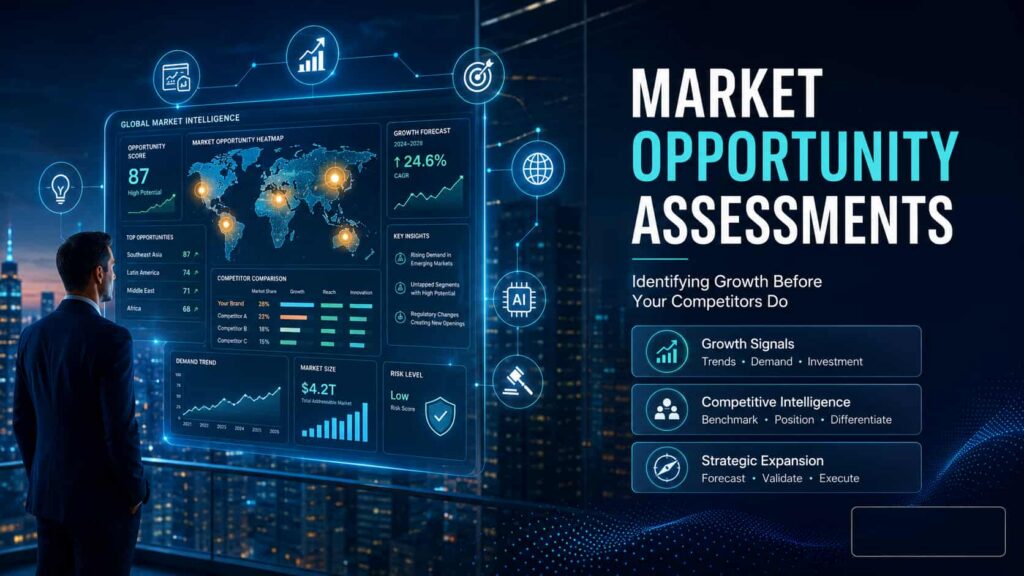
Market Opportunity Analysis (MOA) is a systematic approach to understanding and quantifying untapped market potential. It involves gathering and analyzing both secondary and primary research to evaluate whether a new product, service, market entry, or strategic pivot represents a viable growth path.
But effective MOA goes far beyond basic market sizing. It provides clarity on five critical dimensions:
- Market demand indicators – Are sales volumes, funding levels, and customer interest rising sustainably? A sustained increase signals a broader shift, not just a temporary surge.
- Competitive intelligence – How are existing players investing? Are they expanding operations, shifting strategy, or developing new capabilities? Competitor behavior often reveals market validation before it’s publicly acknowledged.
- Technology and innovation tracking – Is there a breakthrough enabling the market to scale? Emerging technologies like AI, renewable energy, and biotechnology are prime examples of sectors benefiting from continuous breakthroughs.
- Regulatory and policy changes – Are government policies creating incentives or introducing barriers? Legislative shifts can create sudden opportunities or reshape competitive dynamics overnight.
- Strategic fit evaluation – Does this opportunity align with your core competencies and long-term goals? A strong fit enables smoother entry and higher success rates.
The goal isn’t just to spot a promising market—it’s to validate that you can win in it.
The First-Mover Debate: Speed vs. Smarts
Conventional wisdom says first movers win. The data tells a more nuanced story.
Research analyzing export transactions from nine countries found a clear pattern: late-movers—those entering a market at least one year after the first entrant—consistently outperformed explorers in the same product-destination markets. The reason? Late-movers observe, learn from first-mover mistakes, and enter only when success is evident. They have better information on product demand, consumer preferences, quality standards, and distribution networks.
This isn’t an argument for waiting until a market is crowded. It’s a case for informed timing.
Consider the history of category creation: Friendster pioneered social networking. MySpace learned from it. Facebook learned from both and won. AltaVista was first in search; Google came later and dominated. Palm Pilot created the PDA category; the iPhone arrived years later and changed everything. Dropbox wasn’t first in cloud storage—they entered when the market was educated and executed better.
The real advantage isn’t moving first—it’s learning fastest. First movers who learn faster than followers can win. Followers who learn from first movers and execute better usually win. Learning speed matters more than starting position.
The exception is genuine network effects—where a product improves as more people use it. Facebook, LinkedIn, and Uber benefit from this dynamic. But most products don’t. Most businesses can adopt a fast-follower strategy: let pioneers pay to educate the market, identify what works and what fails, and enter when you can avoid their mistakes and improve on their successes.
A Real-World Framework for Assessment
How do you separate genuine opportunity from hype? A structured, evidence-based approach is essential.
1. Scan the External Macroenvironment
Begin with a comprehensive analysis of external factors: economic trends, demographic shifts, technological changes, political forces, and social/cultural developments. These forces shape market viability and timing.
2. Define and Segment the End-User Market
The needs of the end-user create demand. Define your target market with precision—from broad categories to specific product/service markets to branded markets. Break down the broader market into segments defined by demographics, geographies, or emerging needs to identify where growth is accelerating fastest.
3. Assess End-User Values and Decision-Making
What do customers actually value? How do they decide to buy? What factors influence their purchasing behavior? Understanding these dynamics is essential for positioning and messaging.
4. Identify and Analyze Key Competitors
Who are the most successful players in the space—or the most likely to become successful? Collect in-depth information on financial strength, marketing strategies, anticipated product changes, and market approaches.
A client case illustrates the value here: a global industrial component supplier seeking expansion in discrete manufacturing conducted comprehensive research including interviews with 40+ stakeholders, identified over 50 potential product categories, down-selected to 10 high-potential products, and developed detailed competitor profiles. The result: they pinpointed high-potential opportunities and made confident investment decisions on new product development and acquisitions.
5. Conduct Supplier and Channel Analysis
Assess the feasibility of delivering your product or service. What are the requirements of critical suppliers? What channel incentives and cooperation are needed? What are typical operating procedures in the channel?
6. Perform a SWOT Analysis
Conclude with a realistic assessment of internal Strengths and Weaknesses, and external Opportunities and Threats revealed by prior stages. This ensures your growth strategy aligns with your actual capabilities and market realities.
Practical Steps for Immediate Action
For CEOs and Executives:
- Prioritize data over intuition. Identify a specific market or segment you’re considering. Before committing resources, commission a focused opportunity assessment that includes primary research with target customers and competitors.
- Audit your “unknown unknowns.” What market intelligence gaps exist in your current strategy? List the top three questions you can’t answer about your potential growth markets—and make answering them a priority.
- Build a “second-mover playbook.” For each potential market, identify who’s already there, what problems they’re facing, and what customers are complaining about. Enter markets as an educated second mover, not an ignorant first mover.
For Business Development and Strategy Teams:
- Track competitor investment patterns. Where are your competitors allocating R&D and capital? Their investment choices often signal validated market opportunities.
- Monitor regulatory developments. Identify three policy or regulatory changes in your industry pipeline over the next 12–24 months. Map potential market opportunities or threats from each.
- Run a quantitative sizing exercise. Estimate market size, projected market share, channel mix, revenue projections, and gross margins. Use both primary and secondary sources to ground your assumptions in data.
The Competitive Imperative
Growth markets aren’t just new revenue streams—they are the arenas where the next generation of industry leaders will emerge. Some businesses will recognize and act on these opportunities early. Others will wait until the market is crowded, competing for limited share rather than defining the industry’s future.
The organizations that invest in data-driven foresight, strategic research, and disciplined execution won’t just survive shifting markets—they will define them.
At GRMC EdgeSphere, we help enterprises navigate this complexity with precision. From emerging markets intelligence and competitive benchmarking to regulatory compliance and strategic execution support, we provide the clarity you need to move from uncertainty to action. In a world where change is the only constant, the question isn’t whether your markets will shift—it’s whether you’ll be leading the transformation or struggling to keep pace.