
Introduction
In today’s fast-paced digital economy, businesses generate more data than ever before. Every customer interaction, sales transaction, website visit, and operational process creates valuable information that can shape future decisions. However, collecting data alone is not enough. The real competitive advantage lies in understanding what the data means and using it to make informed decisions.
This is where Business Intelligence (BI) and Business Analytics (BA) come into play. Although these terms are often used interchangeably, they serve different purposes and work together to help organizations improve performance, reduce risk, and identify new opportunities.
Whether you’re a startup, a multinational corporation, a government agency, or a nonprofit organization, understanding the difference between Business Intelligence and Business Analytics can help you unlock the full value of your data and stay ahead in an increasingly competitive marketplace. GRMC itself positions Business Intelligence & Analytics as a core part of its strategic consulting services, helping organizations transform data into actionable growth strategies.
What Is Business Intelligence?
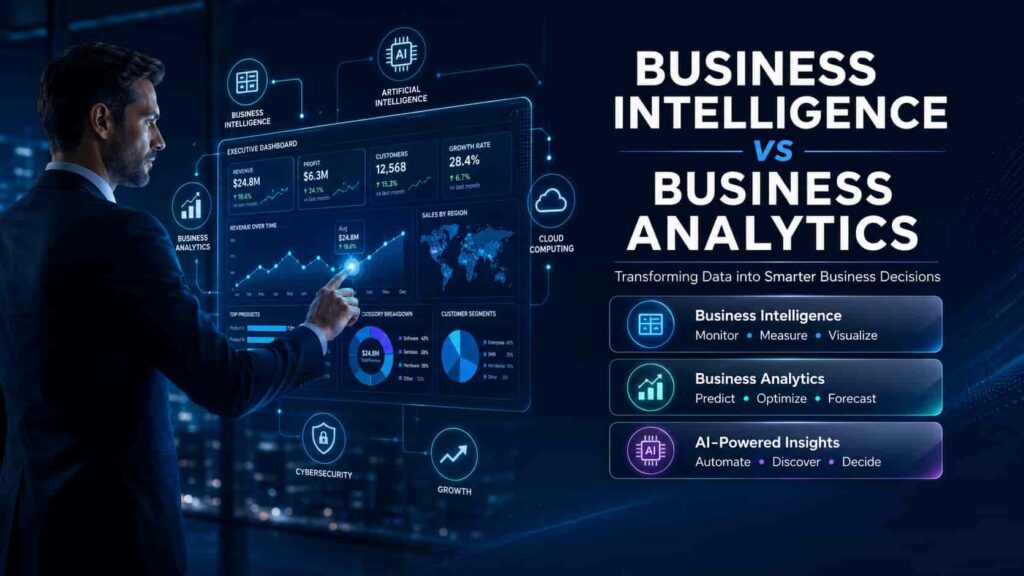
Business Intelligence refers to the processes, technologies, and tools used to collect, organize, and visualize historical and current business data. The primary goal of BI is to provide a clear picture of what has happened and what is happening within an organization.
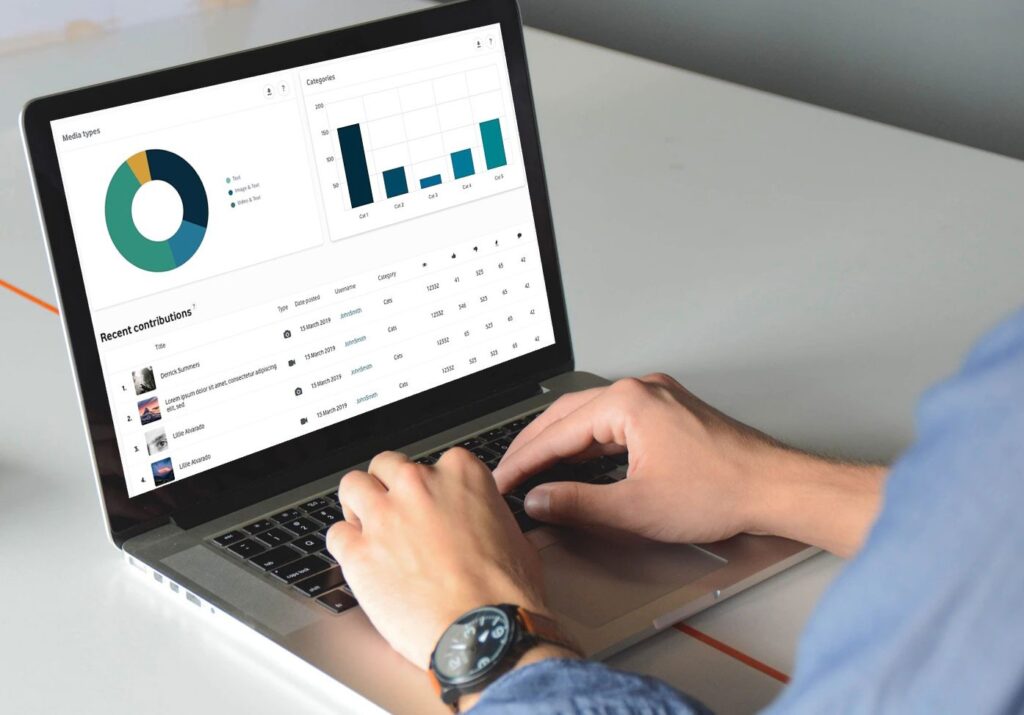
Business Intelligence solutions gather data from multiple sources and transform it into easy-to-understand dashboards, reports, and visualizations that support informed decision-making.
Organizations use Business Intelligence to:
- Monitor business performance
- Track key performance indicators (KPIs)
- Generate operational reports
- Analyze customer trends
- Measure financial performance
- Improve operational efficiency
Instead of relying on assumptions, decision-makers gain access to accurate, real-time insights that support strategic planning.
What Is Business Analytics?
Business Analytics goes one step further by using statistical analysis, predictive modeling, and artificial intelligence to answer not only what happened, but also why it happened, what is likely to happen next, and what actions should be taken.
Business Analytics focuses on identifying patterns, predicting future outcomes, and recommending data-driven strategies.
Common applications include:
- Demand forecasting
- Customer behavior analysis
- Sales predictions
- Risk assessment
- Market trend analysis
- Supply chain optimization
Rather than simply reporting results, Business Analytics helps organizations prepare for future opportunities and challenges.
Business Intelligence vs. Business Analytics: What’s the Difference?
Although Business Intelligence and Business Analytics complement one another, they have distinct objectives.
| Business Intelligence | Business Analytics |
|---|---|
| Focuses on historical and current data | Focuses on future outcomes and predictions |
| Answers “What happened?” | Answers “Why did it happen?” and “What will happen next?” |
| Uses dashboards and reports | Uses statistical models and predictive analysis |
| Supports operational decisions | Supports strategic planning |
| Helps monitor performance | Helps optimize future performance |
The most successful organizations integrate both approaches to gain a comprehensive understanding of their business.
Why Businesses Need Both BI and BA
Modern organizations operate in an environment where market conditions, customer expectations, and competitive landscapes change rapidly.
Using Business Intelligence without Analytics limits organizations to understanding the past. Using Analytics without reliable Business Intelligence can result in inaccurate predictions due to poor-quality data.
Together, they enable businesses to:
- Make faster decisions
- Improve operational efficiency
- Anticipate market changes
- Increase customer satisfaction
- Reduce operational risks
- Identify new revenue opportunities
When integrated effectively, BI and BA create a powerful foundation for sustainable growth.
The Role of Artificial Intelligence in Modern Business Intelligence
Artificial Intelligence is transforming the way organizations use Business Intelligence and Analytics.
AI-powered systems can process vast amounts of structured and unstructured data, identify hidden patterns, automate repetitive analytical tasks, and generate predictive insights with greater speed and accuracy.
Organizations now use AI to:
- Detect customer preferences
- Forecast sales trends
- Identify operational inefficiencies
- Monitor market sentiment
- Enhance decision-making through automation
By combining AI with Business Intelligence, businesses can move from reactive reporting to proactive strategy development. This aligns with GRMC’s emphasis on AI-powered market research, advanced analytics, and digital transformation solutions.
Real-World Applications Across Industries
Business Intelligence and Analytics are valuable across virtually every industry.
Healthcare
Healthcare providers use analytics to improve patient outcomes, optimize staffing, and forecast resource requirements.
Financial Services
Banks and financial institutions rely on Business Intelligence to monitor financial performance, detect fraud, and assess investment risks.
Retail
Retailers analyze purchasing behavior, inventory levels, and seasonal demand to improve customer experiences and maximize profitability.
Government
Public sector organizations use data-driven insights to improve policy development, resource allocation, and public service delivery.
Tourism and Hospitality
Businesses analyze visitor behavior, customer satisfaction, and market trends to deliver personalized experiences and support long-term growth.
Common Challenges Organizations Face
Despite the benefits, many organizations struggle to maximize the value of their data.
Common challenges include:
Poor Data Quality
Incomplete or inaccurate information can lead to misleading insights and poor decision-making.
Disconnected Systems
Data stored across multiple platforms often prevents organizations from obtaining a unified view of business performance.
Limited Analytical Skills
Organizations may possess valuable data but lack the expertise required to interpret it effectively.
Slow Decision-Making
Without automated reporting and analytics, decision-makers may rely on outdated information.
Addressing these challenges requires both the right technology and experienced professionals who understand how to transform data into meaningful business intelligence.
How GRMC Helps Organizations Make Smarter Decisions
At GRMC, data is more than numbers—it is a strategic asset.
By combining market research, advanced analytics, strategic consulting, artificial intelligence, and business intelligence solutions, GRMC helps organizations transform complex information into actionable insights.
GRMC’s tailored approach enables businesses, governments, NGOs, and international organizations to:
- Understand evolving market dynamics
- Monitor customer behavior
- Identify emerging opportunities
- Support evidence-based decision-making
- Strengthen long-term competitiveness
Whether planning market expansion, launching new products, or improving organizational performance, GRMC provides customized intelligence solutions designed to meet each client’s unique objectives. GRMC’s service portfolio includes market research, strategic consulting, business intelligence, analytics, AI automation, cybersecurity, and digital transformation.
The Future of Business Intelligence
As technology continues to evolve, Business Intelligence is becoming more intelligent, automated, and accessible.
Emerging technologies such as artificial intelligence, machine learning, cloud computing, and big data analytics are enabling organizations to generate deeper insights faster than ever before.
Future Business Intelligence platforms will increasingly provide:
- Real-time predictive insights
- Automated decision support
- AI-powered recommendations
- Natural language reporting
- Interactive dashboards
- Enhanced data security
Organizations that embrace these innovations today will be better prepared to navigate tomorrow’s challenges.
Conclusion
Business Intelligence and Business Analytics are no longer optional—they are essential for organizations seeking sustainable growth in an increasingly data-driven world.
While Business Intelligence helps organizations understand their current performance, Business Analytics provides the foresight needed to anticipate change and seize future opportunities.
By combining these capabilities with advanced market research, artificial intelligence, and strategic consulting, organizations can make smarter decisions, improve operational efficiency, and build long-term competitive advantage.
As businesses continue to face evolving markets and growing volumes of data, investing in Business Intelligence and Analytics is not just a technological upgrade—it is a strategic investment in future success.
About GRMC
Global Research & Marketing Consultants (GRMC) is a leading international market research, strategic consulting, and business intelligence firm dedicated to helping organizations make confident, data-driven decisions. Through innovative research methodologies, AI-powered analytics, digital transformation solutions, cybersecurity expertise, and business consulting services, GRMC empowers businesses, governments, NGOs, and institutions across the Caribbean and global markets to achieve sustainable growth and lasting impact.