

Introduction
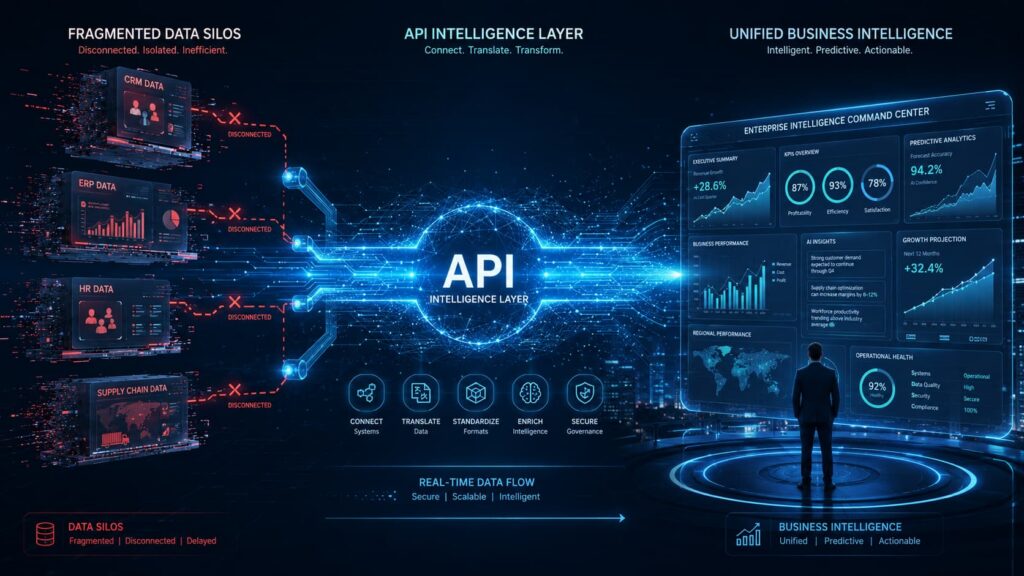
Modern organizations generate enormous volumes of data across departments, platforms, applications, and business processes. Customer information resides in CRM systems, financial data is stored in ERP platforms, operational metrics are scattered across multiple software tools, and business teams often rely on separate databases or spreadsheets.
While enterprises invest heavily in digital technologies, many still struggle with a common challenge: data silos.
When critical information is fragmented across disconnected systems, leaders face delayed reporting, inconsistent insights, operational inefficiencies, and slower decision-making. In an increasingly competitive business environment, these limitations can significantly impact growth, profitability, and innovation.
The solution lies in transforming isolated data into actionable business intelligence through strategic API integration. By connecting systems, automating data flows, and creating a unified information ecosystem, organizations can gain real-time visibility and make faster, more informed decisions.
This article explores how API integration helps enterprises eliminate data silos, strengthen business intelligence capabilities, and accelerate enterprise decision-making.
Understanding the Cost of Data Silos
A data silo occurs when information is stored within a specific department, application, or platform that is not easily accessible across the organization.
Common examples include:
- Sales teams using a CRM disconnected from finance systems
- HR departments managing employee data separately from operational platforms
- Customer service teams lacking visibility into purchasing history
- Manufacturing systems operating independently from supply chain applications
- Government agencies maintaining isolated databases across departments
These disconnected environments create several business challenges:
Delayed Decision-Making
Executives often wait days or weeks for reports that require manual data collection from multiple systems.
Inconsistent Information
Different departments may work with conflicting data sets, leading to inaccurate reporting and poor strategic decisions.
Increased Operational Costs
Employees spend valuable time exporting spreadsheets, manually reconciling data, and creating reports.
Reduced Agility
Organizations struggle to respond quickly to market changes because information is fragmented and difficult to access.
Limited Business Intelligence
Without integrated data, advanced analytics and AI initiatives cannot deliver their full value.
The result is a business environment where leaders operate with incomplete visibility, reducing their ability to make timely, data-driven decisions.
What Is API Integration?
Application Programming Interfaces (APIs) enable different software systems to communicate and exchange information automatically.
Rather than manually transferring data between platforms, APIs create secure connections that allow systems to share information in real time.
For example:
- A CRM platform can automatically send customer updates to an ERP system.
- Financial software can synchronize transaction data with business intelligence dashboards.
- Inventory systems can update e-commerce platforms instantly.
- Human resource applications can exchange employee data with payroll systems.
API integration acts as the digital bridge connecting enterprise applications into a unified ecosystem.
Instead of operating as isolated systems, technologies become part of an interconnected business infrastructure that supports better visibility, automation, and decision-making.
From Data Silos to Business Intelligence
Business Intelligence (BI) depends on accurate, timely, and comprehensive data.
The quality of business intelligence is directly influenced by the quality and accessibility of organizational data.
API integration serves as the foundation that transforms fragmented information into meaningful intelligence.
1. Creating a Single Source of Truth
One of the biggest challenges in enterprise environments is maintaining consistent data across departments.
API integrations synchronize information between systems automatically, ensuring everyone works from the same dataset.
Benefits include:
- Improved reporting accuracy
- Reduced duplicate records
- Greater trust in organizational data
- Consistent KPIs across departments
Executives gain confidence that strategic decisions are based on reliable information rather than conflicting reports.
2. Enabling Real-Time Insights
Traditional reporting often relies on historical data collected manually.
API-driven environments provide real-time access to operational information.
Leaders can monitor:
- Sales performance
- Customer engagement
- Inventory levels
- Financial metrics
- Service delivery performance
Real-time intelligence allows organizations to identify trends, address issues proactively, and capitalize on opportunities faster than competitors.
3. Supporting Advanced Analytics and AI
Artificial Intelligence and predictive analytics require access to high-quality data from multiple sources.
Without integration, AI systems often receive incomplete or outdated information.
API integration enables:
- Predictive forecasting
- Demand planning
- Customer behavior analysis
- Risk assessment
- Operational optimization
Organizations can unlock greater value from AI investments by ensuring that analytical models have access to comprehensive enterprise data.
Enterprise Benefits of API-Driven Business Intelligence
Improved Executive Decision-Making
Leadership teams can access consolidated dashboards that combine data from multiple business functions.
Instead of reviewing disconnected reports, executives gain a comprehensive view of organizational performance.
This supports:
- Faster strategic planning
- Better resource allocation
- Improved risk management
- Stronger performance monitoring
Increased Operational Efficiency
Automation eliminates repetitive manual processes associated with data collection and reporting.
Employees spend less time managing spreadsheets and more time focusing on strategic initiatives.
Benefits include:
- Reduced administrative workload
- Lower operational costs
- Faster reporting cycles
- Higher workforce productivity
Enhanced Customer Experience
Integrated systems create a complete customer view across sales, service, marketing, and operations.
Organizations can:
- Personalize customer interactions
- Resolve issues more quickly
- Improve service delivery
- Strengthen customer retention
A connected data ecosystem enables businesses to respond to customer needs with greater accuracy and speed.
Greater Scalability
As organizations grow, technology complexity increases.
API-first architectures allow enterprises to add new applications without creating additional silos.
This flexibility supports:
- Digital transformation initiatives
- Cloud migration strategies
- Enterprise modernization programs
- Future technology adoption
Scalable integration frameworks ensure long-term business agility.
Practical Enterprise Use Cases
Financial Services
Banks and financial institutions often operate multiple platforms for customer management, transactions, compliance, and risk assessment.
API integration enables unified reporting and real-time visibility into financial performance, helping leaders make faster decisions while maintaining regulatory compliance.
Manufacturing
Manufacturers frequently rely on ERP systems, supply chain platforms, production management software, and quality control systems.
Integrated data enables real-time monitoring of:
- Production efficiency
- Inventory levels
- Supplier performance
- Equipment utilization
This supports proactive decision-making and operational optimization.
Healthcare
Healthcare organizations manage data across clinical systems, patient portals, billing platforms, and operational applications.
API integration helps create a unified patient and operational view, improving service delivery, resource planning, and organizational efficiency.
Government Organizations
Public sector agencies often face challenges with disconnected legacy systems.
Integration initiatives enable:
- Improved citizen services
- Better interdepartmental collaboration
- Enhanced transparency
- More informed policy decisions
Unified data environments support evidence-based governance and operational effectiveness.
Measuring ROI from API Integration
Technology investments must deliver measurable business value.
Organizations implementing API integration commonly evaluate success using metrics such as:
Reduced Reporting Time
Automated data flows significantly decrease the time required to generate reports and dashboards.
Lower Operational Costs
Automation reduces manual labor and minimizes data management inefficiencies.
Faster Decision Cycles
Real-time access to information accelerates strategic and operational decision-making.
Increased Productivity
Employees spend less time gathering information and more time delivering value.
Improved Data Accuracy
Automated synchronization reduces errors caused by manual data entry and reconciliation.
Enhanced Revenue Opportunities
Better visibility into customer behavior and operational performance helps organizations identify growth opportunities more effectively.
When combined, these benefits often produce substantial returns on digital transformation investments.
Best Practices for Successful API Integration
To maximize business value, organizations should approach integration strategically.
Establish Clear Business Objectives
Define the outcomes you want to achieve, such as improved reporting, operational efficiency, or enhanced customer experiences.
Prioritize High-Value Systems
Focus initially on systems that generate the greatest impact on decision-making.
Implement Strong Data Governance
Ensure data quality, consistency, security, and compliance across integrated environments.
Design for Scalability
Build flexible integration architectures that support future growth and evolving business requirements.
Align Technology with Business Strategy
Integration initiatives should directly support organizational goals and measurable business outcomes.
The Future of Enterprise Intelligence
As organizations continue their digital transformation journeys, the ability to connect systems and leverage data effectively will become a critical competitive advantage.
Emerging technologies such as AI, machine learning, predictive analytics, and intelligent automation depend on integrated, high-quality data ecosystems.
Organizations that eliminate data silos and embrace API-driven connectivity position themselves to:
- Respond faster to market changes
- Improve operational efficiency
- Deliver better customer experiences
- Scale innovation initiatives
- Make smarter business decisions
Business intelligence is no longer simply about collecting data—it is about creating a connected enterprise where information flows seamlessly across systems, departments, and decision-makers.
Conclusion
Data silos remain one of the most significant barriers to effective enterprise decision-making. Fragmented information limits visibility, slows operations, and prevents organizations from realizing the full value of their technology investments.
API integration provides a practical and scalable solution by connecting systems, automating information exchange, and creating a unified foundation for business intelligence.
For enterprises, SMEs, government organizations, and digital transformation leaders, the journey from disconnected data to actionable intelligence is not merely a technology upgrade—it is a strategic business initiative that drives efficiency, improves ROI, and strengthens long-term competitiveness.
At GRMC EdgeSphere, we help organizations design intelligent integration strategies that connect systems, unlock business insights, and accelerate data-driven decision-making across the enterprise.