

📌 Executive Summary
Traditional perimeter-based security models are no longer sufficient in today’s distributed, cloud-first, and hybrid work environments. Organizations now operate across multiple networks, devices, applications, and geographies—creating a complex and expanded attack surface that cannot be protected by legacy “trust but verify” approaches.
Zero Trust Architecture (ZTA) has emerged as a modern cybersecurity strategy designed to address these challenges. Built on the principle of “never trust, always verify,” Zero Trust eliminates implicit trust and continuously validates every user, device, and transaction.
For enterprise leaders—including CEOs, CIOs, CTOs, CISOs, and government stakeholders—Zero Trust is not just a security framework but a strategic resilience model that reduces risk exposure, strengthens compliance, and improves operational control.
This article explores the Zero Trust model, its business impact, risk considerations, implementation strategies, and alignment with industry frameworks such as NIST, ISO 27001, and CIS Controls.
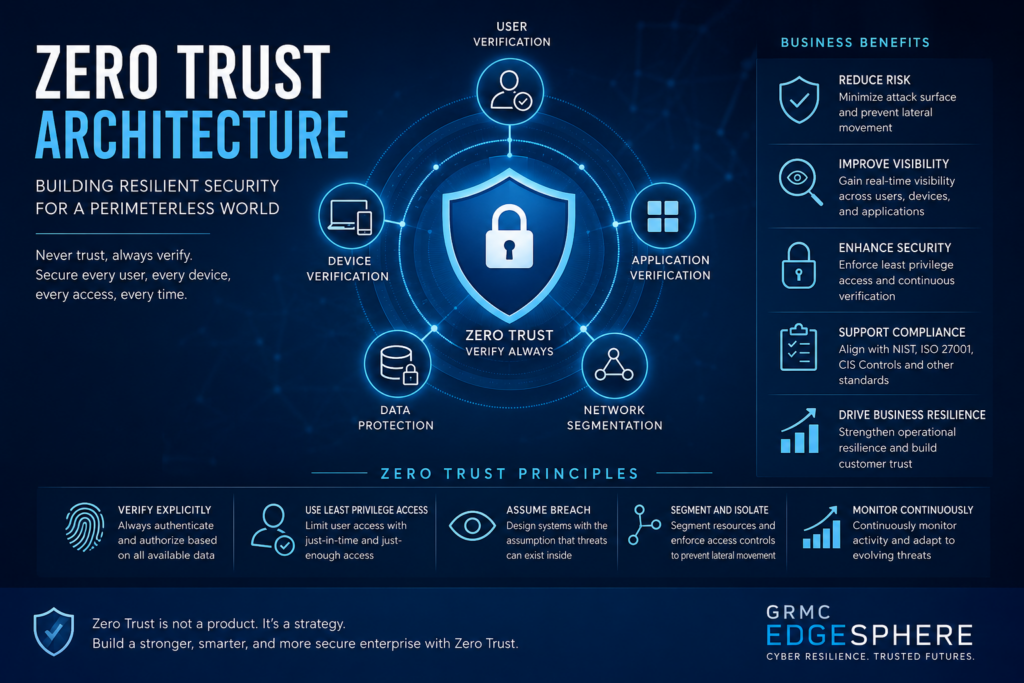
🌐 Current Threat Landscape
The modern threat environment is characterized by persistent, sophisticated, and highly automated cyberattacks. Attackers no longer rely solely on external intrusion; instead, they exploit identity, misconfigurations, and internal trust relationships.
⚠️ Key Threat Trends Driving Zero Trust Adoption
👤 1. Identity-Centric Attacks
Cybercriminals increasingly target credentials rather than systems. Common techniques include:
- Phishing and spear-phishing
- Credential stuffing
- MFA fatigue attacks
- Session hijacking
Once credentials are compromised, attackers often move laterally within networks undetected.
☁️ 2. Cloud and Hybrid Infrastructure Exposure
Organizations are rapidly migrating to cloud environments, often resulting in:
- Misconfigured cloud storage
- Over-permissioned identities
- Insecure APIs
- Lack of visibility across environments
These weaknesses significantly expand the attack surface.
🏠 3. Remote and Hybrid Workforce Risks
The shift to remote work has dissolved traditional network boundaries. Employees now access corporate systems from:
- Personal devices
- Home networks
- Public Wi-Fi environments
This decentralization makes perimeter-based security models ineffective.
🧑💼 4. Insider Threats and Privilege Abuse
Not all threats originate externally. Insider risks include:
- Malicious employees
- Compromised accounts
- Excessive privilege misuse
- Unintentional data exposure
Without strict access controls, internal threats can be highly damaging.
💼 Business Impact of Weak Trust Models
Failing to adopt a Zero Trust approach can expose organizations to significant business risks.
💰 Financial Exposure
Security breaches resulting from excessive trust or weak access controls can lead to:
- Regulatory fines
- Incident response costs
- Legal liabilities
- Business downtime
- Revenue loss
📉 Operational Disruption
Attackers who gain internal access can:
- Disrupt critical systems
- Disable applications
- Manipulate data flows
- Interrupt business continuity
🧠 Reputational Damage
Trust is a core business asset. Security failures may result in:
- Loss of customer confidence
- Negative media coverage
- Reduced market valuation
- Long-term brand erosion
📜 Regulatory Non-Compliance
Organizations may fail to meet requirements under:
- Data protection regulations
- Industry-specific compliance mandates
- Security governance standards
📊 Risk Analysis for Enterprise Environments
🆔 Identity Risk
Identity is the new security perimeter. Weak identity management leads to:
- Unauthorized access
- Privilege escalation
- Account takeover
🌍 Network Risk
Traditional flat networks enable lateral movement once breached. Risks include:
- Malware propagation
- Internal reconnaissance
- Data exfiltration
🧩 Application Risk
Modern enterprises rely on interconnected applications. Vulnerabilities include:
- Insecure APIs
- Weak authentication mechanisms
- Unpatched systems
🗂️ Data Risk
Data remains the most valuable asset. Risks include:
- Unauthorized access
- Data leakage
- Improper sharing
- Lack of encryption
🛡️ Recommended Controls for Zero Trust Implementation
🔑 Implement Strong Identity and Access Management (IAM)
Identity is the foundation of Zero Trust.
Key controls include:
- Multi-Factor Authentication (MFA)
- Single Sign-On (SSO)
- Privileged Access Management (PAM)
- Role-Based Access Control (RBAC)
- Continuous identity verification
🚫 Enforce Least Privilege Access
Users and systems should only have the minimum level of access required.
🧱 Micro-Segmentation of Networks
Network segmentation limits attacker movement within systems.
📡 Continuous Monitoring and Analytics
Organizations should implement:
- SIEM systems
- UEBA tools
- Threat intelligence feeds
- Anomaly detection
💻 Secure Endpoint and Device Posture
- Endpoint Detection and Response (EDR)
- Device compliance checks
- Patch management
- Encryption enforcement
☁️ Secure APIs and Cloud Environments
- API security controls
- CSPM tools
- Configuration management
- Workload isolation
📚 Framework Alignment
🧭 NIST Zero Trust Architecture (SP 800-207)
Core principles:
- Continuous verification
- Least privilege access
- Assume breach mentality
📘 ISO 27001 Information Security Management
Enhances:
- Access control policies
- Risk management
- Security governance
🧩 CIS Critical Security Controls
Supports:
- Asset management
- Logging and monitoring
- Secure configuration
🚀 Best Practices for Enterprise Adoption
🗺️ Develop a Zero Trust Roadmap
- Identity modernization
- Network segmentation
- Application security
- Monitoring integration
🎯 Prioritize High-Value Assets
Focus on:
- Financial systems
- Customer data
- Healthcare records
- Government systems
👥 Strengthen Security Culture
Employees must understand:
- Phishing risks
- Access hygiene
- Device security
- Data handling rules
🔄 Integrate Security Operations
- Automated detection
- Incident response playbooks
- Real-time alerts
🏢 How GRMC EdgeSphere Can Help
🧠 Zero Trust Architecture Design
- Enterprise security planning
- Identity transformation
- Segmentation strategies
📊 Cyber Risk Assessments
- Zero Trust maturity analysis
- Gap assessments
- Risk prioritization
🛠️ SOC Transformation
- Threat detection enhancement
- Security automation
- Incident response optimization
☁️ Cloud Security Enablement
- Cloud posture assessments
- Secure migration
- API security frameworks
📜 Compliance and Governance
- NIST alignment
- ISO 27001 implementation
- Regulatory readiness
🎯 Conclusion
Zero Trust Architecture is no longer optional—it is a necessity in today’s evolving cyber threat landscape. As organizations continue to adopt cloud technologies, remote work models, and digital transformation initiatives, the traditional security perimeter has effectively disappeared.
By implementing Zero Trust principles, enterprises can significantly reduce cyber risk, improve operational resilience, and strengthen compliance posture.
Organizations that adopt Zero Trust early will be better positioned to defend against modern cyber threats while enabling secure and scalable digital growth.
In an era where breaches are inevitable, Zero Trust ensures that impact is not.