

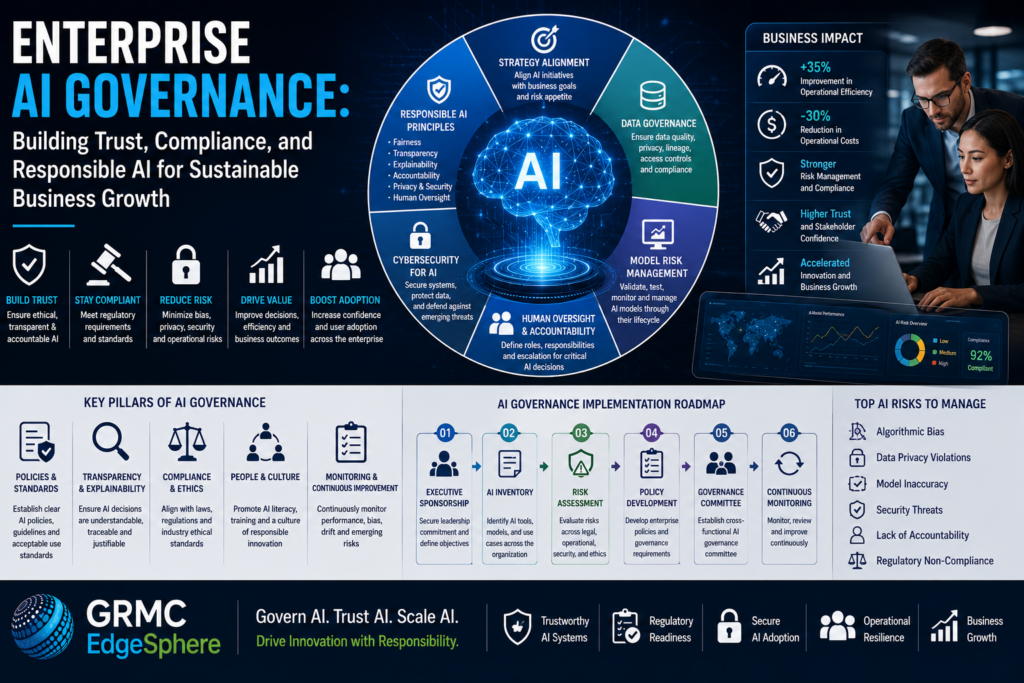
Artificial Intelligence is becoming a core component of enterprise operations. Organizations are using AI to automate workflows, improve decision-making, enhance customer experiences, strengthen cybersecurity, optimize supply chains, and generate business insights at unprecedented speed.
However, as AI adoption accelerates, so do the associated risks. Inaccurate outputs, biased models, regulatory uncertainty, privacy concerns, intellectual property issues, and cybersecurity threats can undermine business value if AI systems are deployed without proper oversight.
For business leaders, AI success is no longer determined solely by technical performance. It increasingly depends on governance—the policies, processes, controls, and accountability mechanisms that ensure AI systems operate responsibly, securely, transparently, and in alignment with business objectives.
Enterprise AI Governance provides the foundation for organizations to scale AI initiatives confidently while maintaining stakeholder trust, regulatory compliance, and operational resilience.
The Business Challenge
Many organizations are adopting AI faster than they are developing governance frameworks.
This creates significant business risks, including:
- Uncontrolled AI usage across departments
- Sensitive corporate data being entered into public AI platforms
- Lack of accountability for AI-generated decisions
- Inconsistent AI policies
- Regulatory compliance challenges
- Bias in automated decision-making
- Intellectual property exposure
- Cybersecurity vulnerabilities
- Limited executive visibility into AI initiatives
Without governance, AI investments can introduce operational, legal, financial, and reputational risks that outweigh their intended benefits.
Understanding Enterprise AI Governance
Enterprise AI Governance is a structured framework that defines how AI systems are designed, deployed, monitored, and managed throughout their lifecycle.
It establishes clear policies for:
- Responsible AI use
- Risk management
- Data governance
- Privacy protection
- Model lifecycle management
- Security controls
- Regulatory compliance
- Human oversight
- Performance monitoring
- Continuous improvement
Rather than slowing innovation, effective governance enables organizations to scale AI safely and consistently across business functions.
Core Components of an AI Governance Framework
AI Strategy Alignment
Every AI initiative should support measurable business objectives rather than being implemented solely because the technology is available.
Key considerations include:
- Business value
- Strategic priorities
- ROI expectations
- Operational impact
- Long-term scalability
Data Governance
AI systems are only as reliable as the data they consume.
Organizations should establish controls for:
- Data quality
- Data ownership
- Classification
- Retention
- Privacy
- Access management
- Data lineage
Strong data governance improves model accuracy while reducing compliance risks.
Model Risk Management
AI models should undergo rigorous validation before production deployment.
Best practices include:
- Accuracy testing
- Bias assessment
- Explainability evaluation
- Performance benchmarking
- Version control
- Continuous monitoring
Regular model reviews help maintain reliability as business conditions evolve.
Responsible AI Principles
Responsible AI promotes ethical and transparent decision-making.
Core principles include:
- Fairness
- Accountability
- Transparency
- Explainability
- Human oversight
- Privacy
- Security
- Inclusivity
These principles strengthen stakeholder confidence and support sustainable AI adoption.
Cybersecurity for AI Systems
AI platforms introduce new attack surfaces that require dedicated security measures.
Organizations should implement:
- Identity and access management
- Encryption
- Secure APIs
- Continuous monitoring
- Threat detection
- Adversarial testing
- Model integrity protection
- Incident response planning
Integrating AI governance with existing cybersecurity programs reduces operational risk.
Business Benefits and ROI
Improved Executive Confidence
Governance provides leadership with clear visibility into AI initiatives, enabling informed investment decisions and strategic oversight.
Regulatory Readiness
Organizations with established governance frameworks are better prepared to adapt to evolving AI regulations and industry standards.
Reduced Operational Risk
Formal governance minimizes errors, unauthorized AI usage, compliance violations, and security incidents.
Higher AI Adoption
Employees are more likely to embrace AI solutions when policies, responsibilities, and acceptable use guidelines are clearly defined.
Better Business Outcomes
Governed AI initiatives deliver more consistent results by ensuring data quality, model reliability, and alignment with organizational objectives.
Real-World Enterprise Applications
Financial Services
Banks use AI governance to oversee credit scoring models, fraud detection systems, and regulatory reporting while maintaining fairness and compliance.
Healthcare
Healthcare organizations govern AI-powered diagnostics, patient data analytics, and clinical decision support to protect sensitive information and improve patient outcomes.
Manufacturing
Manufacturers apply governance to predictive maintenance, quality inspection, and production optimization systems to ensure reliability and operational continuity.
Government
Public sector agencies establish governance frameworks to improve transparency, accountability, and citizen trust when deploying AI-enabled public services.
Retail and E-Commerce
Retailers govern recommendation engines, pricing models, and customer analytics to balance personalization with privacy and ethical data use.
AI Governance Implementation Roadmap
Phase 1: Executive Sponsorship
Secure leadership commitment and define governance objectives aligned with organizational strategy.
Phase 2: AI Inventory
Identify existing AI tools, platforms, models, and business use cases across the organization.
Phase 3: Risk Assessment
Evaluate legal, operational, cybersecurity, privacy, and ethical risks associated with each AI initiative.
Phase 4: Policy Development
Develop enterprise policies covering AI usage, data handling, security, procurement, vendor management, and human oversight.
Phase 5: Governance Committee
Establish a cross-functional governance board involving business leaders, IT, cybersecurity, legal, compliance, risk management, and data teams.
Phase 6: Continuous Monitoring
Track AI performance, regulatory developments, emerging risks, and business outcomes through ongoing reviews and audits.
Measuring Success
Organizations should monitor key performance indicators such as:
- AI adoption rate
- Compliance performance
- Security incidents
- Model accuracy
- Time-to-deployment
- Operational efficiency gains
- Cost savings
- Business value delivered
- User trust and satisfaction
These metrics provide executives with a clear understanding of AI performance and governance effectiveness.
How GRMC EdgeSphere Can Help
GRMC EdgeSphere partners with organizations to establish secure, scalable, and business-focused AI governance programs that support innovation while managing risk.
Our capabilities include:
- Enterprise AI Strategy Development
- AI Governance Framework Design
- Responsible AI Assessments
- AI Risk and Compliance Consulting
- AI Security Architecture
- Data Governance Strategy
- AI Policy Development
- AI Vendor Risk Assessments
- Digital Transformation Consulting
- Executive AI Readiness Workshops
- AI Performance Measurement and Optimization
Our multidisciplinary expertise in artificial intelligence, cybersecurity, governance, and digital transformation enables organizations to adopt AI with confidence while protecting business value.
Conclusion
Artificial Intelligence offers extraordinary opportunities to improve productivity, innovation, and competitive advantage. However, long-term success depends on more than deploying advanced technologies—it requires strong governance that ensures AI systems remain trustworthy, secure, transparent, and aligned with business goals.
Organizations that invest in Enterprise AI Governance today will be better positioned to scale AI responsibly, meet evolving regulatory expectations, protect stakeholder trust, and maximize the return on their AI investments.
As AI continues to reshape industries worldwide, governance will become one of the defining capabilities separating resilient, future-ready enterprises from those struggling to manage increasing technological complexity.