

🌍 Introduction
Artificial Intelligence is entering a new phase. Rather than simply responding to prompts or generating content, modern AI systems are increasingly capable of planning tasks, making decisions, interacting with software, and completing multi-step workflows with minimal human intervention. These systems are commonly referred to as Agentic AI.
From automating procurement processes and managing customer interactions to supporting financial analysis and supply chain optimization, Agentic AI is transforming how organizations operate. However, with greater autonomy comes greater responsibility.
As AI agents gain the ability to make decisions independently, organizations must ensure these systems operate within defined business rules, ethical standards, regulatory requirements, and organizational objectives.
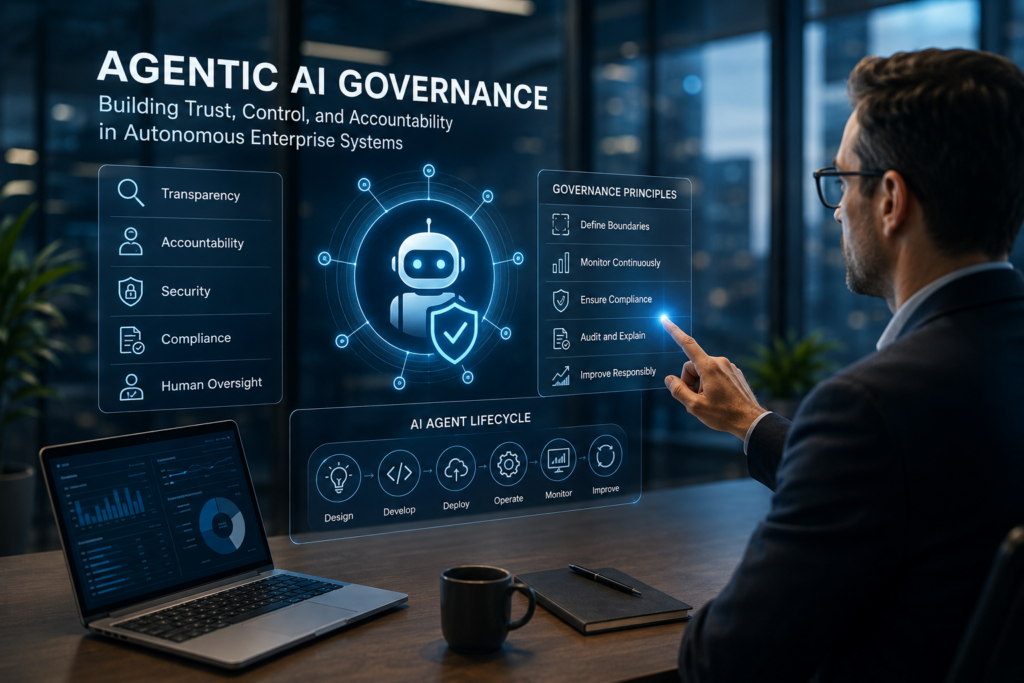
This is where Agentic AI Governance becomes essential. It provides the policies, frameworks, and oversight mechanisms that enable organizations to deploy autonomous AI responsibly while maintaining transparency, accountability, security, and human control.
For CEOs, CIOs, CTOs, government agencies, enterprise leaders, and technology decision-makers, effective governance is becoming the foundation for successful Agentic AI adoption.
📊 Industry Overview
Organizations across every industry are exploring Agentic AI to improve productivity, reduce operational costs, accelerate decision-making, and enhance customer experiences.
Unlike traditional automation, Agentic AI systems can:
- Analyze complex information
- Plan multi-step actions
- Coordinate with multiple applications
- Learn from outcomes
- Adapt to changing conditions
- Execute business workflows autonomously
These capabilities unlock enormous business value, but they also introduce new governance challenges.
Questions such as Who is responsible for an AI agent’s decisions?, How should autonomous actions be monitored?, and How can organizations prevent unintended consequences? are becoming increasingly important.
As governments and regulatory bodies introduce new AI regulations, organizations need governance strategies that balance innovation with responsible AI deployment.
⚠️ Key Challenges
🤖 Autonomous Decision-Making
AI agents can execute business processes with minimal human involvement. Without clear governance policies, autonomous actions may create operational, financial, or compliance risks.
🔍 Limited Transparency
Some AI systems operate as complex decision engines, making it difficult for stakeholders to understand how recommendations or actions were generated.
🔐 Security and Access Control
Agentic AI often interacts with enterprise applications, databases, APIs, and sensitive business information. Poor access management may increase cybersecurity risks.
⚖️ Regulatory Compliance
Organizations must ensure autonomous AI systems comply with evolving regulations regarding privacy, accountability, fairness, and responsible AI use.
📉 Human Oversight
Determining when AI should act independently and when human approval is required remains one of the most significant governance challenges.
📈 AI & Business Insights
📊 Governance Accelerates Responsible Innovation
Organizations with strong governance frameworks often adopt AI more confidently because risks are identified and managed proactively rather than reactively.
🤝 Human-AI Collaboration Delivers Better Outcomes
The most effective organizations combine AI autonomy with human expertise, ensuring critical decisions remain aligned with business strategy and ethical considerations.
🌍 Transparency Builds Stakeholder Trust
Customers, regulators, employees, investors, and business partners increasingly expect organizations to explain how AI systems make decisions, particularly when those decisions influence financial outcomes, customer services, hiring, healthcare, or public services.
Transparent AI governance strengthens organizational credibility and reduces reputational risk.
📈 Continuous Monitoring Improves Performance
Deploying an AI agent is only the beginning. Organizations should continuously evaluate AI performance, monitor outputs, detect unexpected behaviors, and refine models as business conditions evolve.
Continuous monitoring enables organizations to improve reliability while reducing operational risks.
🔐 Governance Supports Scalable AI Adoption
Organizations with standardized governance policies can deploy multiple AI agents across departments while maintaining consistent security, compliance, operational control, and quality assurance.
A well-governed AI ecosystem allows businesses to scale innovation without sacrificing accountability.
🛠️ Practical Recommendations
📋 Establish Clear Governance Policies
Define how AI agents are approved, deployed, monitored, updated, and retired throughout their lifecycle.
Create documented governance frameworks that clearly identify ownership, accountability, approval processes, escalation procedures, and risk management responsibilities.
🔍 Classify AI Decision Levels
Categorize AI activities based on business impact, determining which tasks can operate autonomously and which require human review or executive approval.
For example, routine administrative processes may operate independently, while financial approvals or regulatory decisions should always involve human oversight.
👥 Maintain Human-in-the-Loop Controls
Ensure employees retain authority over high-impact business decisions.
Human oversight should remain available whenever AI recommendations involve legal obligations, customer rights, financial transactions, cybersecurity incidents, or ethical considerations.
🔐 Strengthen AI Security
Implement identity management, access controls, encryption, API security, logging, and continuous monitoring to protect AI agents from unauthorized access or manipulation.
Cybersecurity should be integrated into every stage of the AI lifecycle.
📊 Audit AI Decisions Regularly
Establish audit mechanisms that record AI activities, decision histories, and performance metrics.
Regular audits improve transparency, simplify compliance reporting, and support continuous improvement initiatives.
🌍 Develop Responsible AI Standards
Create internal policies covering fairness, transparency, privacy, accountability, explainability, bias mitigation, and regulatory compliance.
Responsible AI principles should be incorporated into organizational governance rather than treated as standalone initiatives.
📈 Monitor Regulatory Developments
AI regulations continue to evolve worldwide.
Organizations should continuously monitor emerging legal requirements and update governance frameworks to remain compliant with changing legislation and industry standards.
🤝 How GRMC Can Help
GRMC EdgeSphere helps organizations implement responsible Agentic AI through strategic advisory, governance frameworks, business intelligence, and digital transformation expertise.
🤖 Agentic AI Strategy
We help organizations identify high-value opportunities for autonomous AI while ensuring alignment with business objectives and operational priorities.
📊 AI Governance Framework Development
Our experts design governance models that establish accountability, transparency, security, compliance, and operational oversight across AI initiatives.
🔐 AI Risk & Cybersecurity Advisory
GRMC evaluates cybersecurity risks associated with autonomous AI systems and develops strategies to protect enterprise environments.
📈 Business Process Transformation
We identify opportunities where Agentic AI can improve operational efficiency, decision-making, customer experience, and enterprise productivity while maintaining governance controls.
🌍 Executive AI Advisory
Our consultants work closely with executive leadership to develop scalable AI adoption strategies that balance innovation, regulatory compliance, and organizational resilience.
🚀 Conclusion
Agentic AI represents one of the most significant technological advancements in enterprise digital transformation. Its ability to plan, reason, coordinate, and execute complex business processes offers tremendous opportunities for innovation, efficiency, and competitive advantage.
However, successful adoption requires more than advanced technology. Organizations must establish governance frameworks that ensure autonomous AI systems remain transparent, secure, accountable, and aligned with business objectives.
By combining strong governance, continuous monitoring, human oversight, cybersecurity, and responsible AI principles, organizations can confidently deploy Agentic AI while minimizing operational and regulatory risks.
GRMC EdgeSphere empowers enterprises to adopt Agentic AI responsibly through strategic consulting, AI governance frameworks, cybersecurity expertise, and business intelligence—helping organizations unlock the full potential of autonomous AI while maintaining trust, control, and long-term business resilience.