

🌍 Introduction
As organizations adopt Agentic AI across customer service, finance, cybersecurity, operations, and business intelligence, expectations for autonomous AI systems continue to grow. Modern AI agents are no longer expected to complete isolated tasks—they are expected to understand organizational context, remember previous interactions, collaborate across departments, and continuously improve their performance.
However, one of the greatest challenges facing enterprise AI today is maintaining consistency over time.
Without an effective memory architecture, AI agents may repeat work, lose valuable business context, generate inconsistent recommendations, or fail to learn from previous decisions. This limits productivity and reduces confidence in autonomous systems.
To move beyond isolated automation and toward truly intelligent enterprise operations, organizations must develop AI systems capable of retaining, organizing, and utilizing knowledge throughout their operational lifecycle.
This capability is known as AI Agent Memory Architecture.
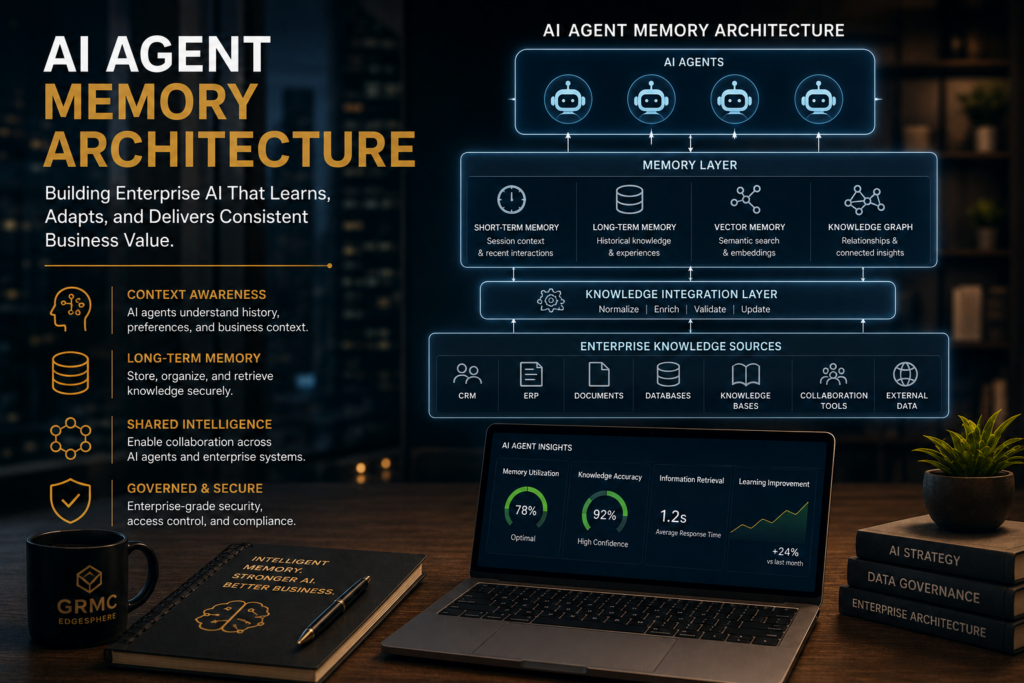
AI Agent Memory Architecture refers to the structured design of how autonomous AI agents capture, organize, retrieve, update, and apply organizational knowledge while executing business processes. Rather than storing information temporarily during a single interaction, enterprise memory architecture enables AI agents to maintain contextual awareness, support long-term learning, improve collaboration, and deliver more accurate recommendations over time.
Instead of asking “How can AI complete this task?”, leading organizations ask:
- How can AI retain business knowledge securely?
- How should AI access historical information?
- How can multiple AI agents share organizational intelligence?
- Which information should be stored permanently and which should remain temporary?
- How do we maintain governance over enterprise AI knowledge?
For CEOs, CIOs, CTOs, Chief Digital Officers, government agencies, and enterprise leaders, AI Agent Memory Architecture is becoming a critical foundation for scalable, intelligent, and trustworthy AI adoption.
📊 Industry Overview
The rapid growth of Agentic AI is changing how organizations manage information.
Traditional AI systems primarily focused on processing user prompts and generating responses based on current input. While effective for individual tasks, these systems often lacked persistent organizational memory.
Enterprise AI is evolving beyond this limitation.
Today’s organizations expect AI agents to understand customer histories, business policies, operational procedures, regulatory requirements, previous project outcomes, executive preferences, and organizational objectives across multiple interactions.
This requires AI systems to access structured enterprise knowledge while maintaining security, governance, and privacy.
Modern memory architectures integrate information from enterprise resource planning systems, customer relationship management platforms, document repositories, business intelligence tools, knowledge bases, collaboration platforms, cloud environments, and operational databases.
By connecting these information sources intelligently, AI agents become more accurate, context-aware, and capable of supporting complex business workflows.
As organizations deploy multiple AI agents across departments, memory architecture also enables secure knowledge sharing that improves collaboration without compromising governance.
⚠️ Key Challenges
🧠 Managing Organizational Knowledge
Large enterprises generate enormous volumes of structured and unstructured information every day.
Without a well-designed memory architecture, valuable knowledge becomes fragmented across multiple systems.
🔐 Protecting Sensitive Information
AI agents frequently interact with confidential business data, customer records, financial information, intellectual property, and strategic documents.
Organizations must ensure stored knowledge remains protected through strong governance, encryption, and access controls.
📊 Maintaining Information Accuracy
Enterprise knowledge evolves continuously.
Policies, regulations, operational procedures, and customer information change over time, requiring AI memory systems to remain current and reliable.
🤝 Coordinating Multiple AI Agents
As organizations deploy specialized AI agents across departments, consistent access to trusted organizational knowledge becomes essential.
Without standardized memory management, different AI agents may produce inconsistent recommendations.
⚖️ Balancing Performance and Governance
AI systems require rapid access to information while maintaining compliance with privacy regulations, audit requirements, and organizational security policies.
Finding this balance remains one of the greatest architectural challenges.
📈 AI & Business Insights
🧠 Context Improves AI Performance
AI agents that understand organizational history, customer relationships, and business processes generate more accurate recommendations than systems relying solely on current user input.
📊 Shared Knowledge Increases Operational Efficiency
When multiple AI agents access the same trusted knowledge sources, organizations reduce duplicated work, improve consistency, and accelerate decision-making.
🌍 Governance Builds Trust
Clearly defined policies governing how AI stores, retrieves, and updates information strengthen executive confidence and support responsible AI adoption.
📈 Continuous Learning Supports Long-Term Value
Organizations that continuously update AI knowledge repositories enable autonomous systems to improve alongside evolving business strategies and market conditions.
🔍 Data Quality Determines Knowledge Quality
Effective memory architecture depends on well-managed enterprise data.
Incomplete, outdated, or inconsistent information reduces AI reliability regardless of model sophistication.
🛠️ Practical Recommendations
📋 Design a Structured Enterprise Knowledge Framework
Identify authoritative information sources, define ownership, and establish governance for all knowledge that AI agents can access.
🔐 Implement Role-Based Access Controls
Ensure AI agents only retrieve information appropriate to their responsibilities while protecting confidential business assets through strong identity and access management.
📊 Integrate Trusted Business Systems
Connect AI memory architecture with CRM platforms, ERP systems, document repositories, knowledge bases, operational databases, and business intelligence platforms to provide comprehensive organizational context.
🔍 Continuously Validate Information Quality
Establish review processes that verify the accuracy, relevance, and timeliness of enterprise knowledge used by AI agents.
🤝 Standardize Knowledge Sharing
Develop centralized knowledge services that allow multiple AI agents to access consistent information while maintaining governance and security.
📈 Monitor Memory Performance
Measure retrieval accuracy, knowledge utilization, response consistency, and business outcomes to continuously optimize AI memory architecture.
🤝 How GRMC Can Help
GRMC EdgeSphere helps organizations build intelligent enterprise AI environments through strategic consulting, governance frameworks, and digital transformation services.
🧠 Enterprise AI Knowledge Strategy
We design AI knowledge architectures that align enterprise information management with business objectives and long-term digital transformation strategies.
📊 AI Memory Architecture
Our specialists develop structured memory frameworks that improve AI consistency, contextual understanding, and operational performance.
🔐 AI Governance & Security
GRMC establishes governance models, access controls, and security policies that protect enterprise knowledge while enabling responsible AI collaboration.
🌍 Intelligent Enterprise Integration
We integrate AI memory systems with business applications, cloud platforms, APIs, analytics platforms, and organizational knowledge repositories.
📈 Executive AI Advisory
Our consultants help leadership teams implement scalable AI architectures that improve decision-making, operational efficiency, and long-term business resilience.
🚀 Conclusion
As Agentic AI becomes increasingly integrated into enterprise operations, the ability to retain, manage, and apply organizational knowledge will become one of the defining characteristics of successful AI implementations.
AI Agent Memory Architecture enables organizations to move beyond isolated automation by creating AI systems that understand context, learn continuously, collaborate effectively, and support consistent business outcomes.
By combining secure knowledge management, governance, enterprise integration, and continuous optimization, organizations can unlock greater value from autonomous AI while maintaining transparency, accountability, and trust.
GRMC EdgeSphere empowers organizations to build intelligent AI ecosystems through enterprise knowledge architecture, governance, and digital transformation—helping businesses create future-ready operations powered by trusted, context-aware autonomous AI.