

🌍 Introduction
Every digital transformation initiative introduces new opportunities for business growth—but it also creates new cybersecurity challenges. As organizations expand into cloud environments, adopt Software-as-a-Service (SaaS) platforms, enable remote work, integrate third-party applications, and connect operational technologies, their digital footprint grows significantly.
While these technologies improve efficiency and innovation, they also increase an organization’s attack surface—the collection of digital assets, systems, applications, identities, cloud services, and internet-facing resources that could potentially be targeted by cybercriminals.
Many organizations focus their cybersecurity efforts on responding to threats after they are detected. However, leading enterprises are shifting toward a more proactive strategy: understanding exactly what is exposed before attackers identify those opportunities.
This proactive approach is known as Cybersecurity Attack Surface Intelligence.
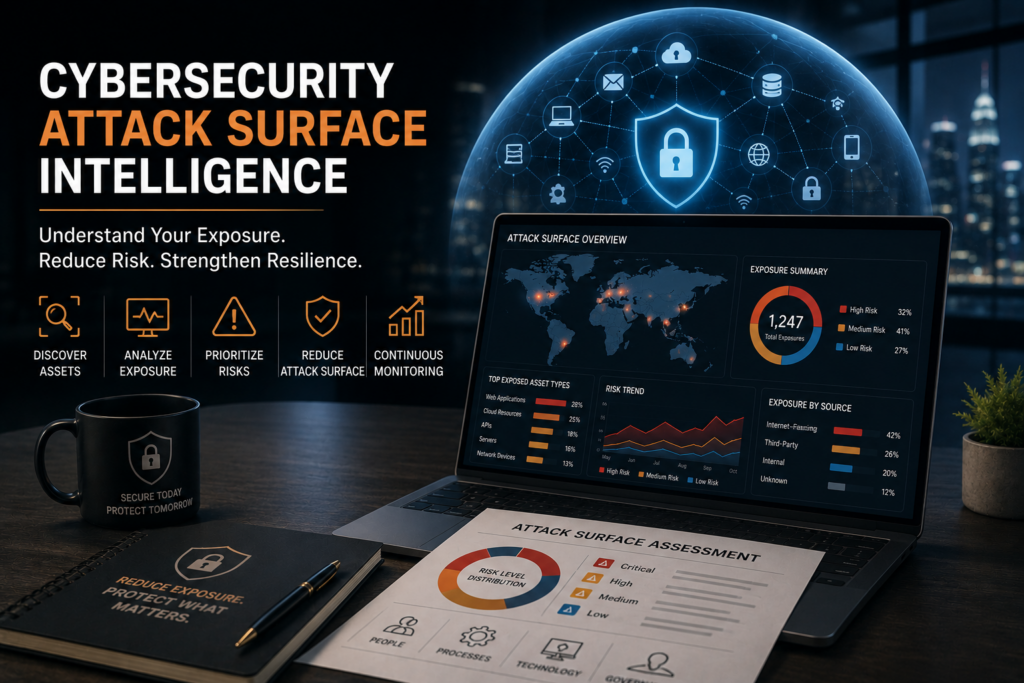
Cybersecurity Attack Surface Intelligence is the continuous process of discovering, monitoring, analyzing, and reducing an organization’s digital exposure across internal infrastructure, cloud platforms, external assets, third-party connections, and emerging technologies. It enables organizations to identify security gaps, prioritize risk, and strengthen cyber resilience before vulnerabilities become incidents.
Instead of asking “Can we stop every cyberattack?”, forward-thinking organizations ask:
- What digital assets are currently exposed?
- Which systems represent the greatest business risk?
- How has our attack surface changed over time?
- Which exposures require immediate attention?
- How can we continuously reduce cyber risk while supporting business growth?
For CISOs, CIOs, CTOs, government agencies, and enterprise leaders, Attack Surface Intelligence provides the visibility needed to protect modern digital ecosystems while enabling secure innovation.
📊 Industry Overview
Enterprise environments have evolved dramatically over the past decade.
Organizations no longer operate solely within traditional corporate networks. Business operations now extend across public cloud platforms, hybrid environments, remote work infrastructures, mobile devices, SaaS applications, APIs, Internet of Things (IoT) devices, operational technology, and globally distributed workforces.
As digital ecosystems expand, maintaining visibility becomes increasingly difficult.
New servers are deployed, cloud resources are provisioned, applications are updated, vendors gain access to enterprise systems, employees use personal devices, and business units adopt new technologies—often faster than security teams can monitor them.
Each new asset increases potential exposure.
Attackers frequently exploit forgotten cloud resources, misconfigured services, unused accounts, exposed APIs, outdated software, and unmanaged internet-facing systems because these assets are often overlooked during routine security assessments.
Attack Surface Intelligence provides organizations with a continuously updated understanding of their digital environment, helping security teams identify hidden exposures before attackers discover them.
⚠️ Key Challenges
🌐 Rapid Digital Expansion
Cloud adoption, digital transformation initiatives, and remote work have dramatically increased the number of systems organizations must secure.
Maintaining complete visibility across rapidly changing environments remains a significant challenge.
🔍 Unknown Assets
Many organizations are unaware of every server, application, API, database, domain, or cloud service connected to their business.
Unknown assets frequently become attractive targets for cybercriminals.
☁️ Cloud Visibility Gaps
Cloud platforms enable rapid deployment but can also introduce security risks when resources are created without centralized governance or continuous monitoring.
🤝 Third-Party Dependencies
Modern organizations rely heavily on vendors, managed service providers, technology partners, and software integrations.
Weaknesses within external relationships can increase organizational cyber exposure.
📉 Limited Risk Prioritization
Security teams often receive thousands of alerts and vulnerability reports.
Without understanding which exposed assets are most critical to business operations, prioritizing remediation becomes difficult.
📈 Cybersecurity Insights
📊 Visibility Is the Foundation of Cybersecurity
Organizations cannot effectively protect assets they do not know exist.
Comprehensive asset discovery is the first step toward reducing cyber risk.
🔐 External Exposure Changes Continuously
Infrastructure evolves daily through software updates, cloud deployments, new integrations, and business expansion.
Continuous monitoring is more effective than periodic assessments alone.
🌍 Business Context Improves Risk Management
Not every exposed asset presents the same level of business risk.
Critical customer platforms, financial systems, executive communications, and operational technologies should receive higher priority.
📈 Intelligence Supports Faster Decision-Making
Attack Surface Intelligence enables leadership teams to focus cybersecurity investments on the areas with the greatest operational impact.
🤝 Proactive Security Reduces Incident Costs
Organizations that identify exposure before attackers do are generally better positioned to reduce downtime, financial losses, regulatory consequences, and reputational damage.
🛠️ Practical Recommendations
📋 Maintain a Comprehensive Asset Inventory
Develop and continuously update an inventory of servers, cloud resources, applications, databases, endpoints, APIs, domains, and connected devices.
Ensure all business assets are documented and assigned ownership.
🔍 Continuously Monitor Internet-Facing Assets
Regularly review publicly accessible systems to identify unnecessary exposure, outdated services, expired certificates, or unauthorized changes.
☁️ Strengthen Cloud Governance
Establish standardized security policies for cloud deployments, identity management, storage permissions, and network configurations.
Conduct routine reviews to verify compliance with organizational security standards.
🤝 Evaluate Third-Party Risk
Assess vendor security practices, contractual obligations, access permissions, and integration points before granting access to enterprise systems.
Continue monitoring third-party exposure throughout the relationship.
📊 Prioritize Business-Critical Assets
Rank identified exposures based on business impact, operational importance, data sensitivity, and potential financial consequences to ensure remediation efforts focus on the highest risks first.
📈 Establish Continuous Improvement Processes
Attack Surface Intelligence should become an ongoing business capability rather than a one-time assessment.
Regular reviews help organizations adapt to changing technologies, evolving threats, and expanding digital operations.
🤝 How GRMC Can Help
GRMC EdgeSphere supports organizations in building proactive cybersecurity strategies through advanced cyber risk intelligence, governance, and strategic consulting.
🔐 Attack Surface Assessments
We identify and evaluate internal, external, and cloud-based digital assets to help organizations understand their overall cyber exposure.
📊 Cyber Risk Intelligence
Our specialists combine technical findings with business impact analysis, enabling leadership teams to prioritize cybersecurity investments effectively.
☁️ Cloud Security Advisory
GRMC assesses cloud environments, identity management, and infrastructure configurations to improve visibility and reduce exposure.
🤝 Third-Party Risk Management
We help organizations evaluate external relationships, vendor access, and supply chain security to minimize third-party cyber risks.
🌍 Executive Cybersecurity Advisory
Our consultants work closely with leadership teams to strengthen governance, improve cyber resilience, and align cybersecurity initiatives with long-term business objectives.
🚀 Conclusion
Modern organizations cannot secure what they cannot see.
As digital ecosystems continue expanding, understanding the organization’s complete attack surface has become essential for effective cybersecurity and business resilience.
Cybersecurity Attack Surface Intelligence provides organizations with the visibility needed to identify hidden exposures, prioritize security improvements, reduce operational risk, and strengthen executive decision-making.
By combining continuous asset discovery, cloud visibility, third-party risk management, business intelligence, and proactive governance, organizations can significantly reduce cyber exposure while supporting innovation and sustainable growth.
GRMC EdgeSphere empowers organizations to build resilient digital environments through cybersecurity intelligence, strategic advisory, and risk-based security solutions—helping businesses stay one step ahead of evolving cyber threats.