
In today’s data-driven business environment, executives face a critical challenge: making strategic decisions with incomplete information. Too many organizations rely solely on internal performance metrics or external market observations, never integrating the two for a complete picture. This fragmented approach leads to missed opportunities and costly strategic errors.
Understanding the distinction between Business Intelligence (BI) and Market Intelligence (MI)—and more importantly, how they complement each other—is essential for effective leadership. As GRMC EdgeSphere’s work with governments, enterprises, and communities across the GCC, Caribbean, and international markets demonstrates, the integration of these intelligence disciplines transforms raw data into actionable strategy.
Defining the Intelligence Disciplines
Business Intelligence: The Internal Dashboard
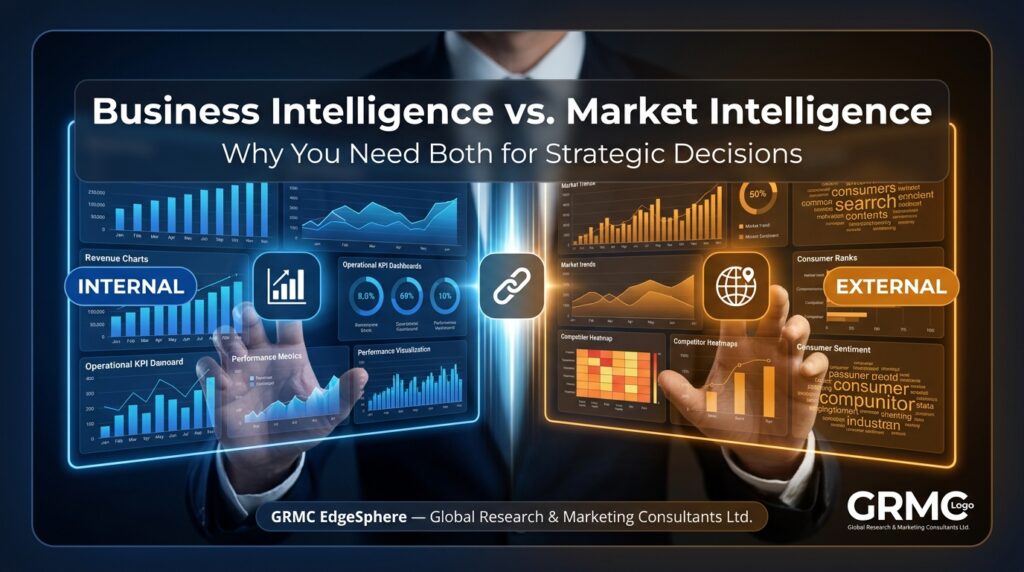
Business Intelligence focuses on internal data generated from an organization’s operations. It encompasses information stored in data warehouses, CRM systems, ERP software, financial dashboards, and internal sales reports . The primary objective is to optimize decision-making and improve operational efficiency by analyzing what has happened or what is currently happening within the organization .
BI provides a detailed look inward, helping leaders understand performance metrics, cost structures, sales trends, and operational bottlenecks. Tools like Microsoft Power BI transform complex internal data into visualizations that offer a clear, summarized view of organizational performance .
Market Intelligence: The External Windshield
Market Intelligence, in contrast, is the process of gathering and analyzing information from the external environment in which your business operates . It encompasses competitive analysis, customer insights, market trends, and macroeconomic factors . MI provides a forward-looking perspective, helping organizations anticipate shifts and position themselves effectively .
As one expert aptly noted, “Your dashboard is like business intelligence data, it gives you a very good idea of how effective and how efficient your car is running. Your windshield is your view of the world [market intelligence]” . This external view enables organizations to identify opportunities and threats before they impact the business.
Key Differences at a Glance
| Aspect | Business Intelligence | Market Intelligence |
|---|---|---|
| Primary Focus | Internal performance and operations | External market dynamics and competition |
| Main Objective | Optimize decision-making and efficiency | Inform strategic positioning and market entry |
| Data Sources | Internal systems (CRM, ERP, financials) | Public data, competitor analysis, customer feedback |
| Approach | Analytical, retrospective, dashboard-driven | Investigative, predictive, trend-driven |
| Time Orientation | Historical and real-time | Forward-looking and trend-based |
| Typical Users | Operations, finance, product teams | Strategy, marketing, executive leadership |
Source: Adapted from Veridion analysis
Why Integration Matters
Separately, BI and MI provide only half of the picture. Used appropriately, market intelligence can provide context for business intelligence . Consider the analogy of driving a car: “You cannot drive a car by just looking at your dashboard and you cannot drive your car just by looking through your windshield. It’s the same in business” .
When an executive sees a market opportunity through MI, BI tells whether the organization has the right resources, tools, assets, and processes in place to execute effectively . Conversely, internal performance metrics without external context create blind spots—a company might appear to be performing well internally while losing market share to competitors.
Practical Applications
Market Entry Strategy
When entering new markets across the Caribbean, LATAM, or Africa, organizations need both disciplines. MI provides insights on market demand, competitive landscape, and regulatory environment . BI complements this by assessing internal readiness—financial capacity, operational capabilities, and resource availability.
Product Development
MI helps identify customer needs and market gaps, informing new product development . BI then tracks the operational costs, production capacity, and supply chain implications of bringing these products to market.
Competitive Positioning
MI enables organizations to benchmark against competitors and identify differentiation opportunities . BI monitors the internal performance metrics needed to execute competitive strategies effectively.
Implementation Challenges
Integrating BI and MI presents several challenges that organizations must address:
Data Quality and Timeliness: External market intelligence data may not be as timely or accurate as internal data . Organizations have much more control over the accuracy of their BI data than they do over external MI sources .
Synchronization Issues: Timing differences between internal operations and external market movements can cause decisions to become misaligned . Production decisions based on outdated market intelligence can lead to capacity mismatches with actual demand.
Data Integration: Combining disparate data sources—structured internal data and unstructured external information—requires sophisticated analytics capabilities .
Actionable Recommendations for Decision-Makers
1. Establish Clear Ownership and Governance
Assign dedicated teams or individuals responsible for BI and MI functions. Ensure these teams collaborate regularly, sharing insights and aligning on strategic priorities.
2. Invest in Integrated Analytics Platforms
Modern analytics solutions can bridge the gap between internal and external data sources. Look for platforms with robust semantic layers that unify data definitions and support AI-driven insights . As one organization discovered, “I thought AI in BI would just be a gadget. Instead, Omni’s AI became our users’ favorite features” .
3. Develop a Culture of Intelligence-Driven Decision-Making
Move beyond data collection to insight activation. Create processes where both BI and MI insights are systematically incorporated into planning cycles. According to industry experts, this requires “a cultural shift to an organization that truly ‘listens'” .
4. Build Continuous Intelligence Capabilities
Market research provides snapshot views, but market intelligence requires ongoing monitoring . Implement continuous data collection and analysis processes to track market evolution and internal performance simultaneously.
5. Prioritize Data Quality and Integration
Address data quality issues proactively. Develop capabilities to synchronize internal and external data streams, acknowledging that “it really is about making business decisions in the context of having imperfect information” .
Conclusion
The choice between Business Intelligence and Market Intelligence is a false dilemma. Strategic decision-making requires both—the internal dashboard and the external windshield. Organizations that successfully integrate these intelligence disciplines gain a comprehensive view that enables confident, informed decision-making.
As GRMC EdgeSphere’s work across international markets demonstrates, the integration of BI and MI capabilities transforms research into strategy, enabling clients to navigate complex markets with clarity and confidence.