

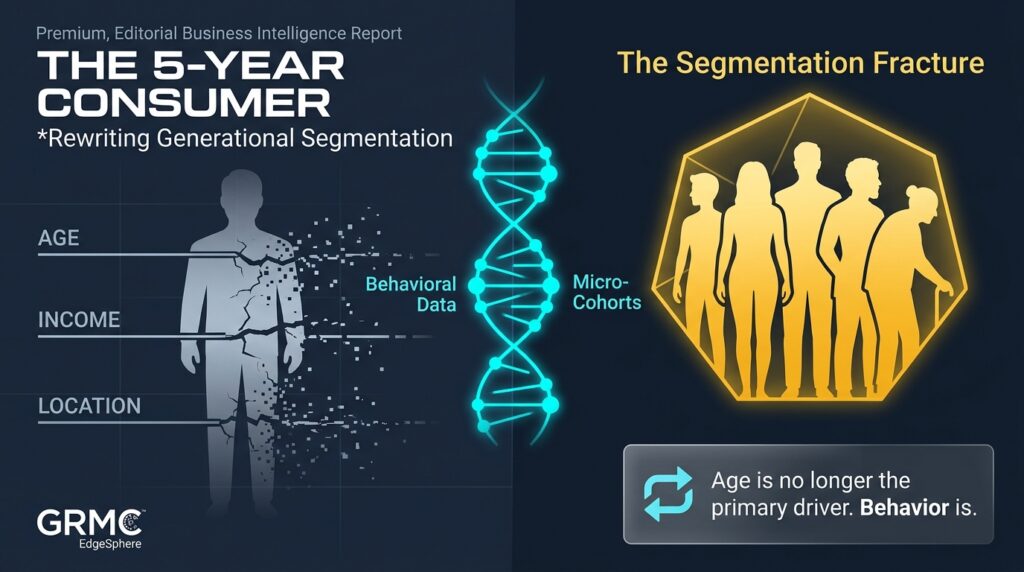
For decades, demographic segmentation followed a predictable rhythm. Marketers organized consumers into neat generational boxes—Baby Boomers, Gen X, Millennials, Gen Z—and crafted strategies around birth years and shared life stage assumptions. That model is collapsing.
The fundamental question facing business leaders today is no longer “Which generation are we targeting?” but rather “How do we understand consumers whose behaviors are shaped by forces that transcend age?”
The 5-year consumer concept captures this new reality. Rapid technological adoption, economic volatility, geopolitical disruption, and shifting cultural values are compressing the traditional generational timeline. Consumers five years apart in age now exhibit more behavioral divergence than consumers twenty years apart did in previous decades. This demands a complete rethink of how organizations approach market research, customer segmentation, and go-to-market strategy.
Why Traditional Generational Models Are Failing
The conventional approach to generational segmentation was built on a stable world. Baby Boomers grew up in an era of postwar prosperity, Millennials came of age during the rise of the internet, and Gen Z entered adulthood with smartphones already in hand. But the acceleration of change has rendered these broad-brush categories increasingly meaningless for practical business decision-making.
Consider the following dynamics reshaping consumer behavior:
- Technology adoption no longer follows age lines. A 45-year-old executive and a 25-year-old recent graduate may use the same AI tools, consume content through the same platforms, and share similar expectations for digital experiences. Age has become a poor proxy for digital fluency.
- Economic uncertainty affects all generations simultaneously. Inflation, housing affordability, and employment volatility impact consumers across age groups, though in different ways. This creates cross-generational cohorts defined by economic anxiety rather than birth year.
- Geopolitical awareness is universal. Consumers in 2026 are more globally conscious than ever before. Events in one region resonate across borders, creating shared consumer sentiment that traditional models fail to capture.
The result is that businesses relying on outdated generational frameworks are making costly errors in product development, messaging, and channel strategy.
The Generational Shifts Reshaping Consumer Markets
The Compression of Life Stages
Historically, life stages followed a predictable sequence: education, career establishment, family formation, mid-career consolidation, and retirement. Today, these stages are blurring. Individuals in their 30s may be returning to education, while those in their 60s launch new ventures. The linear progression that underpinned traditional segmentation has disappeared.
For businesses, this means that targeting by age group is no longer sufficient. A 30-year-old entrepreneur and a 50-year-old career changer may have more in common than two individuals of the same age with different education levels, income trajectories, and digital habits.
The Rise of Micro-Cohorts
Our research identifies the emergence of micro-cohorts—groups defined by shared experiences, values, and behaviors rather than demographic attributes. These micro-cohorts form around:
- Shared technological milestones. Consumers who adopted AI tools at the same time tend to share similar productivity expectations and quality standards.
- Economic shock experiences. Those who entered the workforce during a recession exhibit distinct spending and saving patterns compared to those who did not.
- Cultural fluency. Consumers from different generations who share language, values, and media consumption habits often form more meaningful market segments than traditional age-based groupings.
The Globalization of Consumer Identity
Consumers in the GCC, Caribbean, North America, LATAM, and Africa increasingly share values and expectations that transcend their geographic markets. Business leaders planning international expansion cannot assume that generational patterns transfer directly across borders. Instead, they must understand how local economic conditions, cultural norms, and technological infrastructure interact with global consumer trends.
Market Research Implications for Business Decision-Makers
The shift from generational to behavioral segmentation has profound implications for how organizations conduct and interpret market research.
Moving Beyond Demographic Data
Traditional segmentation relied heavily on demographic variables: age, income, education, and location. These remain relevant but are no longer sufficient. Leading organizations are integrating:
- Psychographic mapping. Understanding consumer values, attitudes, and lifestyle choices provides depth that demographics alone cannot deliver.
- Behavioral analytics. Actual purchasing patterns, digital engagement, and interaction histories reveal more about consumer preferences than stated intentions.
- Contextual intelligence. Understanding the circumstances in which consumers make decisions—economic conditions, social pressures, personal priorities—enables more accurate prediction.
The Importance of Real-Time Research
The accelerated pace of change means that research conducted 12 months ago may already be outdated. Businesses need continuous intelligence gathering that captures evolving sentiment and behavior in near real-time. This is particularly critical for:
- Market entry strategy in rapidly changing regions
- Product development that must anticipate future needs
- Brand positioning that must remain relevant across shifting cultural landscapes
Cross-Generational Segmentation in Practice
Our work with clients across international markets demonstrates the value of cross-generational segmentation. For a consumer goods company entering Middle Eastern markets, we identified that consumers aged 25-40 in the Gulf region shared more behavioral commonalities with consumers aged 20-35 in North America than with older consumers in the same region. This insight fundamentally changed their marketing approach.
Actionable Recommendations for Business Leaders
- Audit your current segmentation model. Review whether your existing consumer groupings still reflect actual purchasing behavior. If your segments are still defined primarily by age and income, you are likely missing critical nuances.
- Invest in behavioral intelligence. Implement research methodologies that capture actual consumer behavior, not just stated preferences. This includes purchase data analysis, digital interaction tracking, and ethnographic observation.
- Build cross-functional consumer intelligence teams. Break down silos between market research, product development, marketing, and sales. A unified view of the consumer—spanning generational and behavioral dimensions—enables better decision-making.
- Develop micro-segmentation capabilities. Segment your consumer base by behaviors and experiences, not just age. Look for micro-cohorts that share meaningful characteristics and target them with tailored strategies.
- Monitor for emerging cohorts. The consumer landscape is constantly evolving. Establish systematic processes for identifying new cohorts as they emerge, rather than waiting for them to become visible in conventional data.
How GRMC Can Help
At GRMC EdgeSphere, we specialize in helping organizations navigate the shifting consumer landscape. Our approach combines:
- Advanced behavioral analytics. We go beyond traditional demographic research to capture the full spectrum of consumer behavior and motivation.
- Regional market expertise. With experience across GCC, Caribbean, North America, LATAM, and Africa, we understand how global trends manifest in local contexts.
- Strategic implementation support. We don’t just deliver insights—we help you translate them into actionable business strategy.
- Real-time intelligence capabilities. Our research frameworks capture consumer sentiment and behavior as they evolve, enabling proactive rather than reactive decision-making.
- Cross-generational segmentation expertise. We help organizations identify and target the micro-cohorts that matter most for their specific business context.
Conclusion
The 5-year consumer reality represents both a challenge and an opportunity. Traditional segmentation models are no longer fit for purpose, but this disruption creates space for organizations willing to embrace new approaches. Business leaders who invest in understanding the behavioral drivers of consumer decision-making—regardless of age—will be better positioned to connect with customers, enter new markets, and build lasting competitive advantage.
The question is no longer whether to evolve your segmentation strategy, but when. In a rapidly changing consumer landscape, those who act decisively will lead; those who wait will follow.
GRMC EdgeSphere stands ready to help you navigate this complexity. With our international expertise, advanced research capabilities, and commitment to actionable insights, we can help you understand the consumers who matter most to your business—and reach them effectively.