

🌟 Introduction
Artificial Intelligence has evolved rapidly over the past decade. Organizations have moved from basic automation and analytics to machine learning, predictive intelligence, and Generative AI. Today, a new frontier is emerging that promises to redefine how businesses operate: Agentic AI.
Unlike traditional AI systems that respond to specific prompts or perform predefined tasks, Agentic AI systems can independently plan, reason, make decisions, and execute actions to achieve business objectives. These AI agents function as intelligent digital workers capable of handling complex workflows, coordinating across systems, and continuously adapting to changing conditions.
For CEOs, CIOs, CTOs, and digital transformation leaders, Agentic AI represents a significant opportunity to improve operational efficiency, accelerate decision-making, enhance customer experiences, and unlock new levels of organizational productivity.
This article explores the business value of Agentic AI, its practical enterprise applications, implementation considerations, and how organizations can leverage this emerging technology to gain a sustainable competitive advantage.
🚧 The Business Challenge
Modern organizations face growing operational complexity.
Business leaders are expected to:
- Manage increasing volumes of data
- Improve customer responsiveness
- Reduce operational costs
- Accelerate innovation
- Scale services efficiently
- Maintain compliance and governance
- Support distributed workforces
Despite significant investments in technology, many organizations still rely on fragmented systems, manual workflows, and siloed decision-making processes.
Traditional automation solutions can automate repetitive tasks but often struggle with dynamic situations requiring judgment, contextual understanding, and multi-step decision-making.
As business environments become more complex, organizations need intelligent systems capable of operating beyond simple rule-based automation.
This is where Agentic AI creates substantial business value.
🧠 Technology Overview: What Is Agentic AI?
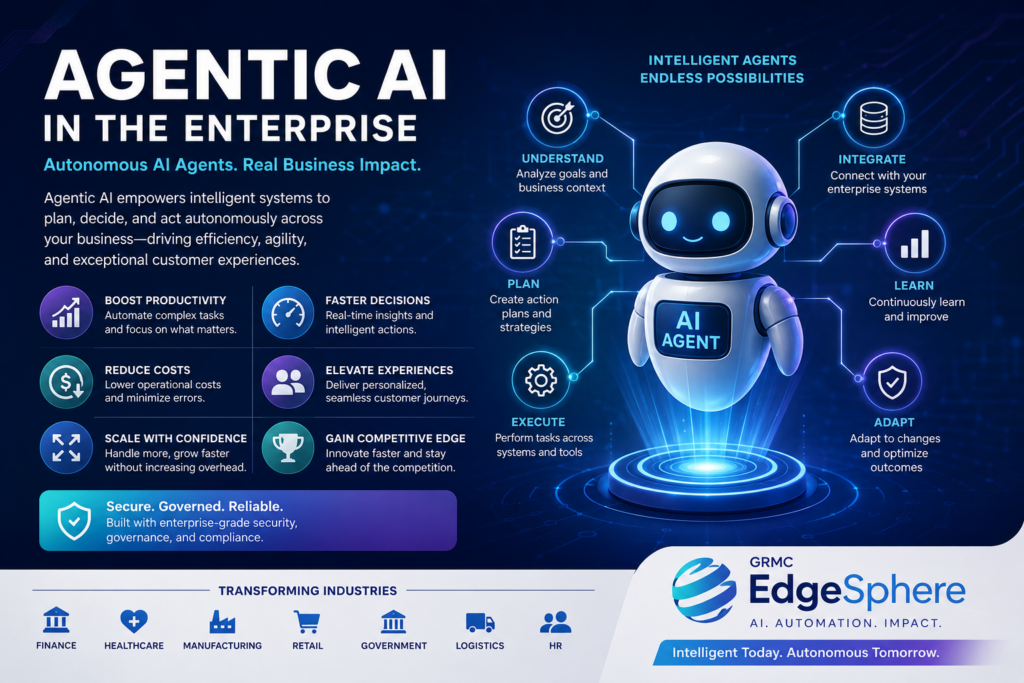
Agentic AI refers to AI systems that can autonomously pursue goals, make decisions, interact with digital environments, and execute tasks with minimal human intervention.
Unlike conventional automation tools that follow predefined instructions, AI agents can:
- Understand objectives
- Analyze context
- Develop action plans
- Interact with multiple systems
- Monitor outcomes
- Adapt strategies when conditions change
An AI agent operates much like a highly capable digital team member.
For example, instead of merely generating a sales report, an AI agent could:
- Gather data from CRM and ERP systems
- Analyze sales performance
- Identify declining regions
- Compare historical trends
- Generate recommendations
- Notify relevant stakeholders
- Schedule follow-up actions
All of these activities can occur automatically within predefined governance frameworks.
🔍 Core Components of Agentic AI
💬 Large Language Models (LLMs)
Provide reasoning, communication, and natural language understanding capabilities.
⚙️ Workflow Orchestration
Coordinates tasks and manages complex business processes.
🔗 API Connectivity
Allows agents to interact with enterprise software, databases, cloud services, and third-party applications.
🧩 Memory and Context Management
Enables agents to retain information, learn from previous interactions, and improve future performance.
📊 Decision Intelligence
Supports data-driven decision-making using analytics, business rules, and predictive models.
Together, these technologies create intelligent systems capable of delivering outcomes rather than simply executing commands.
💰 Business Benefits and ROI
🚀 1. Significant Productivity Improvements
AI agents can perform tasks continuously without the limitations of traditional work schedules.
Organizations can automate activities such as:
- Data gathering
- Report generation
- Compliance checks
- Customer inquiries
- Workflow management
Employees can focus on strategic initiatives, innovation, and customer engagement rather than routine administrative work.
⚡ 2. Faster Decision-Making
Business opportunities often require rapid action.
Agentic AI can:
- Monitor business metrics in real time
- Detect anomalies
- Analyze trends
- Recommend actions
- Trigger workflows automatically
This reduces delays and enables organizations to respond quickly to market changes.
💵 3. Reduced Operational Costs
AI agents can eliminate many repetitive and resource-intensive processes.
Cost savings often result from:
- Lower manual processing requirements
- Reduced error rates
- Faster task completion
- Improved resource utilization
- More efficient service delivery
The result is a leaner, more scalable operating model.
💖 4. Enhanced Customer Experience
Customer expectations continue to rise.
Agentic AI enables organizations to provide:
- 24/7 intelligent support
- Personalized interactions
- Faster issue resolution
- Proactive service recommendations
- Seamless omnichannel experiences
Improved responsiveness strengthens customer loyalty and brand reputation.
📈 5. Enterprise Scalability
Traditional growth frequently requires proportional increases in staffing and operational resources.
AI agents enable organizations to:
- Manage higher transaction volumes
- Support larger customer bases
- Expand services
- Handle increased workloads
without equivalent increases in operational costs.
🏆 6. Competitive Advantage
Organizations that successfully deploy Agentic AI gain advantages through:
- Faster execution
- Improved agility
- Better customer experiences
- Enhanced innovation capacity
- More efficient operations
These capabilities help businesses adapt and compete in rapidly evolving markets.
🌍 Real-World Applications
🎧 Intelligent Customer Service Operations
AI agents can:
- Resolve common customer issues
- Access customer history
- Process service requests
- Escalate complex cases
- Schedule follow-up actions
This reduces support workloads while improving service quality.
💼 Sales and Revenue Optimization
AI agents can continuously analyze:
- Pipeline performance
- Lead quality
- Customer engagement
- Revenue trends
Agents can identify opportunities, recommend actions, and even initiate outreach workflows.
💳 Finance and Accounting
Organizations are using AI agents to:
- Reconcile transactions
- Monitor spending
- Detect anomalies
- Generate financial reports
- Support compliance requirements
This improves accuracy and accelerates financial operations.
👥 Human Resources
Agentic AI can streamline:
- Candidate screening
- Employee onboarding
- Training recommendations
- Workforce analytics
- Performance tracking
HR teams gain greater efficiency while improving employee experiences.
🚚 Supply Chain Management
AI agents can:
- Monitor inventory levels
- Predict demand fluctuations
- Identify supply risks
- Optimize procurement
- Coordinate logistics activities
These capabilities improve resilience and operational efficiency.
🏛️ Government and Public Services
Public sector organizations can use AI agents to:
- Process citizen requests
- Automate documentation
- Improve service delivery
- Monitor compliance
- Support policy implementation
This enables more efficient and responsive public services.
🛠️ Implementation Roadmap
🎯 Step 1: Identify High-Value Opportunities
Organizations should focus on processes that are:
- Repetitive
- Data-intensive
- Cross-functional
- Resource-heavy
- Customer-facing
These areas often generate the fastest and most measurable returns.
🛡️ Step 2: Establish Governance
Agentic AI requires strong governance frameworks covering:
- Security
- Compliance
- Data privacy
- Risk management
- Human oversight
Responsible deployment is essential for long-term success.
🔌 Step 3: Build Integration Foundations
AI agents require access to enterprise systems.
Organizations should prioritize:
- API integration
- Data accessibility
- Workflow connectivity
- Cloud infrastructure readiness
A connected technology ecosystem maximizes agent effectiveness.
🧪 Step 4: Launch Pilot Programs
Start with targeted use cases that deliver measurable outcomes.
Pilot projects help organizations:
- Demonstrate value
- Build stakeholder confidence
- Refine governance models
- Measure ROI
Successful pilots create momentum for broader adoption.
📡 Step 5: Scale Across the Enterprise
Once proven, organizations can deploy AI agents across departments, creating an intelligent operational ecosystem that continuously improves performance and efficiency.
🤝 How GRMC EdgeSphere Can Help
GRMC EdgeSphere helps organizations design, deploy, and scale enterprise-grade Agentic AI solutions that deliver measurable business outcomes.
🗺️ Agentic AI Strategy Development
Identifying high-value use cases and creating practical implementation roadmaps.
🤖 AI Agent Design and Deployment
Building intelligent agents tailored to organizational objectives and workflows.
🔗 Enterprise System Integration
Connecting AI agents with ERP, CRM, HRMS, cloud platforms, databases, and business applications.
⚙️ Intelligent Automation Solutions
Combining Agentic AI with workflow automation to optimize end-to-end business processes.
📊 Data Analytics and Decision Intelligence
Enabling AI agents with the insights required for smarter decision-making.
🔒 Governance, Security, and Compliance
Ensuring AI deployments align with organizational policies and regulatory requirements.
Our focus is on creating scalable, secure, and business-driven AI ecosystems that generate long-term value.
🎉 Conclusion
Agentic AI represents the next major evolution in enterprise automation and digital transformation.
By enabling intelligent systems to plan, reason, act, and adapt autonomously, organizations can move beyond traditional automation toward outcome-driven operations.
The benefits are substantial: increased productivity, faster decision-making, improved customer experiences, lower operational costs, and enhanced scalability.
Organizations that strategically embrace Agentic AI today will be better positioned to innovate, compete, and thrive in the increasingly intelligent digital economy.
As AI continues to evolve, the enterprises that successfully combine human expertise with autonomous digital agents will define the next generation of business excellence.