
🧭 Introduction
In 2026, the most successful enterprises are no longer asking, “What will demand look like next quarter?” Instead, they are asking, “What is demand doing right now—and how do we respond instantly?”
Traditional forecasting models, once the backbone of strategic planning, are struggling to keep up with volatile consumer behavior, fragmented digital ecosystems, and rapidly shifting global supply chains. Static reports and periodic planning cycles are increasingly being replaced by real-time demand sensing and signal intelligence systems that continuously interpret live market behavior.
This transformation is redefining how organizations plan production, allocate inventory, optimize pricing, and execute marketing strategies. Businesses that fail to adapt are discovering that delayed insight is no longer just inefficient—it is commercially dangerous.
📊 Industry Overview
The global shift toward real-time intelligence is being driven by three powerful forces: digital acceleration, AI maturity, and supply chain fragility.
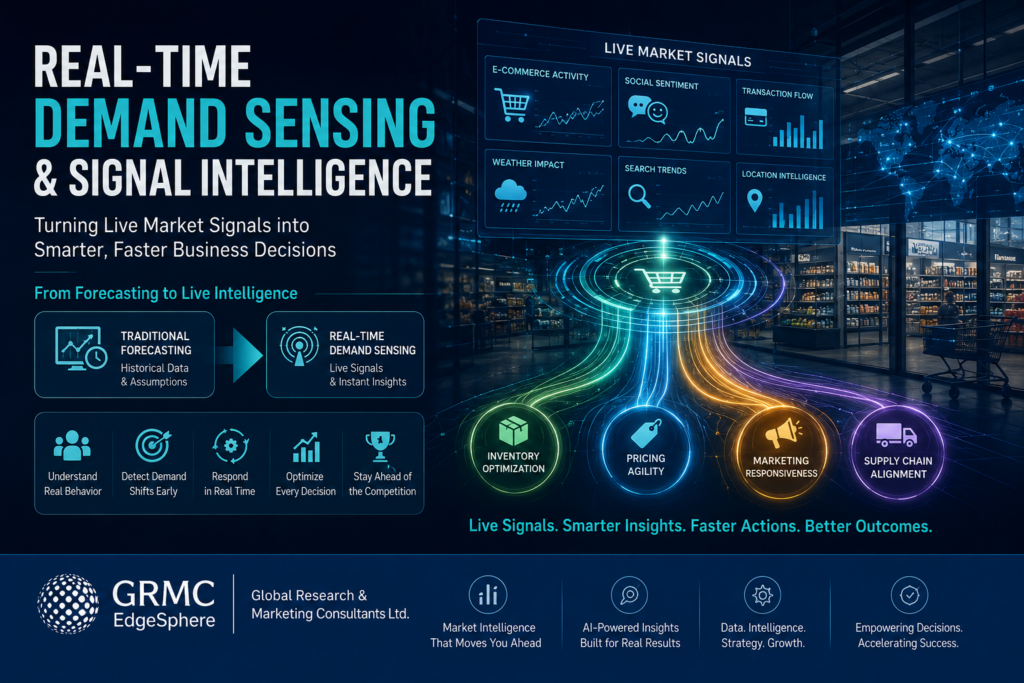
Modern enterprises are now integrating multiple live data streams, including:
- E-commerce browsing and purchase behavior
- Mobile app interaction patterns
- Social media sentiment and trend velocity
- Payment and transaction flows
- Logistics and inventory movement data
- External signals such as weather, inflation, and geopolitical events
Unlike traditional business intelligence, which focuses on historical reporting, demand sensing systems interpret live behavioral signals and convert them into immediate operational decisions.
Advanced AI models now allow enterprises to detect subtle demand shifts before they fully materialize in sales data. This enables a proactive approach to market responsiveness—especially critical in industries such as retail, FMCG, manufacturing, and digital commerce.
Organizations such as GRMC EdgeSphere are increasingly helping enterprises design intelligence architectures that bridge data collection, predictive modeling, and real-time execution layers.
⚠️ Key Challenges in Traditional Forecasting Systems
Despite technological progress, many organizations still rely heavily on outdated forecasting methods. This creates structural inefficiencies across the business.
📉 1. Lagging Data Dependencies
Forecasting models depend on historical sales and seasonal trends, which fail to capture sudden market disruptions or behavioral shifts.
📦 2. Supply Chain Rigidity
Fixed production and procurement cycles make it difficult to respond to unexpected demand fluctuations, leading to either overstocking or stockouts.
📊 3. Fragmented Data Ecosystems
Data is often siloed across departments—marketing, sales, logistics, and finance operate independently, limiting real-time decision alignment.
🧠 4. Limited Behavioral Visibility
Traditional models rarely account for psychological, cultural, or digital behavior patterns influencing demand.
⏳ 5. Slow Decision Cycles
Even when insights are available, organizational approval structures delay execution, reducing the value of real-time intelligence.
📡 Market Research Insights: The Rise of Signal Intelligence
The evolution of market intelligence is shifting from static analysis to continuous signal interpretation systems.
Key developments include:
📈 1. Multi-Signal Data Fusion
Enterprises now combine structured and unstructured data sources into unified intelligence systems that detect demand patterns across channels.
🤖 2. AI-Powered Demand Sensing Models
Machine learning algorithms identify micro-shifts in consumer behavior before they appear in traditional KPIs.
🌐 3. External Signal Integration
Weather patterns, geopolitical risks, social media trends, and economic indicators are now directly influencing demand forecasting models.
🔄 4. Closed-Loop Decision Systems
Instead of reporting insights, systems now trigger automated responses—adjusting pricing, inventory, and promotions in real time.
📍 5. Hyper-Local Demand Tracking
Organizations are moving from national-level forecasting to city-level and even store-level demand sensing for precision targeting.
🛠️ Practical Recommendations for Business Leaders
To transition from forecasting-driven operations to real-time demand sensing, organizations must redesign both their data infrastructure and decision culture.
⚙️ 1. Build a Unified Data Intelligence Layer
Integrate all internal and external data streams into a centralized intelligence system that supports real-time processing and analysis.
🧩 2. Eliminate Data Silos Across Departments
Ensure marketing, supply chain, finance, and sales operate within a shared intelligence framework rather than isolated reporting systems.
📊 3. Adopt AI-Driven Signal Monitoring Tools
Implement machine learning models that continuously track anomalies, trends, and behavioral shifts across customer segments.
⚡ 4. Shorten Decision Execution Cycles
Redesign approval hierarchies to allow faster response to live market signals, especially in pricing and inventory decisions.
🌍 5. Implement Localized Demand Strategy Models
Move away from national averages and adopt micro-market segmentation strategies for more precise demand responsiveness.
🏢 How GRMC Can Help
Modern enterprises require more than dashboards—they need intelligent systems that interpret signals and support real-time decisions.
GRMC EdgeSphere helps organizations design and implement advanced demand sensing and market intelligence frameworks that transform raw data into actionable strategy.
GRMC supports clients through:
- 📡 Real-Time Market Intelligence System Design
- 📊 Advanced Demand Sensing Framework Development
- 🤖 AI-Powered Business Intelligence Integration
- 📦 Supply Chain Intelligence Optimization
- 🌍 Hyper-Local Market Behavior Analysis
- ⚙️ Decision Automation & Operational Intelligence Systems
By combining AI, market research, and strategic consulting, GRMC enables organizations to move from reactive forecasting to proactive, intelligence-driven execution.
🎯 Conclusion
The future of enterprise planning is no longer built on prediction—it is built on perception.
Organizations that continue relying on static forecasting models will struggle to keep pace with dynamic market behavior. In contrast, enterprises adopting real-time demand sensing and signal intelligence systems will gain a decisive advantage in responsiveness, efficiency, and customer alignment.
In this new environment, success is defined not by how accurately a company predicts the future—but by how quickly it senses and responds to the present.
For organizations aiming to build this capability, partnering with intelligence-driven consultancies like GRMC EdgeSphere provides the strategic foundation required to operate in a real-time business world.