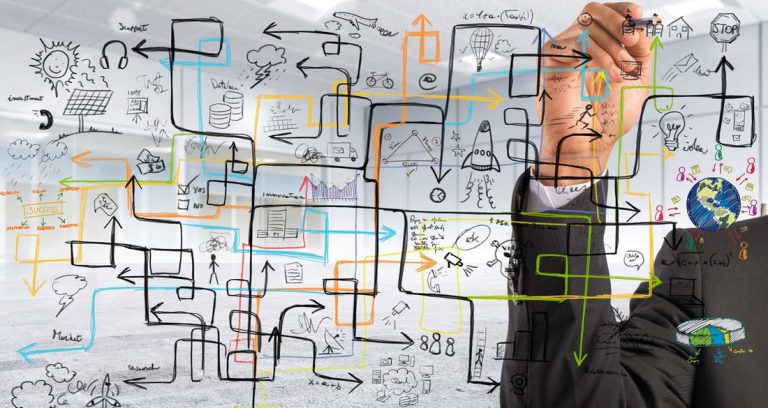

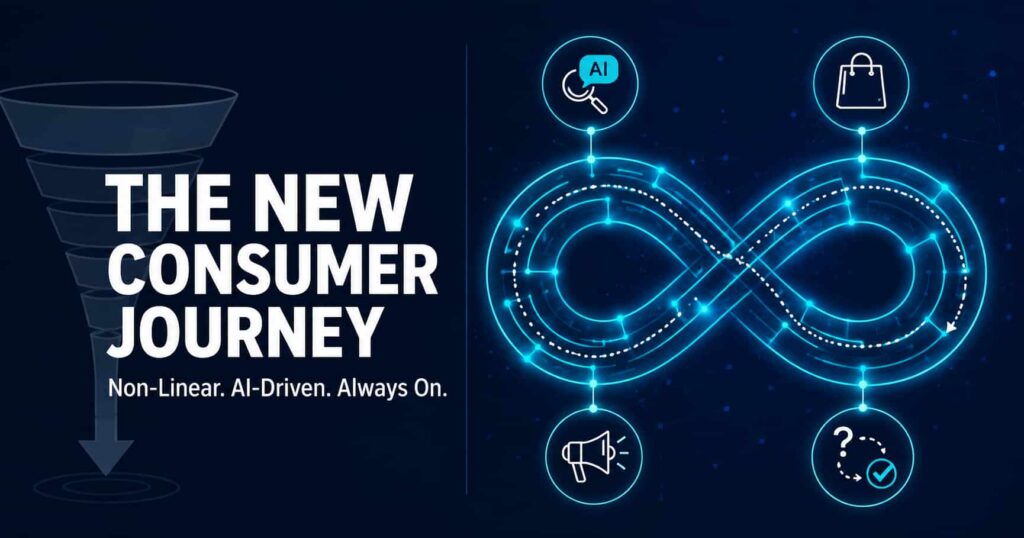
For decades, the marketing funnel was the undisputed blueprint for understanding consumers. It was a tidy, linear model that started with broad awareness and methodically narrowed down to a single purchase. The problem is that this model hasn’t accurately reflected reality for years. As Yu-kai Chou, a behavioral designer who has worked with companies like Microsoft and Coca-Cola, notes, “For a hundred years, marketers drew the same picture… The trouble is that real buyers stopped behaving like that, if they ever did at all” .
In 2009, McKinsey’s groundbreaking research on nearly 20,000 consumers across five industries officially buried the funnel, introducing the “Consumer Decision Journey” . This new model is not a line but a loop—a dynamic, nonlinear process where consumers add brands in the middle of their research and where the most critical marketing moment often happens after the sale .
For business leaders, CEOs, and decision-makers, clinging to the old funnel is a strategic risk. It leads to misallocated budgets, outdated measurement, and a failure to connect with the modern, tech-enabled consumer. This article explores why traditional market research is struggling to keep up and how a more sophisticated, insights-driven approach is essential for growth.
1. The Funnel is Dead: Why the Old Model Fails
The traditional purchase funnel is a brand’s-eye view of the world. It assumes brands are in control, “pushing” consumers down a predetermined path from awareness to purchase . The reality is starkly different. The modern consumer journey is a buyer’s-eye view where the customer is in control, often using information the brand never created and cannot see .
What traditional research misses:
- Non-Linear Paths: Consumers don’t just narrow their options. Research shows that during the active evaluation phase, they frequently add new brands to their consideration set based on friend recommendations, online reviews, or social media . A consumer might start considering three car models and end up buying a fifth option they discovered during their research. This widening of the funnel in the middle is a phenomenon that traditional “top-of-funnel” metrics completely fail to capture.
- The “Invisible Audience”: Upstream influencers, often not the final buyer, can disproportionately shape decisions . A child’s preference or a friend’s casual recommendation can insert a brand into a consideration set, making traditional attribution models nearly useless.
- AI as a Black Box: Generative AI is now a parallel discovery channel. A staggering 45% of global consumers now use AI during their buying journeys . When a consumer asks ChatGPT or Gemini for “the best laptop for video editing,” it synthesizes information from countless third-party sources. Traditional market research has no framework for measuring this “Answer Engine Influence” (AEI), which is becoming a primary source of consumer trust .
2. AI Compression and the “Dual Front Door”
The rise of AI isn’t just another touchpoint; it’s fundamentally altering the structure of the journey. The middle of the funnel, the traditional “consideration” phase, is rapidly collapsing . Why? Because AI has automated the research process.
The Implication for Brands:
This compression means purchases are increasingly driven by two extremes :
- Impulse Decisions: A single, hyper-relevant AI-generated recommendation or a compelling social commerce post can trigger an instant purchase. The decision is made in seconds.
- Instinctive Trust: For trusted brands, the journey is skipped entirely. The consumer is already in the “loyalty loop” and purchases without comparison.
What is diminishing is everything in between. There is little room for slow, nurturing, education-heavy content. As a result, marketing is no longer just for human shoppers; it must now serve two new audiences: AI-assisted consumers and autonomous AI agents (agentic commerce) . Each requires a different content strategy. Brand websites are currently cited in only 1% of the sources used by AI models, highlighting a massive blind spot for companies that have not optimized for AI-driven discovery .
3. The Data Gap: Beyond the Survey
Traditional market research is fundamentally too slow and too biased to capture the reality of this new journey. The core tools—surveys, focus groups, and in-depth interviews—are prone to significant blind spots .
- The Recall Problem: Asking a consumer to recall their decision-making process weeks after a purchase is unreliable. Their memory is a story, not data.
- Social Desirability Bias: People in focus groups often say what they think is expected, not what they actually did.
- Misleading Metrics: As one industry expert notes, 75% of today’s consumers follow disrupted, non-linear paths, yet many businesses obsess over metrics like “total brand awareness” or “future consideration.” Asking consumers who aren’t actively shopping to predict their future actions is “as insightful as polling toddlers on their preferred retirement plan” .
The shift is moving from Marketing Research (answering specific questions with static data) to Customer Insights (a living system of intelligence derived from real-time, observed behavior) . Companies must move beyond “post-campaign analysis” to “predictive simulation” .
4. Actionable Intelligence: A Roadmap for 2026 and Beyond
To thrive in this complex landscape, organizations must modernize their approach. Here is a practical roadmap for decision-makers.
1. Embrace AI for Research: Stop treating AI as a threat and start using it as a research tool.
- Simulate Decisions: Use AI to anticipate behavior and test creative decisions before committing budgets. The shift from hindsight to foresight is what reduces decision risk .
- Focus on Behavioral Data: First-party, observed behavioral data is your new competitive moat. Invest in systems that track real actions, not just stated intentions .
2. Optimize for the New Influencers:
- Invest in Generative Engine Optimization (GEO): Structure your website with clear, scannable content (FAQs, lists, technical documentation) to ensure AI tools return accurate, brand-consistent results .
- Diversify Discovery Channels: Allocate budgets beyond saturated platforms. Experiment with high-intent environments where detailed discussions happen, such as Reddit and specialized forums, alongside established social commerce .
3. Differentiate and Personalize the Journey:
- Strengthen Physical Retail: As AI dominates digital discovery, the physical store becomes a powerful differentiator. Turn your physical locations into community hubs and experiential spaces that create lasting emotional connections .
- Earn Trust Relentlessly: AI can handle the “what,” but trust comes from demonstrating brand capability (can you deliver?) and brand character (do you act with integrity?) . Consistency in delivering value is the only thing that can bypass an AI’s recommendation.
4. Rethink Your Metrics:
- Track the “Win Rate”: Instead of just measuring awareness, measure your “brand win rate” against competitors .
- Monitor Digital Reputation: Actively track what is being said about your brand across forums, blogs, and review sites, as this is the data AI is using to form its recommendations .
Conclusion
The new consumer decision journey is a reality. It is fragmented, tech-driven, and non-linear. Traditional market research, built for a simpler time, is failing to capture its complexity.
For business leaders, the message is clear: the companies that will win are those that stop trying to force consumers into a funnel and start investing in the intelligence to understand their dynamic, multi-channel journey. By moving from static reports to living insights, optimizing for AI, and focusing on building unshakeable trust, your organization can navigate this new terrain and create a sustainable competitive advantage.