

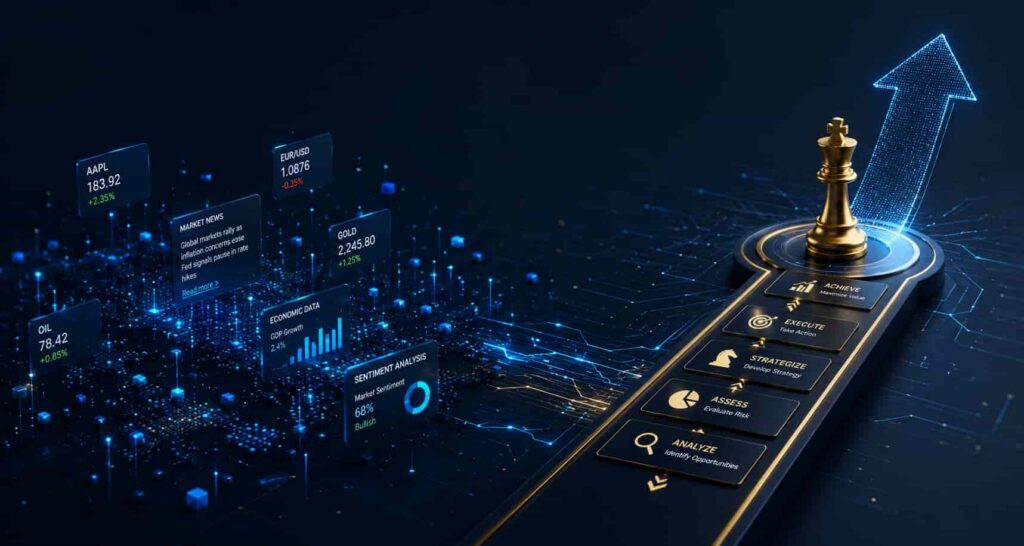
In today’s volatile business environment, the difference between market leadership and reactive scrambling often comes down to one capability: the ability to detect, interpret, and act on competitive signals before they become obvious to everyone else . Traditional competitor monitoring—quarterly reports, static battlecards, and lagging win-loss analysis—no longer provides the decision advantage that business leaders require. The pace of market change has accelerated to the point where periodic intelligence cycles have become strategic liabilities.
At GRMC EdgeSphere, we help organizations across the GCC, Caribbean, North America, LATAM, and Africa transform their approach to competitive intelligence. The shift is fundamental: from monitoring what competitors have done to interpreting what they are doing now and anticipating their next moves.
The Signal vs. Noise Challenge
The most common mistake organizations make is confusing data collection with intelligence. Today’s competitive landscape generates an overwhelming volume of information—pricing updates, job postings, partnership announcements, social media activity, regulatory filings, and earnings transcripts. Yet most organizations collect far more than they can meaningfully analyze .
The challenge isn’t access to information. The challenge is pattern recognition. A single competitor discounting a product line might be routine. But when that discounting appears across multiple accounts, combined with messaging shifts toward cost efficiency and hiring freezes in sales teams, it signals something strategic—likely internal pressure to protect short-term revenue .
Organizations achieving superior competitive intelligence outcomes share a common approach: they distinguish between meaningful signals and background noise by evaluating every piece of intelligence against defined business decisions . If information wouldn’t change a decision you’re about to make, it’s noise, not intelligence.
From Static Monitoring to Continuous Signal Detection
Periodic competitor analysis was designed for slower, more predictable market environments. Those conditions no longer exist. Competitors now adjust strategies continuously across multiple platforms simultaneously .
This shift demands a fundamental change in how organizations approach competitive intelligence. The most effective programs operate in two distinct modes :
Rapid response mode addresses urgent questions where speed is the priority. Secondary and primary research happen in parallel. Analysis and delivery are compressed. The goal is getting the right answer to the right person within the decision window.
Strategic analysis mode focuses on high-stakes, forward-looking questions. This involves systematic secondary research, primary research where warranted, rigorous analysis, and co-created delivery with decision-makers.
The practical shift requires intentional design. Map your known decision windows—board preparation cycles, quarterly business reviews, budget planning, product roadmap reviews, annual strategy processes. Build monitoring and analytical cadence around these windows proactively . The goal is arriving at every major decision moment with context already built.
What Real-Time Competitive Signals Look Like in Practice
Real-time competitive signals are observable shifts in competitor behavior that affect live deals. They are not rumors, not one-off comments from prospects, and not long-term trend reports. They are patterns showing how a competitor is operating right now .
These signals manifest in three categories:
Market-level signals appear in public moves: pricing updates, packaging changes, new positioning on websites, hiring freezes in sales, or increased hiring in customer success. Each move signals priority and resource allocation.
Deal-level signals emerge inside active opportunities: a competitor discounting earlier than usual, pushing multi-year contracts harder, or procurement suddenly focusing on new issues because a competitor has framed them differently.
Behavioral signals reflect how competitors act across accounts: sales teams targeting your installed base, marketing campaigns focusing on migration offers, or customer churn stories increasing on review sites.
On their own, these signals look small. Together, they reveal strategic intent. Organizations that systematically track and interpret these signals consistently reduce surprises and shift from reactive to proactive competitive positioning .
The Competitive Intelligence Maturity Gap
Despite significant investment in intelligence functions, most organizations remain stuck at an intermediate maturity level. According to recent benchmarking, 63% of intelligence teams have structured processes and monitoring workflows but remain loosely connected to business processes—delivering intelligence after decisions have already been made and struggling to demonstrate value to leadership .
The gap between intermediate and world-class intelligence programs isn’t about doing more of the same things better. It requires building differently across six key dimensions:
Focus: Owning the intelligence agenda rather than responding to whoever shouts loudest. This requires mapping top intelligence consumers to their highest-stakes decisions and prioritizing accordingly .
Process: Operating in both rapid response and strategic analysis modes, with clear protocols for when and how to deploy each.
Deliverables: Shifting the product mix from market signals and competitor profiles toward analysis reports, briefings with actionable recommendations, and strategic workshops where intelligence and decision-makers co-create implications .
Organization: Positioning intelligence where strategy is made. While many leaders can’t restructure immediately, they can build influence by identifying senior leaders making high-stakes decisions and formally participating in their planning rhythms .
Tools: Focusing on analytical capacity rather than more data. More subscriptions and monitoring rarely solve the interpretation challenge.
Culture: Building the expectation that decisions are informed by intelligence, not just supported by it afterward.
Building a Signal-Driven Intelligence System
Creating a real-time competitive signal system requires structure, not complex technology. Organizations already see the signals—they just don’t capture or interpret them consistently .
Step 1: Define what counts as a signal. Not every data point matters. Limit categories to meaningful movements: pricing or discounting changes, packaging or contract structure shifts, messaging pivots, target segment changes, hiring trends in sales/product/customer success, and recurring objections in late-stage deals.
Step 2: Establish a weekly signal review. Signals decay quickly. A simple thirty-minute weekly review involving sales, product, and intelligence teams asking three questions: What changed this week? Where are we seeing repeated patterns? What might this mean? The goal isn’t reporting—it’s interpretation .
Step 3: Turn observations into hypotheses. A signal without interpretation is just data. If a competitor discounts earlier than usual, ask why: cash pressure, growth targets, strategic land-and-expand, new funding, defensive move? Form a working hypothesis and test it in the next deal .
Step 4: Push insight back into live deals. Intelligence that stays in slide decks has no impact. Translate signal insights into short updates for the field: adjust battlecards, share weekly signal summaries, flag high-risk accounts, update positioning guidance .
The objective is simple: notice change early, interpret it quickly, and act before it becomes obvious to everyone else.
How GRMC EdgeSphere Transforms Competitive Intelligence
GRMC EdgeSphere brings deep expertise in competitive and industry analysis, business intelligence, and strategic consulting to help organizations build intelligence systems that shape decisions rather than simply report on competitor activity. Our approach integrates proprietary analytics, primary research methodologies, and continuous monitoring frameworks tailored to client-specific decision contexts .
Our competitive intelligence practice is built on the principle that intelligence creates value only when it changes decisions. This means understanding not just what competitors are doing, but why, and what that signals about future moves. We help organizations across industries establish the focus, process, and deliverables that shift intelligence from monitoring function to strategic advisor.
The Strategic Advantage of Early Signal Detection
Organizations that effectively detect and interpret competitive signals gain a decisive advantage. When competitors adjust pricing, positioning, or deal tactics, the impact shows up quickly. The only question is how quickly you see it .
In stable conditions, a strong strategy carries you far. The environment doesn’t shift enough to punish slow feedback loops. In volatile conditions, timing becomes a strategic advantage. The organizations that win are not necessarily those with better products or bigger budgets. They are the ones that detect change earlier and adjust faster.
Real-time competitive signals make this possible. They don’t guarantee wins—they reduce blind spots. And in uncertain markets, that alone shifts the odds.
Actionable Steps for Leaders
- Audit your current intelligence cycle. Determine whether you are operating on weekly or quarterly rhythms, and whether your intelligence arrives before or after key decisions are made.
- Map your decision windows. Identify the moments when you most need current competitive context—budget cycles, board preparations, product roadmaps, major deal reviews.
- Define your signal categories. Agree as a leadership team on what changes actually matter to strategic decisions, then filter intelligence accordingly.
- Build a weekly review cadence. Thirty minutes of focused interpretation across sales, product, and intelligence teams consistently outperforms quarterly reporting.
- Connect intelligence to action. For every competitive insight, ask what decision it changes. If the answer is unclear, it may not be intelligence—just information.
GRMC EdgeSphere is an international market research, strategic consulting, and business intelligence firm serving clients across the GCC, Caribbean, North America, LATAM, Africa, and international markets. We help organizations transform competitive intelligence from monitoring function to strategic decision advantage.