

One of the most common reasons businesses struggle to achieve sustainable growth is attempting to serve everyone with the same products, services, and marketing strategies. In today’s highly competitive marketplace, customers have diverse needs, purchasing behaviors, expectations, and decision-making processes. Organizations that fail to recognize these differences often experience lower conversion rates, ineffective marketing campaigns, declining customer loyalty, and missed revenue opportunities.
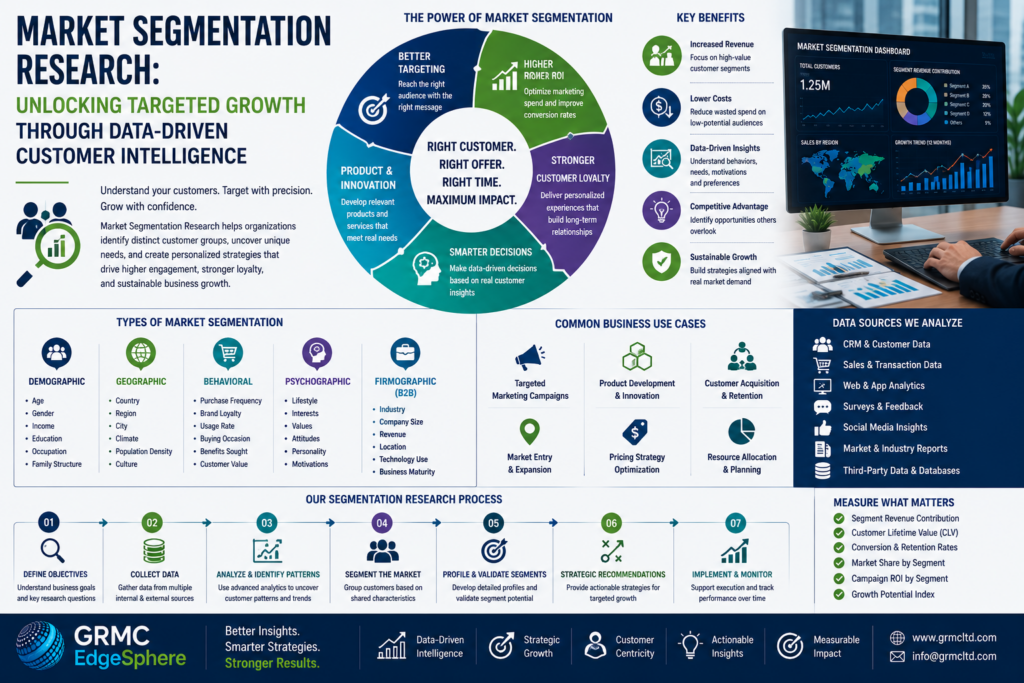
Market Segmentation Research enables organizations to divide broad markets into clearly defined customer groups based on shared characteristics, behaviors, needs, or purchasing patterns. Rather than treating the market as a single audience, businesses can develop tailored products, personalized customer experiences, and more effective go-to-market strategies.
For executives, investors, government organizations, and enterprise leaders, segmentation research provides the intelligence required to allocate resources efficiently, improve customer acquisition, strengthen competitive positioning, and maximize long-term profitability.
Industry Overview
Digital transformation, globalization, and changing customer expectations have fundamentally altered how organizations approach market growth.
Customers now expect personalized experiences across every interaction. At the same time, organizations have access to more customer data than ever before through CRM systems, e-commerce platforms, mobile applications, loyalty programs, social media, and business intelligence tools.
This abundance of information has shifted business strategy from mass marketing to precision targeting.
Market Segmentation Research has become essential across industries, including:
- Financial Services
- Healthcare
- Manufacturing
- Retail and E-commerce
- Telecommunications
- Education
- Government Services
- Hospitality and Tourism
- Information Technology
- Logistics and Transportation
- Professional Services
Whether launching a new product, entering a foreign market, or improving customer retention, organizations increasingly rely on segmentation insights to guide strategic decisions.
Key Challenges Organizations Face
Treating All Customers the Same
Customers differ significantly in demographics, purchasing power, motivations, and expectations.
Uniform marketing and sales strategies often fail to resonate with diverse audiences, resulting in lower engagement and weaker business performance.
Inefficient Marketing Investments
Without clearly defined customer segments, organizations frequently spend marketing budgets on audiences that are unlikely to convert.
This reduces campaign effectiveness and increases customer acquisition costs.
Weak Product-Market Fit
Products and services designed without understanding customer differences may satisfy only a small portion of the market.
Segmentation research helps organizations align offerings with the needs of specific customer groups.
Limited Customer Retention
Different customer segments leave for different reasons.
Understanding segment-specific expectations enables organizations to improve retention strategies and strengthen long-term relationships.
Difficulty Expanding into New Markets
Organizations entering new industries or geographic regions often assume customer behavior is similar across markets.
Segmentation research identifies local preferences, cultural differences, and purchasing behaviors that influence market success.
Market Research Insights
Leading organizations treat segmentation as an ongoing strategic capability rather than a one-time research exercise.
Demographic Segmentation
Demographic segmentation groups customers based on measurable characteristics such as:
- Age
- Gender
- Income
- Occupation
- Education
- Family Structure
These insights help organizations tailor products, pricing, and communication strategies to specific audiences.
Geographic Segmentation
Customer preferences often vary across countries, regions, cities, and even neighborhoods.
Geographic segmentation supports:
- International expansion
- Regional product adaptation
- Distribution planning
- Location-based marketing
- Territory management
This approach is particularly valuable for multinational organizations and public-sector initiatives.
Behavioral Segmentation
Behavioral segmentation focuses on how customers interact with products and services.
Key variables include:
- Purchasing frequency
- Brand loyalty
- Product usage
- Buying occasions
- Customer lifetime value
- Digital engagement
Behavioral insights enable organizations to design highly targeted marketing campaigns and loyalty programs.
Psychographic Segmentation
Psychographic research examines customer lifestyles, attitudes, values, interests, and motivations.
Understanding why customers make purchasing decisions often provides greater strategic value than knowing who they are.
Organizations use these insights to strengthen brand positioning and create more meaningful customer relationships.
Firmographic Segmentation (B2B)
For business-to-business markets, segmentation typically considers:
- Industry
- Organization size
- Revenue
- Geographic presence
- Technology adoption
- Procurement processes
- Business maturity
Firmographic analysis helps organizations prioritize high-value business opportunities and improve account-based marketing strategies.
Practical Recommendations
Organizations seeking sustainable growth should integrate market segmentation into strategic planning and decision-making.
Build Data-Driven Customer Profiles
Combine customer surveys, CRM data, transaction records, website analytics, and market research to develop comprehensive customer profiles.
Accurate profiles provide the foundation for effective segmentation.
Prioritize High-Value Segments
Not every customer group offers the same growth potential.
Evaluate segments based on profitability, growth prospects, strategic alignment, and competitive intensity before allocating resources.
Personalize Customer Experiences
Use segmentation insights to tailor:
- Marketing messages
- Product recommendations
- Pricing strategies
- Customer support
- Digital experiences
- Loyalty programs
Personalization strengthens engagement and improves customer satisfaction.
Align Products with Customer Needs
Segment-specific research should guide product development and service innovation.
Organizations that solve the unique challenges of each customer group are more likely to achieve strong product-market fit.
Continuously Update Segmentation Models
Customer behavior evolves due to economic conditions, technological innovation, demographic shifts, and changing expectations.
Regularly reviewing segmentation models ensures that business strategies remain relevant and effective.
How GRMC EdgeSphere Can Help
GRMC EdgeSphere provides comprehensive Market Segmentation Research services that help organizations better understand their customers, identify high-value opportunities, and make informed strategic decisions.
Our consultants combine market research, advanced analytics, business intelligence, and industry expertise to develop segmentation frameworks that support measurable business outcomes.
Our Market Segmentation Services Include
Customer Segmentation Research
Identify and profile distinct customer groups based on demographics, behaviors, needs, and purchasing patterns.
B2B Market Segmentation
Develop firmographic segmentation models that support account prioritization, sales planning, and enterprise growth strategies.
Consumer Behavior Analysis
Understand customer motivations, buying journeys, decision-making processes, and loyalty drivers.
Geographic Market Analysis
Assess regional market opportunities, customer preferences, and location-specific demand to support expansion initiatives.
Market Potential Assessment
Evaluate the size, profitability, and growth prospects of individual market segments to guide investment decisions.
Customer Persona Development
Create evidence-based customer personas that support product design, marketing, and customer experience initiatives.
Strategic Growth Consulting
Transform segmentation insights into actionable strategies for market entry, product development, customer acquisition, and long-term business growth.
GRMC EdgeSphere works with enterprises, government organizations, startups, investors, financial institutions, healthcare providers, manufacturers, and technology companies to deliver segmentation research that enables smarter, more targeted business decisions.
Conclusion
Understanding the market begins with understanding the people and organizations within it. Market Segmentation Research enables businesses to move beyond broad assumptions and develop strategies tailored to the specific needs of their most valuable customer groups.
Organizations that embrace segmentation are better positioned to improve marketing effectiveness, strengthen customer relationships, optimize product development, and allocate resources where they generate the greatest return.
As markets become more competitive and customer expectations continue to evolve, segmentation research provides a strategic advantage that supports sustainable growth, innovation, and long-term success.
At GRMC EdgeSphere, we help organizations transform customer data into meaningful market intelligence, empowering leaders to make informed decisions, identify high-value opportunities, and build strategies that deliver measurable business results.