

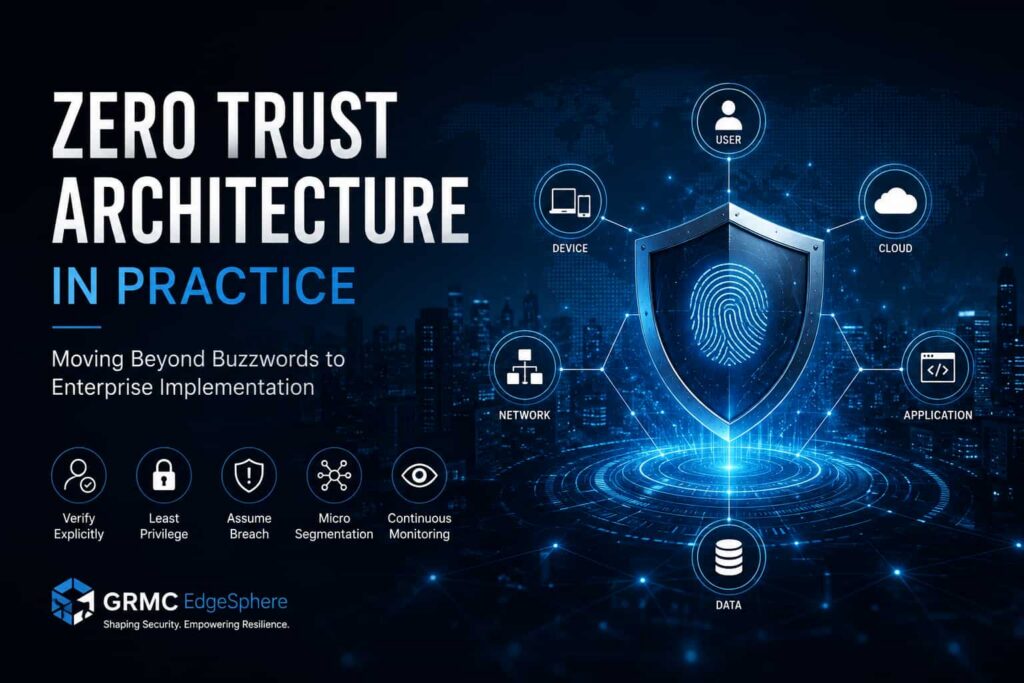
In today’s threat landscape, perimeter-based security models are no longer sufficient. Modern enterprises operate in hybrid environments—spanning cloud, on-premises infrastructure, SaaS applications, remote workforces, and third-party integrations. This expanded attack surface demands a fundamental shift in security philosophy.
Zero Trust Architecture (ZTA) is often discussed in strategic cybersecurity conversations, but many organizations still struggle to move from conceptual adoption to operational implementation. This article breaks down how enterprises can practically implement Zero Trust beyond buzzwords, aligning it with business risk, governance, and established security frameworks.
Why Traditional Security Models Are Failing
Legacy security architectures were built on a simple assumption:
“Trust everything inside the network, and distrust everything outside.”
This assumption no longer holds.
Today’s enterprise reality includes:
- Remote and hybrid employees accessing systems from unmanaged networks
- Cloud workloads distributed across multiple providers
- API-driven ecosystems connecting internal and external systems
- Third-party vendors with privileged access
- Persistent ransomware and credential-based attacks
Once an attacker gains initial access, lateral movement inside flat or weakly segmented networks becomes straightforward. This is why modern breaches are rarely “front-door attacks”—they are identity and privilege exploitation events.
Zero Trust: A Business Risk Model, Not Just a Security Framework
Zero Trust is often misunderstood as a product or a network design. In reality, it is a risk-based security model centered on one principle:
Never trust, always verify—explicitly and continuously.
From an enterprise perspective, Zero Trust is about:
- Reducing breach impact
- Controlling identity-driven risk
- Enforcing least privilege access
- Increasing visibility across all assets and users
Zero Trust aligns strongly with major cybersecurity frameworks, including:
- NIST Cybersecurity Framework
- ISO/IEC 27001
- CIS Critical Security Controls
- Zero Trust Architecture
These frameworks consistently emphasize identity governance, access control, continuous monitoring, and risk-based decision-making.
Core Pillars of Zero Trust Implementation
A practical Zero Trust strategy is built on five interdependent pillars:
1. Identity-Centric Security
Identity becomes the new perimeter.
Enterprises must enforce:
- Strong authentication (MFA / passwordless)
- Identity governance and lifecycle management
- Privileged Access Management (PAM)
- Continuous identity risk scoring
The goal is simple: no identity should be implicitly trusted at any time.
2. Least Privilege Access Enforcement
Users and systems should only have the minimum access required to perform their functions.
Key practices include:
- Role-Based Access Control (RBAC)
- Just-In-Time (JIT) access provisioning
- Time-bound administrative privileges
- Micro-segmentation of access pathways
This significantly limits lateral movement during a breach.
3. Micro-Segmentation of Networks and Workloads
Traditional flat networks allow attackers to move freely once inside.
Micro-segmentation introduces controlled boundaries between:
- Applications
- Workloads
- Databases
- Cloud environments
- Internal services
This ensures that compromise of one system does not automatically lead to enterprise-wide exposure.
4. Continuous Monitoring and Analytics
Zero Trust is not static—it is continuously enforced.
Organizations should implement:
- Security Information and Event Management (SIEM)
- User and Entity Behavior Analytics (UEBA)
- Security Operations Center (SOC) monitoring
A mature Security Operations Center enables real-time detection of anomalous behavior and rapid containment.
5. Data-Centric Security Controls
Data must remain protected regardless of where it resides.
This includes:
- Encryption at rest and in transit
- Data Loss Prevention (DLP)
- Tokenization and classification
- Access logging and audit trails
Ultimately, data security becomes independent of network location.
Mapping Zero Trust to Enterprise Risk Management
Zero Trust should not be treated as an isolated IT initiative—it must align with enterprise risk objectives.
From a CISO and executive perspective, Zero Trust directly supports:
- Reduction in cyber risk exposure
- Improved regulatory compliance posture
- Faster incident response and containment
- Lower financial impact of breaches
- Enhanced audit readiness
When mapped to enterprise governance, Zero Trust becomes a measurable risk reduction strategy rather than a technical upgrade.
Common Implementation Challenges
Despite strong theoretical alignment, enterprises often face practical barriers:
1. Legacy Infrastructure Constraints
Older systems may not support modern identity or segmentation controls.
2. Organizational Silos
Security, network, and application teams often operate independently, slowing adoption.
3. Complexity of Hybrid Environments
Multiple cloud providers and SaaS platforms complicate policy consistency.
4. Skills and Operational Gaps
Zero Trust requires expertise in identity, cloud security, automation, and analytics.
A Phased Implementation Approach
Enterprises should avoid “big bang” Zero Trust transformations. Instead, adopt a phased roadmap:
Phase 1: Identity Foundation
- Implement MFA across all users
- Centralize identity provider
- Establish PAM for critical accounts
Phase 2: Visibility and Monitoring
- Deploy SIEM and SOC capabilities
- Establish baseline behavior analytics
- Inventory all assets and access paths
Phase 3: Access Control Modernization
- Introduce RBAC and JIT access
- Remove standing privileges
- Enforce conditional access policies
Phase 4: Network and Application Segmentation
- Micro-segment critical workloads
- Isolate high-value assets
- Secure API communication channels
Phase 5: Continuous Optimization
- Automate policy enforcement
- Integrate threat intelligence
- Continuously refine risk scoring models
Executive Takeaway
Zero Trust is not a technology product—it is an enterprise-wide security operating model. Organizations that treat it as a compliance exercise will fail to realize its full value. Those that embed it into identity governance, risk management, and operational security will significantly reduce breach impact and improve resilience.
In a threat environment defined by identity compromise and cloud complexity, Zero Trust is no longer optional—it is foundational.