✨ Introduction
In today’s highly competitive and data-driven business environment, making decisions based solely on historical reports is no longer sufficient. Organizations must anticipate future outcomes, identify emerging risks, and uncover growth opportunities before competitors do.
This is where Predictive Analytics is creating significant business value.
By combining artificial intelligence (AI), machine learning (ML), advanced statistical modeling, and enterprise data, predictive analytics enables organizations to forecast future events with greater accuracy and confidence.
From predicting customer behavior and market demand to identifying operational risks and optimizing resource allocation, predictive analytics is helping enterprises move from reactive decision-making to proactive business management.
For CEOs, CIOs, CTOs, and transformation leaders, predictive analytics is not simply a reporting tool—it is a strategic capability that drives efficiency, profitability, resilience, and long-term competitive advantage.
At GRMC EdgeSphere, we help organizations leverage predictive analytics solutions that transform enterprise data into actionable business intelligence and measurable ROI.
GRMC EdgeSphere Official Website
⚠️ Business Challenge
Modern organizations generate massive amounts of data from operations, customers, supply chains, financial systems, and digital platforms.
However, many businesses still struggle with:
1. Reactive Decision-Making
Decisions are often based on past events rather than future projections.
2. Unpredictable Market Conditions
Rapid shifts in customer demand, economic conditions, and competitive pressures create uncertainty.
3. Resource Allocation Inefficiencies
Organizations frequently overinvest or underinvest due to inaccurate forecasting.
4. Customer Churn Risks
Many businesses identify customer dissatisfaction only after losing valuable customers.
5. Supply Chain Disruptions
Unexpected shortages, delays, and logistics challenges can impact operations and profitability.
6. Financial Planning Challenges
Inaccurate forecasts often lead to budgeting errors and revenue shortfalls.
Without predictive capabilities, organizations remain vulnerable to risks and miss opportunities for growth.
🧠 Technology Overview
Predictive analytics combines multiple technologies to generate accurate forecasts and recommendations.
1. Machine Learning Algorithms
Analyze historical data and identify patterns that humans may overlook.
2. Artificial Intelligence
Processes large datasets and continuously improves forecasting accuracy.
3. Statistical Modeling
Applies mathematical methods to estimate future outcomes and probabilities.
4. Data Integration Platforms
Combine information from ERP, CRM, finance, supply chain, and operational systems.
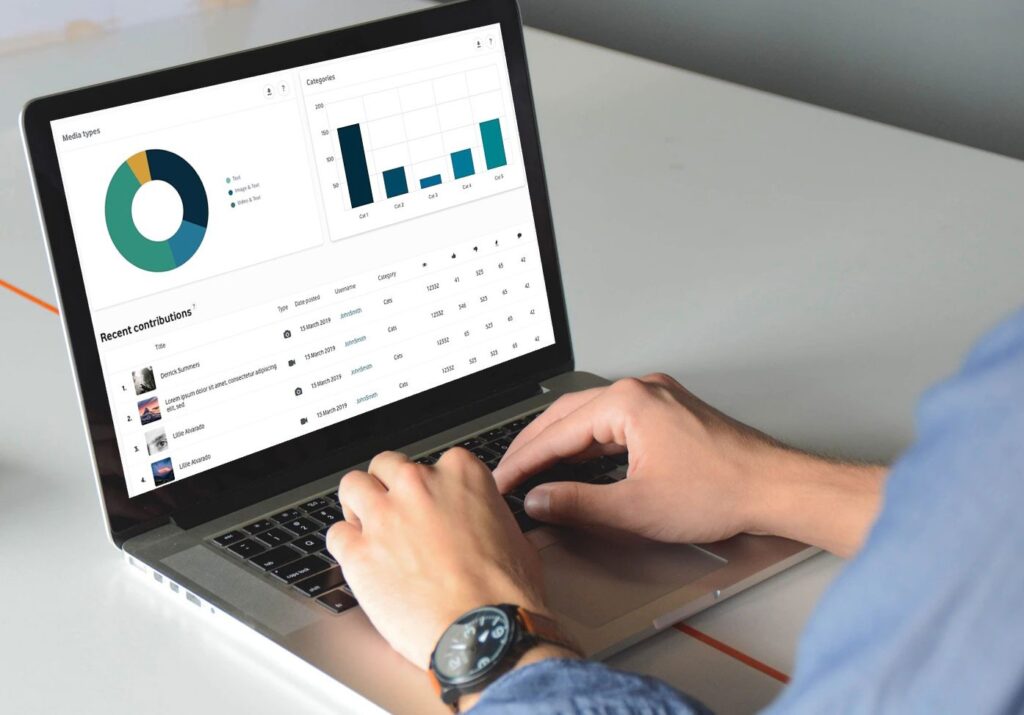
5. Business Intelligence Dashboards
Present predictive insights through visual reports and real-time monitoring tools.
6. Real-Time Analytics
Enable organizations to make immediate adjustments based on emerging trends.
Together, these technologies allow organizations to forecast future scenarios and make more informed decisions.
📈 Benefits and ROI
Predictive analytics delivers value across every major business function.
1. Improved Decision-Making
Leadership teams gain data-driven insights that support strategic planning and operational execution.
2. Increased Revenue
Organizations can identify growth opportunities, optimize pricing strategies, and improve sales forecasting.
3. Reduced Operational Costs
Forecasting enables more efficient inventory management, staffing, and resource utilization.
4. Enhanced Risk Management
Potential threats can be identified before they become major business issues.
5. Better Customer Retention
Predictive models help detect churn risks and improve customer engagement strategies.
6. Faster Business Agility
Organizations can respond quickly to market changes and emerging trends.
ROI Benchmarks
Enterprises implementing predictive analytics commonly achieve:
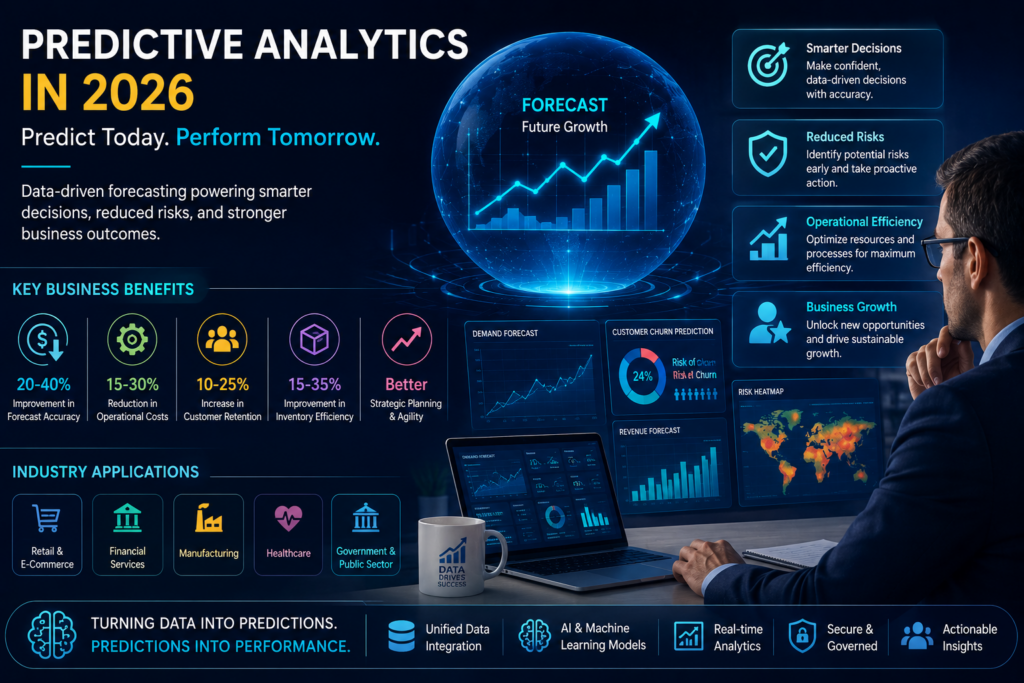
- 20–40% improvement in forecast accuracy
- 15–30% reduction in operational waste
- 10–25% increase in customer retention
- 15–35% improvement in inventory efficiency
- Significant improvements in strategic planning effectiveness
The greatest value comes from enabling organizations to act proactively rather than reactively.
🏢 Real-World Applications
1. Retail & E-Commerce
Predictive analytics helps retailers:
- Forecast product demand
- Optimize inventory levels
- Personalize customer offers
- Improve pricing strategies
Result: Reduced stock shortages and increased sales performance.
2. Financial Services
Banks and financial institutions use predictive analytics to:
- Assess credit risk
- Detect fraud patterns
- Forecast investment performance
- Improve customer targeting
Result: Better risk control and higher profitability.
3. Manufacturing
Manufacturers leverage predictive models for:
- Equipment maintenance forecasting
- Production planning
- Supply chain optimization
- Quality control improvements
Result: Reduced downtime and higher operational efficiency.
4. Healthcare
Healthcare organizations use predictive analytics to:
- Forecast patient demand
- Improve resource planning
- Predict treatment outcomes
- Reduce operational bottlenecks
Result: Better patient experiences and improved resource utilization.
5. Government & Public Sector
Public-sector organizations apply predictive analytics to:
- Resource allocation planning
- Fraud detection
- Infrastructure maintenance forecasting
- Public service optimization
Result: Improved service delivery and reduced operational costs.
🛣️ Implementation Roadmap
Successful predictive analytics adoption requires a structured approach.
Phase 1: Business Objective Definition
- Identify key business challenges
- Define measurable KPIs
- Prioritize high-value use cases
Phase 2: Data Assessment
- Evaluate data quality
- Identify data sources
- Establish governance standards
Phase 3: Technology Selection
- Choose analytics platforms
- Select AI and machine learning tools
- Design integration architecture
Phase 4: Model Development
- Build predictive models
- Train algorithms using historical data
- Validate forecasting accuracy
Phase 5: Deployment
- Integrate models into business workflows
- Deploy dashboards and reporting systems
- Train users and stakeholders
Phase 6: Continuous Improvement
- Monitor model performance
- Retrain algorithms regularly
- Expand predictive capabilities across departments
This phased approach helps organizations maximize adoption success while minimizing implementation risks.
🤝 How GRMC Can Help
Many organizations possess valuable data but struggle to convert it into actionable intelligence.
GRMC EdgeSphere helps enterprises unlock the full value of predictive analytics through end-to-end consulting, implementation, and optimization services.
1. Predictive Analytics Strategy Development
We identify high-impact opportunities and create data-driven transformation roadmaps.
2. Data Architecture & Integration
We unify enterprise data sources to establish a reliable analytics foundation.
3. AI & Machine Learning Solutions
We develop predictive models tailored to specific industry and business requirements.
4. Business Intelligence Platforms
We create executive dashboards that transform complex data into actionable insights.
5. Enterprise Analytics Governance
We implement governance frameworks that ensure security, compliance, and data quality.
Our focus is not on technology for technology’s sake—we deliver predictive analytics solutions that generate measurable business outcomes.
Learn more: GRMC EdgeSphere Official Website
🎯 Conclusion
In 2026, predictive analytics has become a strategic necessity for organizations seeking growth, efficiency, and resilience.
Businesses can no longer afford to rely solely on historical reporting when AI-powered forecasting capabilities can provide visibility into future opportunities and risks.
By leveraging predictive analytics, enterprises can optimize operations, improve customer experiences, strengthen risk management, and make faster, more confident decisions.
Organizations that embrace predictive intelligence today will be better positioned to navigate uncertainty, outperform competitors, and achieve sustainable growth tomorrow.
GRMC EdgeSphere remains committed to helping organizations transform data into strategic advantage through practical, scalable, and ROI-driven analytics solutions.