

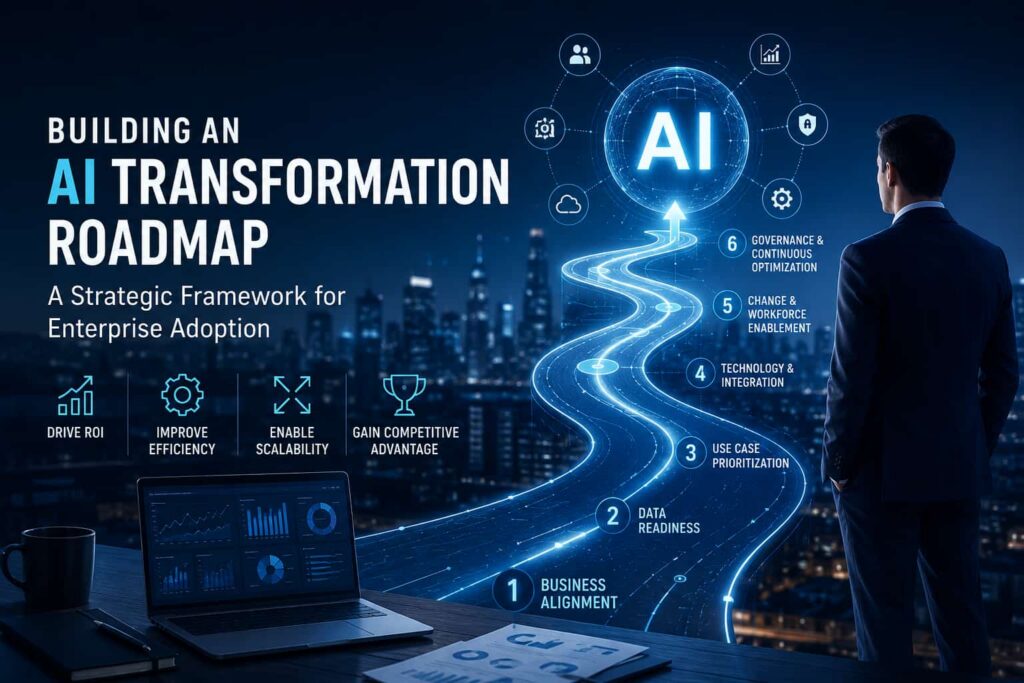
Introduction: Why AI Transformation Requires a Roadmap, Not Experimentation
Artificial Intelligence (AI) and automation are no longer experimental technologies reserved for innovation labs. They are now core enterprise capabilities influencing operational efficiency, customer experience, cost structure, and long-term competitiveness.
However, many organizations still approach AI in a fragmented way—running isolated pilots, adopting tools without integration, and expecting immediate ROI without strategic alignment.
The result is predictable: low adoption, poor scalability, and limited business impact.
A successful AI journey requires a structured AI Transformation Roadmap—a strategic framework that connects technology investments directly to measurable business outcomes.
What Is an AI Transformation Roadmap?
An AI Transformation Roadmap is a structured enterprise framework that defines how an organization will adopt AI and automation in alignment with business goals, operational priorities, and governance requirements.
It is not a technical document—it is a business transformation strategy that integrates:
- Business objectives (growth, cost reduction, efficiency)
- Process optimization opportunities
- Data readiness and infrastructure maturity
- AI/automation use case prioritization
- Governance, risk, and compliance frameworks
- Change management and workforce adaptation
The Business Case: Why Enterprises Need Structured AI Adoption
Organizations that adopt AI without a roadmap often face:
- Redundant technology investments
- Poor data integration across systems
- Limited ROI visibility
- Resistance from employees
- Scalability challenges
In contrast, enterprises with a structured roadmap typically achieve:
- 20–40% operational efficiency improvements in targeted functions
- Reduced process cycle times through automation
- Improved decision-making speed via predictive analytics
- Lower operational costs through intelligent process redesign
- Faster innovation cycles and product delivery
The difference is not the technology—it is the strategy behind adoption.
Strategic Framework for AI Transformation
A robust enterprise AI roadmap consists of six key phases:
1. Business Alignment and Value Definition
AI transformation must begin with business clarity, not technology selection.
Key questions include:
- Which business processes are cost-heavy or inefficient?
- Where do delays or manual dependencies exist?
- What decisions require better data intelligence?
- Which customer experiences need improvement?
At this stage, organizations define measurable KPIs such as:
- Cost per transaction reduction
- Customer response time improvement
- Revenue uplift from personalization
- Operational throughput increase
This ensures AI initiatives are directly tied to ROI.
2. Data Readiness and Infrastructure Assessment
AI is only as strong as the data foundation supporting it.
Enterprises must evaluate:
- Data quality and consistency
- Data silos across departments
- Integration between ERP, CRM, and legacy systems
- Cloud readiness and scalability
- Real-time data availability
A common enterprise gap is not lack of data—but lack of usable, structured, and accessible data.
Without addressing this, AI initiatives remain limited in scope and impact.
3. Use Case Identification and Prioritization
Not all AI use cases deliver equal business value. A structured roadmap prioritizes based on:
- ROI potential
- Implementation complexity
- Data availability
- Time to value
High-impact enterprise use cases include:
- Intelligent customer service automation (chatbots, AI agents)
- Predictive maintenance in manufacturing
- Fraud detection in financial systems
- Demand forecasting in supply chain
- HR automation for recruitment and onboarding
A prioritization matrix ensures quick wins while building long-term capability.
4. Technology Architecture and Integration Strategy
This phase defines how AI will integrate into the enterprise ecosystem.
Key considerations include:
- Cloud vs on-prem AI deployment
- API-driven integration strategy
- Automation platforms (RPA + AI fusion)
- Data pipelines and real-time analytics systems
- Security and compliance architecture
The goal is not just deployment—but scalable integration across the enterprise landscape.
5. Change Management and Workforce Enablement
One of the most overlooked aspects of AI transformation is people.
Successful adoption requires:
- Workforce upskilling programs
- Redesign of job roles and responsibilities
- AI literacy across departments
- Leadership alignment and communication strategy
- Resistance management and cultural adaptation
AI does not replace organizations—it transforms how they operate. Without structured change management, adoption fails regardless of technology quality.
6. Governance, Risk, and Continuous Optimization
AI systems must be governed to ensure ethical, secure, and compliant usage.
Governance frameworks should address:
- Data privacy and regulatory compliance
- Model transparency and explainability
- Bias detection and mitigation
- Performance monitoring and retraining cycles
Additionally, AI transformation is not a one-time project. It requires continuous optimization based on:
- Performance metrics
- Business feedback loops
- Market changes
- Technology advancements
Enterprise Example: AI in Customer Service Operations
Consider a large enterprise with high customer service volume.
Before AI Transformation:
- High call center dependency
- Long response times
- Repetitive manual queries
- High operational cost
After AI Roadmap Implementation:
- AI-powered virtual assistants handle 60–70% of queries
- Human agents focus on complex cases
- Integrated CRM provides real-time customer insights
- Predictive systems anticipate customer issues before escalation
Business Impact:
- Reduced service cost per ticket
- Improved customer satisfaction scores
- Faster resolution times
- Scalable customer support without proportional staffing increases
This is the difference a structured roadmap creates—measurable and scalable business value.
ROI-Driven AI Adoption: What Enterprises Should Measure
A successful AI transformation is always measured through business outcomes, not deployment metrics.
Key ROI indicators include:
- Operational cost reduction (%)
- Process automation rate (%)
- Revenue uplift from AI-driven insights
- Reduction in manual workload
- Time saved per business process
- Customer retention and satisfaction improvement
Enterprises that fail to define ROI early often struggle to justify long-term AI investments.
Common Mistakes in AI Transformation
Many organizations fail due to avoidable strategic errors:
- Starting with tools instead of business problems
- Ignoring data infrastructure readiness
- Overestimating short-term ROI
- Underinvesting in change management
- Lack of governance structure
- Running disconnected pilot projects
A roadmap eliminates these risks by ensuring structured progression.
Conclusion: From AI Adoption to AI-Driven Enterprise
AI transformation is not about adopting technology—it is about redesigning how the enterprise creates, delivers, and captures value.
A well-defined AI Transformation Roadmap enables organizations to:
- Align AI with business strategy
- Prioritize high-value use cases
- Build scalable and secure architectures
- Ensure workforce readiness
- Achieve measurable ROI
Enterprises that treat AI as a strategic transformation—rather than a technical experiment—will define the next era of competitive advantage.