

🌍 Introduction
The cybersecurity landscape is evolving at an unprecedented pace.
Organizations across industries are investing heavily in cybersecurity technologies to protect their digital assets, sensitive information, and operational systems. However, despite these investments, cyber incidents continue to increase in frequency, sophistication, and impact.
The reality is that no organization can guarantee complete protection against every cyber threat.
As a result, leading organizations are shifting their focus from cybersecurity alone to a broader concept known as Cyber Resilience Intelligence.
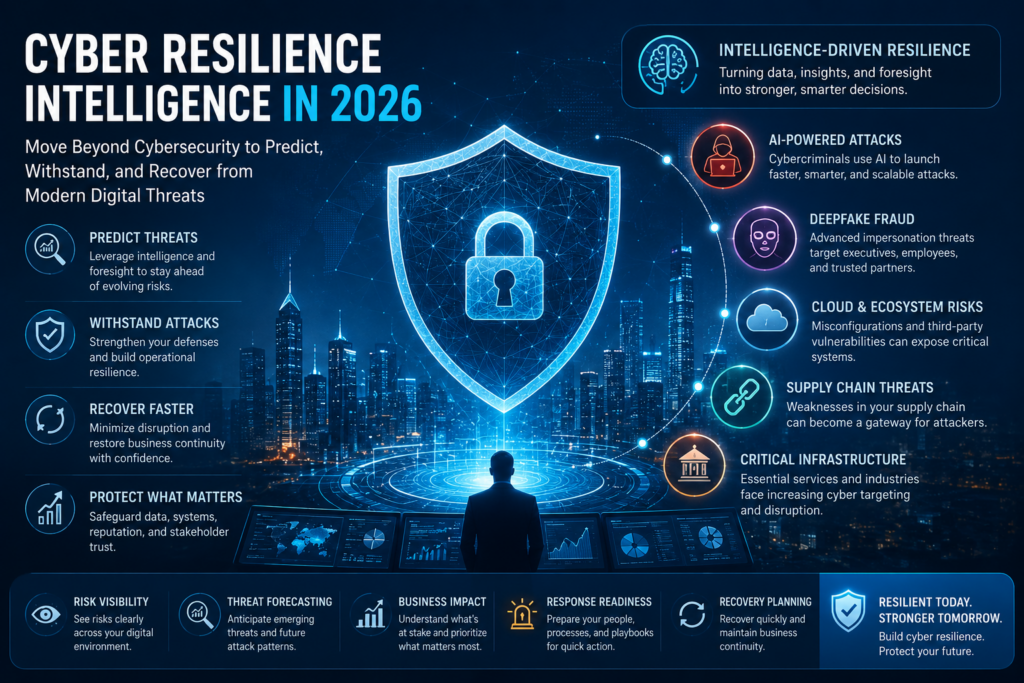
Cyber Resilience Intelligence combines cybersecurity, business intelligence, risk management, and strategic foresight to help organizations not only defend against cyber threats but also anticipate disruptions, maintain operations during incidents, and recover quickly when attacks occur.
For executives, government agencies, investors, and business leaders, cyber resilience is becoming a critical factor in long-term organizational success.
📊 Industry Overview
Digital transformation continues to accelerate across the globe.
Organizations are increasingly relying on:
- Cloud infrastructure
- Artificial intelligence
- Connected devices
- Remote work environments
- Digital services
- Third-party vendors
- Global data ecosystems
While these technologies create significant opportunities, they also expand the cyber threat landscape.
Several trends are reshaping cybersecurity in 2026:
- AI-powered cyberattacks
- Advanced ransomware campaigns
- Supply chain compromises
- Deepfake fraud schemes
- Insider threats
- Regulatory compliance requirements
- Critical infrastructure targeting
These developments are forcing organizations to rethink traditional cybersecurity strategies and embrace a more resilient approach.
⚠️ Key Challenges
🔐 Cybersecurity Cannot Guarantee Complete Prevention
Many organizations still operate under the assumption that sufficient security controls can prevent all cyber incidents.
Unfortunately, modern threat actors continuously adapt their techniques, making it increasingly difficult to stop every attack.
Organizations must prepare for the possibility that defenses may eventually be breached.
📈 Expanding Digital Attack Surfaces
As businesses adopt new technologies, the number of potential entry points for cybercriminals increases.
Attack surfaces now include:
- Cloud platforms
- Mobile devices
- Remote work environments
- Internet of Things (IoT) devices
- Third-party service providers
- Digital supply chains
Managing these interconnected systems presents significant security challenges.
🤖 AI-Powered Threats Are Increasing
Artificial intelligence is transforming cybersecurity on both sides of the battlefield.
Cybercriminals are using AI to:
- Generate sophisticated phishing campaigns
- Automate reconnaissance activities
- Create convincing deepfakes
- Launch adaptive attacks
Traditional security approaches may struggle to keep pace with these evolving threats.
🌐 Third-Party and Supply Chain Risks
Organizations increasingly depend on external vendors and partners.
A security weakness within a supplier or service provider can expose an entire ecosystem to cyber risks.
Recent incidents demonstrate that attackers often target the weakest link in the supply chain.
⚖️ Regulatory and Compliance Pressures
Governments worldwide continue introducing stricter cybersecurity regulations.
Organizations must address:
- Data protection requirements
- Cyber incident reporting obligations
- Industry-specific regulations
- Digital resilience standards
Failure to comply can result in financial penalties and reputational damage.
💡 What Is Cyber Resilience Intelligence?
Cyber Resilience Intelligence is the ability to continuously monitor cyber risks, anticipate emerging threats, evaluate business impacts, and enable rapid response and recovery through intelligence-driven decision-making.
Unlike traditional cybersecurity, Cyber Resilience Intelligence focuses on:
- Prevention
- Detection
- Response
- Recovery
- Adaptation
Its objective is not simply to stop attacks but to ensure business continuity despite cyber disruptions.
🔍 Emerging Cyber Risks Organizations Must Monitor in 2026
🤖 AI-Generated Cyber Attacks
Artificial intelligence enables attackers to scale operations and create highly personalized attacks.
Organizations must monitor how AI is reshaping cybercrime tactics.
🎭 Deepfake Fraud and Identity Manipulation
Deepfake technology is increasingly being used to impersonate executives, employees, and trusted partners.
These attacks can lead to unauthorized transactions, reputational harm, and operational disruption.
☁️ Cloud Ecosystem Vulnerabilities
Cloud adoption continues to grow rapidly.
Misconfigurations, access control weaknesses, and third-party integrations can introduce significant risks if not properly managed.
🔗 Supply Chain Cyber Threats
Organizations are becoming more interconnected than ever before.
Cybercriminals increasingly target suppliers, contractors, and service providers to gain indirect access to larger organizations.
🏗️ Critical Infrastructure Attacks
Energy, transportation, healthcare, telecommunications, and public services are becoming attractive targets for cyber adversaries.
Protecting critical systems requires proactive resilience planning.
💰 The True Cost of Cyber Disruption
Cyber incidents affect far more than IT systems.
Potential consequences include:
- Revenue losses
- Operational downtime
- Customer trust erosion
- Regulatory fines
- Legal liabilities
- Brand reputation damage
- Investor confidence decline
Organizations that lack resilience often experience prolonged recovery periods and greater financial losses.
🛠️ Building a Cyber Resilience Intelligence Framework
👁️ Risk Visibility
Organizations must maintain continuous visibility into vulnerabilities, threats, and operational risks.
Comprehensive monitoring improves awareness and supports informed decision-making.
🔮 Threat Forecasting
Cyber resilience requires looking ahead rather than reacting after incidents occur.
Threat forecasting helps organizations identify emerging attack patterns and future risk scenarios.
📊 Business Impact Analysis
Understanding how cyber incidents affect operations enables leaders to prioritize resources and response strategies.
Impact assessments should evaluate:
- Financial exposure
- Operational disruption
- Customer impact
- Regulatory implications
🚨 Response Readiness
Effective incident response plans help organizations act quickly during cyber events.
Preparedness activities should include:
- Response playbooks
- Crisis management exercises
- Stakeholder communication plans
- Executive decision-making frameworks
🔄 Recovery Planning
Business continuity and disaster recovery strategies are essential components of resilience.
Organizations should regularly test recovery capabilities to ensure operational stability.
📈 The Role of Business Intelligence in Cybersecurity
Cyber resilience is not solely a technology challenge.
Business intelligence provides valuable insights that support cybersecurity decision-making.
Organizations can leverage:
- Risk intelligence
- Competitive intelligence
- Market intelligence
- Trend analysis
- Strategic foresight
to better understand evolving threats and prioritize investments.
The integration of business intelligence and cybersecurity creates a stronger foundation for resilience.
🏆 Cyber Resilience as a Competitive Advantage
Leading organizations increasingly view cyber resilience as a business differentiator.
Resilient organizations often achieve:
- Faster recovery from disruptions
- Greater stakeholder trust
- Stronger customer confidence
- Enhanced investor assurance
- Improved regulatory readiness
- Sustainable long-term growth
Cyber resilience is no longer just an operational necessity—it is a strategic advantage.
🌟 Practical Recommendations
📋 Establish a Cyber Resilience Strategy
Develop a comprehensive framework that aligns cybersecurity efforts with business objectives.
🎯 Conduct Regular Risk Assessments
Continuously evaluate threats, vulnerabilities, and operational impacts.
👥 Strengthen Workforce Awareness
Employees remain one of the most important lines of defense.
Provide ongoing cybersecurity education and resilience training.
🔄 Test Response and Recovery Plans
Organizations should conduct regular simulations to identify weaknesses and improve readiness.
📅 Review Resilience Programs Quarterly
Cyber threats evolve rapidly.
Frequent reviews help ensure resilience strategies remain effective and aligned with emerging risks.
🤝 How GRMC EdgeSphere Can Help
GRMC EdgeSphere supports organizations through advanced research, intelligence, and strategic advisory services designed to strengthen cyber resilience and improve decision-making.
🔍 Cyber Risk Intelligence
We help organizations identify emerging cyber risks and evaluate their potential business impacts.
📊 Business Intelligence Solutions
Our intelligence programs provide actionable insights that support strategic planning and risk management.
🌍 Strategic Foresight Studies
We analyze future cyber trends, technology developments, and regulatory changes to support long-term resilience planning.
🏆 Risk Assessment Programs
GRMC delivers comprehensive assessments that help organizations strengthen security and operational resilience.
📈 Executive Decision Support
Our research and intelligence services enable leaders to make informed decisions with greater confidence.
🌐 Global Research Coverage
We support organizations across the GCC, Caribbean, North America, LATAM, Africa, and international markets with tailored intelligence solutions.
🚀 Conclusion
Cyber threats will continue to evolve in complexity, scale, and sophistication.
Organizations that focus solely on prevention may find themselves unprepared when disruptions occur.
Cyber Resilience Intelligence enables leaders to move beyond reactive cybersecurity and adopt a proactive approach that combines threat awareness, strategic foresight, business intelligence, and operational preparedness.
In an increasingly digital world, the organizations that thrive will not necessarily be those that avoid every cyber incident, but those that can anticipate risks, withstand disruptions, recover rapidly, and adapt to future challenges.
By investing in Cyber Resilience Intelligence today, organizations can build stronger foundations for security, stability, and sustainable growth in the years ahead.