

🌍 Introduction
The business environment has never been more interconnected, complex, or unpredictable.
Organizations today face constant disruption from technological innovation, changing customer expectations, regulatory developments, geopolitical uncertainty, economic fluctuations, and emerging competitive threats. While data is more abundant than ever, many organizations struggle to transform information into actionable intelligence.
Executives are often overwhelmed by reports, dashboards, forecasts, and market updates generated from multiple departments and external sources. Unfortunately, valuable insights frequently remain isolated within organizational silos, limiting their strategic value.
As organizations seek to navigate uncertainty and accelerate growth, a new approach is emerging: Strategic Intelligence Ecosystems.
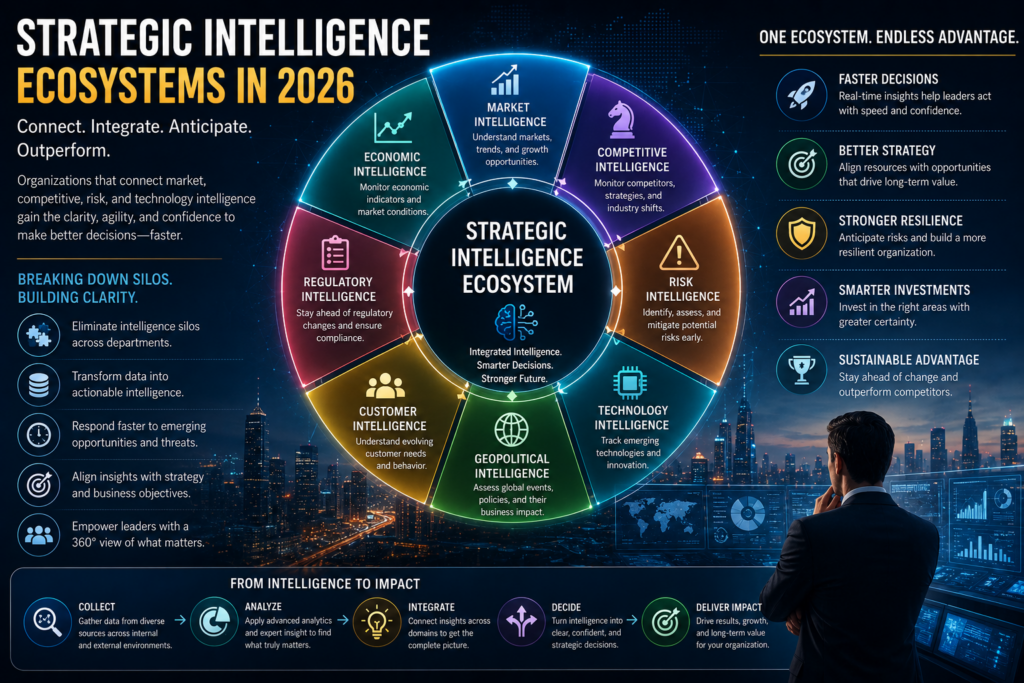
A Strategic Intelligence Ecosystem integrates multiple intelligence disciplines into a unified framework that supports faster, smarter, and more confident decision-making.
Organizations that successfully build these ecosystems are better equipped to identify opportunities, anticipate risks, respond to disruptions, and create sustainable competitive advantages.
📊 Industry Overview
Modern organizations operate within a rapidly evolving global landscape.
Several factors are accelerating business complexity:
- Artificial intelligence adoption
- Digital transformation initiatives
- Economic diversification programs
- Geopolitical shifts
- Supply chain restructuring
- Regulatory changes
- Sustainability requirements
- Workforce transformation
- Customer behavior evolution
Each of these forces generates large volumes of information.
However, information alone does not create value.
The organizations that succeed are those that can connect insights across multiple domains and transform them into strategic intelligence.
This is driving increased investment in integrated intelligence capabilities that support enterprise-wide decision-making.
⚠️ Key Challenges
🧩 Intelligence Silos
Many organizations collect intelligence across different departments.
Examples include:
- Market Research Teams
- Business Development Teams
- Risk Management Functions
- Technology Departments
- Strategy Offices
- Compliance Teams
Unfortunately, these teams often operate independently, limiting the organization’s ability to identify connections between emerging developments.
📈 Information Overload
The volume of available information continues to grow exponentially.
Organizations monitor:
- Industry reports
- Market databases
- Financial publications
- Social media platforms
- Customer feedback
- Government announcements
- Technology trends
- Competitor activities
The challenge is not access to information but determining what truly matters.
⏳ Delayed Strategic Responses
When intelligence remains fragmented, decision-makers may struggle to respond quickly to emerging opportunities or threats.
Delayed action can result in:
- Lost market opportunities
- Competitive disadvantages
- Increased risk exposure
- Inefficient resource allocation
🌐 Limited External Visibility
Organizations frequently focus on their direct competitors while overlooking developments occurring elsewhere.
Many disruptive innovations originate from adjacent industries, emerging technologies, or changing regulatory environments.
Without broader visibility, organizations may fail to anticipate future market shifts.
🎯 Difficulty Aligning Intelligence with Strategy
Intelligence initiatives often generate large volumes of data but fail to directly support strategic objectives.
Organizations need structured frameworks that connect intelligence activities to business priorities and executive decision-making.
💡 What Is a Strategic Intelligence Ecosystem?
A Strategic Intelligence Ecosystem is a coordinated framework that continuously collects, analyzes, integrates, and interprets information from multiple sources to support organizational strategy.
Rather than treating intelligence functions as separate activities, the ecosystem connects them into a unified decision-support system.
A Strategic Intelligence Ecosystem typically combines:
- 📊 Market Intelligence
- 🏆 Competitive Intelligence
- ⚠️ Risk Intelligence
- 🤖 Technology Intelligence
- 🌍 Geopolitical Intelligence
- 👥 Customer Intelligence
- 📜 Regulatory Intelligence
- 💰 Economic Intelligence
Together, these intelligence streams provide a comprehensive understanding of the forces shaping future opportunities and risks.
🔍 Market Research Insights
📊 Market Intelligence Reveals Emerging Opportunities
Market Intelligence helps organizations understand:
- Market demand
- Growth sectors
- Industry trends
- Customer expectations
- Market gaps
Organizations that monitor market developments continuously are often better positioned to identify new opportunities before competitors.
🏆 Competitive Intelligence Improves Strategic Positioning
Competitive Intelligence provides visibility into:
- Competitor investments
- Product launches
- Expansion strategies
- Partnerships
- Technology adoption
Understanding competitor behavior enables organizations to make more informed strategic decisions.
⚠️ Risk Intelligence Enhances Organizational Resilience
Risk Intelligence helps identify:
- Operational risks
- Financial risks
- Regulatory risks
- Supply chain vulnerabilities
- Emerging threats
Proactive risk identification improves organizational preparedness and resilience.
🤖 Technology Intelligence Supports Innovation
Technology advancements continue to reshape industries.
Organizations must monitor developments in:
- Artificial Intelligence
- Automation
- Cybersecurity
- Data Analytics
- Digital Platforms
- Emerging Technologies
Technology Intelligence helps leaders understand which innovations may create opportunities or disruptions.
🌍 Geopolitical Intelligence Influences Business Strategy
Global developments increasingly impact local markets.
Organizations must consider:
- Trade policies
- International regulations
- Political developments
- Regional conflicts
- Economic agreements
Geopolitical Intelligence helps businesses anticipate external influences on growth and operations.
👥 Customer Intelligence Drives Competitive Advantage
Customer preferences continue to evolve rapidly.
Organizations that understand changing customer expectations can:
- Improve products
- Enhance services
- Strengthen customer experiences
- Increase loyalty
Customer Intelligence provides valuable insights that support sustainable growth.
📈 Benefits of Strategic Intelligence Ecosystems
🚀 Faster Decision-Making
Integrated intelligence enables leaders to access relevant insights more quickly and respond with confidence.
🎯 Improved Strategic Planning
Organizations can align resources and investments with future opportunities and risks.
⚠️ Stronger Risk Management
Comprehensive intelligence improves visibility into emerging threats and vulnerabilities.
💰 Smarter Investment Decisions
Leaders gain a clearer understanding of where to allocate capital and resources for maximum impact.
🌟 Sustainable Competitive Advantage
Organizations that identify market changes early often gain advantages over slower-moving competitors.
🛠️ Practical Recommendations
📋 Establish a Centralized Intelligence Framework
Organizations should create structured processes for gathering, evaluating, and sharing intelligence.
🔄 Integrate Multiple Intelligence Sources
Market, risk, competitive, and technology intelligence should work together rather than independently.
📊 Develop Executive Intelligence Dashboards
Decision-makers need concise and actionable intelligence rather than overwhelming amounts of data.
📅 Conduct Regular Strategic Reviews
Quarterly intelligence reviews help organizations reassess priorities and respond to changing conditions.
🧠 Foster an Intelligence-Driven Culture
Encourage collaboration, curiosity, and continuous learning across departments.
Organizations that value intelligence tend to make stronger strategic decisions.
🔮 The Future of Strategic Intelligence Ecosystems
As artificial intelligence and advanced analytics continue to evolve, Strategic Intelligence Ecosystems will become increasingly sophisticated.
Future ecosystems may include:
- AI-powered intelligence monitoring
- Predictive analytics
- Automated trend detection
- Real-time risk assessment
- Scenario forecasting
- Strategic foresight platforms
Organizations that invest early in these capabilities will likely achieve greater agility and resilience.
🤝 How GRMC EdgeSphere Can Help
GRMC EdgeSphere helps organizations transform fragmented information into actionable intelligence that supports growth, innovation, and resilience.
📊 Market Intelligence Solutions
We help organizations identify emerging opportunities, customer trends, and market developments.
🏆 Competitive Intelligence Programs
Our intelligence services provide insights into competitor activities and industry dynamics.
⚠️ Risk Intelligence Assessments
We evaluate strategic, operational, and market risks that may impact organizational performance.
🤖 Technology and Innovation Intelligence
GRMC analyzes emerging technologies and innovation trends that may shape future business environments.
🌍 Strategic Foresight Studies
We provide forward-looking assessments that support long-term planning and investment decisions.
📈 Executive Decision Support
Our research and intelligence solutions enable leaders to make evidence-based decisions with greater confidence.
🌐 Global Research Coverage
GRMC supports clients across the GCC, Caribbean, North America, LATAM, Africa, and international markets through customized intelligence and research solutions.
🚀 Conclusion
In an increasingly complex and rapidly evolving business environment, organizations can no longer rely on isolated intelligence functions.
The future belongs to organizations that can connect market intelligence, competitive intelligence, risk intelligence, technology intelligence, and strategic foresight into a unified ecosystem.
Strategic Intelligence Ecosystems empower leaders to make faster decisions, identify emerging opportunities, mitigate risks, and strengthen long-term competitiveness.
By integrating diverse intelligence sources into a single strategic framework, organizations can transform information into actionable insights and build a sustainable advantage in an uncertain world.
GRMC EdgeSphere helps organizations develop intelligence-driven strategies that turn complexity into clarity, uncertainty into opportunity, and insights into measurable business value.