

🌍 Introduction
In business, timing often determines success. Enter a market too late, and competitors may already dominate customer attention. Invest in a declining sector, and growth opportunities may disappear before returns are realized. Miss a significant market shift, and organizations can spend years trying to catch up.
Traditional market research has long focused on understanding current market conditions. While this remains essential, today’s business environment requires leaders to look beyond what is happening now and identify what may happen next.
This is where Market Signals Intelligence is becoming increasingly important.
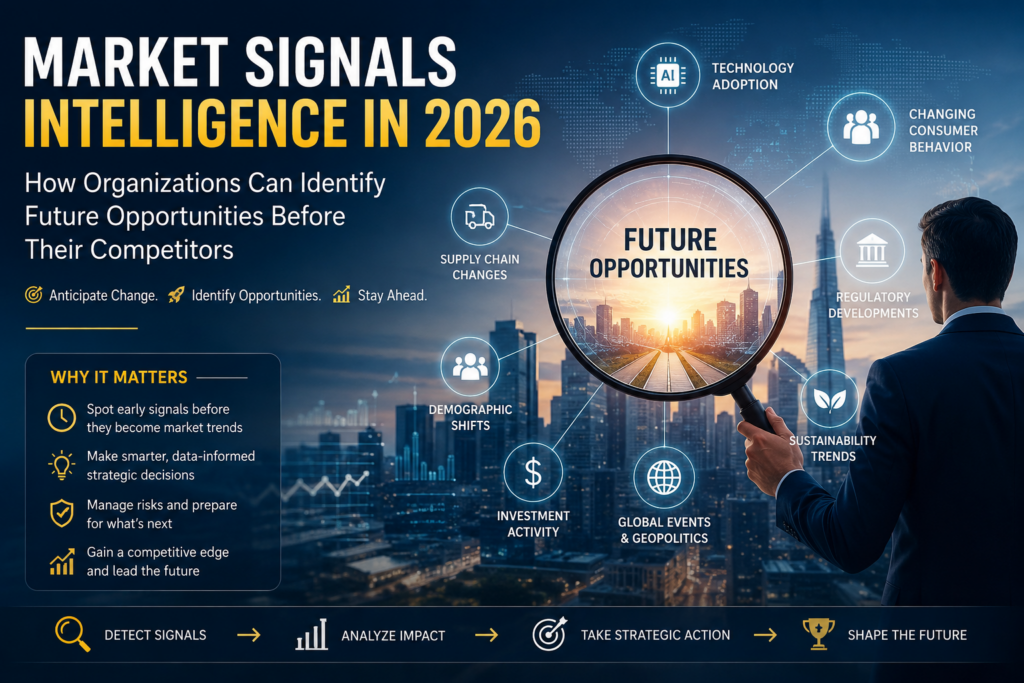
Market Signals Intelligence is the process of identifying, analyzing, and interpreting early indicators of change before they evolve into established market trends. These signals can emerge from customer behavior, technology adoption, regulatory developments, investment activity, demographic shifts, supply chain changes, or emerging business models.
For business owners, executives, investors, government organizations, and strategic planners, the ability to recognize market signals early can provide a significant competitive advantage. Organizations that develop this capability are often better positioned to identify opportunities, manage risks, and make informed investment decisions before the broader market reacts.
📊 Industry Overview
Today’s markets are evolving faster than ever before.
Several factors are contributing to this acceleration:
- Digital transformation initiatives
- Artificial intelligence adoption
- Economic diversification programs
- Climate and sustainability policies
- Global supply chain restructuring
- Workforce evolution
- Consumer preference shifts
- Regulatory changes
These developments create new opportunities but also introduce uncertainty.
The challenge for organizations is that major market trends rarely appear overnight. They typically begin as small, often overlooked signals that gradually gain momentum.
For example:
- A niche customer preference may evolve into a mainstream buying behavior.
- A regulatory discussion may eventually become industry-wide legislation.
- A technology used by early adopters may become a market standard.
- A small startup segment may reshape an entire industry.
Organizations that identify these signals early gain more time to prepare, adapt, and invest strategically.
⚠️ Key Challenges
🔍 Overreliance on Historical Data
Many organizations base strategic decisions primarily on historical performance.
While historical analysis is valuable, it often explains what has already happened rather than what is likely to happen next.
In rapidly changing markets, relying solely on historical trends can create blind spots.
🧩 Information Overload
Organizations today have access to unprecedented amounts of information.
Sources include:
- Industry reports
- News publications
- Social media platforms
- Customer feedback
- Government announcements
- Financial reports
- Market databases
The challenge is not collecting information but identifying which signals are meaningful and which are simply noise.
⏳ Short-Term Decision-Making
Many businesses focus heavily on quarterly performance targets and immediate operational concerns.
This can limit attention to emerging developments that may significantly impact future competitiveness.
Organizations often recognize major trends only after they become obvious to everyone else.
🌐 Limited Visibility Beyond Core Markets
Businesses frequently monitor their direct competitors while overlooking developments in adjacent industries.
However, some of the most disruptive changes originate outside traditional competitive boundaries.
Companies that monitor only their immediate market may miss emerging threats and opportunities.
⚖️ Difficulty Translating Signals into Strategy
Identifying a signal is only the first step.
Organizations must determine:
- Whether the signal is credible
- How quickly it may develop
- Which business functions may be affected
- What actions should be taken
Without a structured evaluation framework, valuable insights may never influence decision-making.
📈 Market Research Insights
💡 Emerging Opportunities Often Begin at the Margins
Market shifts frequently originate within small customer groups, niche industries, or early-stage innovations.
What appears insignificant today may represent a major opportunity tomorrow.
Organizations that systematically monitor these developments often gain a substantial first-mover advantage.
🏦 Investment Activity Provides Early Indicators
Investment patterns can reveal where future growth may occur.
Monitoring:
- Venture capital activity
- Private equity investments
- Corporate acquisitions
- Research funding
can provide insight into sectors attracting long-term confidence and innovation.
📜 Regulatory Signals Matter More Than Ever
Governments worldwide are introducing new policies related to:
- Artificial intelligence
- Cybersecurity
- Sustainability
- Data privacy
- Digital services
- Infrastructure development
Regulatory developments often create both opportunities and risks before markets fully respond.
👥 Consumer Behavior Is Evolving Faster
Changing demographics, digital adoption, and economic conditions continue to reshape purchasing decisions.
Early changes in consumer expectations frequently signal larger market transformations.
Businesses that monitor evolving customer behavior are better equipped to adapt products, services, and strategies.
🌎 Global Events Influence Local Markets
Organizations increasingly recognize that developments in one region can affect opportunities elsewhere.
Supply chain changes, trade policies, labor market trends, and technology adoption patterns often create ripple effects across industries and geographies.
Market Signals Intelligence helps organizations understand these interconnected dynamics.
🛠️ Practical Recommendations
📊 Establish a Market Signals Monitoring Framework
Organizations should define:
- Priority industries
- Strategic markets
- Emerging technologies
- Regulatory developments
- Customer trends
A structured framework improves consistency and relevance.
🔎 Monitor Adjacent Industries
Innovation often emerges outside traditional industry boundaries.
Businesses should monitor developments that may indirectly influence their sector, including technology, logistics, finance, healthcare, energy, and digital services.
📑 Combine Quantitative and Qualitative Research
Effective Market Signals Intelligence requires both:
Quantitative Sources
- Market data
- Economic indicators
- Industry statistics
- Investment activity
Qualitative Sources
- Expert interviews
- Customer feedback
- Industry observations
- Stakeholder perspectives
The combination provides a more comprehensive view of emerging opportunities.
🎯 Develop Opportunity Scoring Criteria
Organizations should evaluate signals using criteria such as:
- Potential market impact
- Strategic relevance
- Time horizon
- Competitive implications
- Investment requirements
Scoring systems help prioritize attention and resources.
📅 Conduct Regular Strategic Reviews
Signals should be reviewed continuously rather than annually.
Quarterly reviews help organizations:
- Identify new developments
- Reassess priorities
- Update strategic plans
- Respond more quickly to change
🧠 Build a Culture of Strategic Curiosity
Organizations that encourage exploration and external awareness are often more successful at identifying opportunities.
Leaders should promote cross-functional collaboration and continuous market learning.
🤝 How GRMC Can Help
GRMC EdgeSphere helps organizations strengthen strategic decision-making through advanced Market Research, Business Intelligence, and Strategic Foresight services.
📈 Market Signals Intelligence Programs
We help organizations establish structured monitoring systems that identify emerging opportunities and risks before they become mainstream trends.
🔍 Industry and Trend Analysis
Our research teams analyze evolving market dynamics, technology developments, regulatory changes, and customer behavior patterns.
🌍 Strategic Foresight Studies
GRMC provides forward-looking assessments that support long-term planning, investment decisions, and growth strategies.
🏆 Competitive and Market Intelligence
We deliver actionable intelligence that helps organizations anticipate market shifts and improve strategic positioning.
📊 Executive Decision Support
Our insights enable business leaders, investors, and government organizations to make evidence-based decisions with greater confidence.
🌐 Global Research Coverage
GRMC supports clients across the GCC, Caribbean, North America, LATAM, Africa, and international markets with region-specific intelligence and analysis.
🚀 Conclusion
The organizations that achieve sustainable growth are often not those that react fastest to established trends, but those that recognize important signals before those trends emerge.
Market Signals Intelligence enables decision-makers to move beyond reactive planning and adopt a more proactive approach to growth, innovation, and risk management.
In an increasingly complex and rapidly changing business environment, the ability to identify early indicators of change can provide a powerful competitive advantage.
By combining structured market research, business intelligence, and strategic foresight, organizations can better anticipate future developments, allocate resources more effectively, and position themselves for long-term success.
GRMC EdgeSphere helps organizations transform emerging market signals into actionable intelligence, enabling leaders to make informed decisions today that create opportunities for tomorrow.