

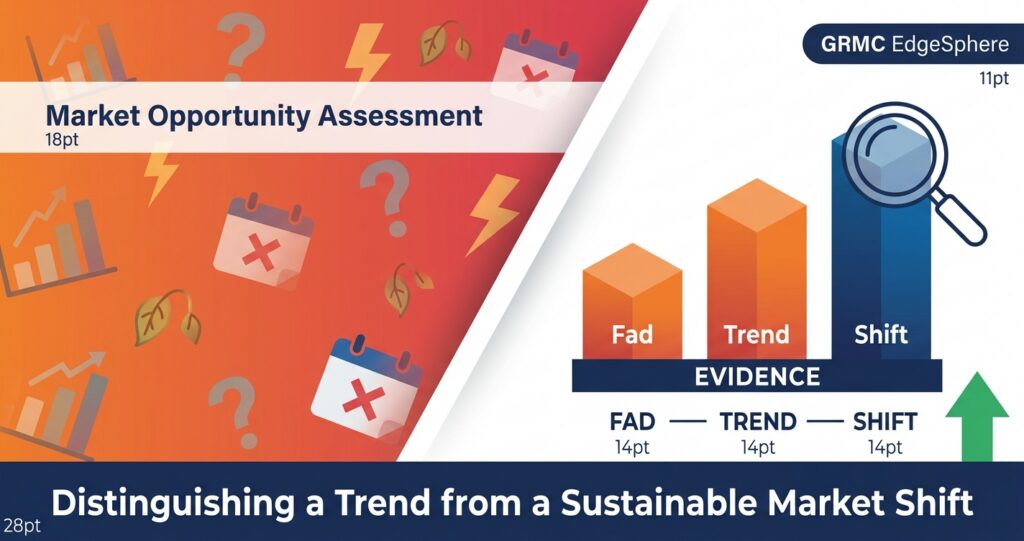
In today’s hyper-competitive global economy, the line between a fleeting fad and a fundamental market shift is becoming increasingly difficult to identify. Business leaders often find themselves at a crossroads, asking: Is this a moment of change or a lasting transformation? For CEOs, investors, and government decision-makers, a misstep can mean the difference between leading a market and losing significant capital.
Many enterprises commit billions of dollars into markets they believe are booming, only to realize later that they misinterpreted a temporary surge for a structural change. The cost of this misjudgment isn’t just financial; it includes wasted time, misallocated resources, and missed momentum.
At GRMC EdgeSphere, we utilize rigorous frameworks to help organizations assess market opportunity with clarity. We aim to distinguish between what is real and what is merely a flash in the pan.
The Strategic Cost of Misreading the Market
The question is rarely whether to do the research; it is whether you do it before or after you have already paid for the lesson. Organizations that skip a structured opportunity assessment often fall into predictable traps:
- Overestimating Demand: Confusing early adoption or a viral moment with sustained market interest.
- Underestimating Competition: Assuming a large market equates to an easy win, ignoring the barriers that may prevent market share capture.
- Misidentifying Customer Segments: Targeting the wrong audience based on surface-level trends rather than deep behavioral data.
Moving quickly into the wrong market leads to failure at a faster pace. A “fail fast” mentality is only valuable if you learn the right lessons. Proactive assessment is how smart companies win.
The Anatomy of a Sustainable Shift
To determine if a signal indicates a durable change, we must look beyond the hype. We suggest evaluating the opportunity along four primary dimensions:
1. Market Sizing vs. Serviceable Reality
A common executive error is confusing Total Addressable Market (TAM) with the Serviceable Obtainable Market (SOM). A large market does not guarantee a large share. Accurate sizing models, which combine secondary research, primary insights, and proprietary analytics, build estimates that withstand scrutiny from stakeholders and investors. If you project a market opportunity but fail to consider conversion rates or market accessibility, you are building a business plan on a shaky foundation.
2. Consumer Behavior vs. Expressed Sentiment
What consumers say and what they do are often two different things.
A recent analysis of fashion data revealed that while 73% of Gen Z said they prefer sustainable brands, the majority still bought 30+ garments a year from fast-fashion retailers. The core insight here is that trend brings attention, but retention and trust build the business.
Evaluation Tip: Look for repetition, commitment, and persistence in behavior. Ask: “What is someone now doing that they did not do before?” It is not enough to rely on survey data that indicates willingness to pay.
3. The Nature of the Signal
Any market signal should be subjected to rigorous scrutiny. Experts suggest triangulating evidence across three levels:
- Primary Evidence: Usage data, observable behavior, regulation, and business results.
- Secondary Evidence: Sector reports, expert interviews, and specialist media.
- Exploratory Signals: Social media chatter and event buzz.
A trend supported by a single narrative remains a fragile hypothesis. We recommend applying the “devil’s advocate” test: What evidence would refute this trend? If a hypothesis cannot be disproven, it hasn’t been properly evaluated.
4. Barriers vs. Enablers
Barriers such as price, regulatory hurdles, cultural resistance, and technological limitations do not invalidate an opportunity; they define its scope and pace. A structural change usually involves a reduction in these barriers or a significant regulatory change that opens a market. For example, the rise of plant-based proteins wasn’t just about changing consumer sentiment; it was driven by technological breakthroughs in formulation and significant capital investment. Companies that acted on these early indicators secured prime market positioning before the space became crowded.
Actionable Framework: From Assessment to Integration
To avoid the hype trap, we recommend a tiered approach to decision-making based on the evidence at hand.
Applying the Trend vs. Shift Logic to Business Decisions
To operationalize this, leaders should create a “Trend Dossier” for every potential market move:
- What is the Observed Signal? (e.g., “Generative AI usage in our industry is growing 40% YoY”).
- What is the Hypothesis? (e.g., “AI will replace our traditional customer service model”).
- What are the Barriers? (e.g., integration complexity, data privacy, talent gap).
- What is the Audiences Affected? (e.g., B2B vs. B2C).
- What is the Decision? Ignore, Monitor, Experiment, or Integrate.
This exercise forces a shift from reactive thinking to a structured intelligence framework, ensuring that your organization doesn’t just chase trends but builds resilience and sustainability into its growth strategy.
Conclusion
In a landscape where trends move four times faster than they did a decade ago, the real advantage belongs to those who invest in understanding uncertainties before they become costly mistakes. Identifying a sustainable market shift is not about having a crystal ball; it is about analyzing the right data, understanding the barriers, and making a decision proportionate to the evidence.
At GRMC EdgeSphere, we view market opportunity assessment not as a one-time report, but as an ongoing strategic discipline. By combining traditional research with real-time market signals and robust data analytics, we empower businesses and governments to navigate complexity with confidence.