
For decades, the dominant narrative in B2B marketing has been that businesses make purchasing decisions based on logic, data, and cold, hard ROI. Sales decks are packed with spreadsheets, case studies, and technical specifications, all meticulously crafted to appeal to the “rational buyer.”
This approach is not just incomplete—it is increasingly ineffective.
At GRMC EdgeSphere, our work with global enterprises, governments, and NGOs consistently reveals a fundamental truth that many B2B leaders overlook: behind every corporate purchase order is a human being making a high-stakes decision, and that decision is deeply emotional.
In this article, we’ll explore why the reliance on purely rational arguments often fails to close deals, the powerful emotional drivers that actually influence B2B buyers, and how leading organizations can build a brand strategy that addresses both the balance sheet and the buyer’s unspoken anxieties.
The Myth of the Rational B2B Buyer
The assumption that B2B decisions are purely rational is one of the most pervasive and damaging myths in business. This “economic man” fallacy suggests that buyers are emotionless calculators who simply compare features and price to arrive at the optimal choice .
However, this view ignores a critical reality: B2B buyers are not spending their own money. They are spending their company’s budget, and their career is often on the line . A wrong decision can lead to significant financial loss and damage to personal reputation, making the stakes incredibly high.
This inherent risk transforms the buying process into a profoundly emotional experience. As one LinkedIn expert notes, buyers are not just asking, “Will this work?” but also, “Can I trust this partner?” and, “Will this decision put my job at risk?” . This fear of personal failure is a powerful, often unacknowledged, emotional driver that can override even the most compelling ROI calculation .
Consider the classic example of IBM. Their “No one ever got fired for buying IBM” campaign didn’t focus on technical superiority. It sold the emotional benefit of safety, security, and risk mitigation. The message created a powerful sense of trust that protected the careers of the managers who chose them, a powerful emotional appeal that transcended any feature list .
The Data is Clear: Emotion Over Logic
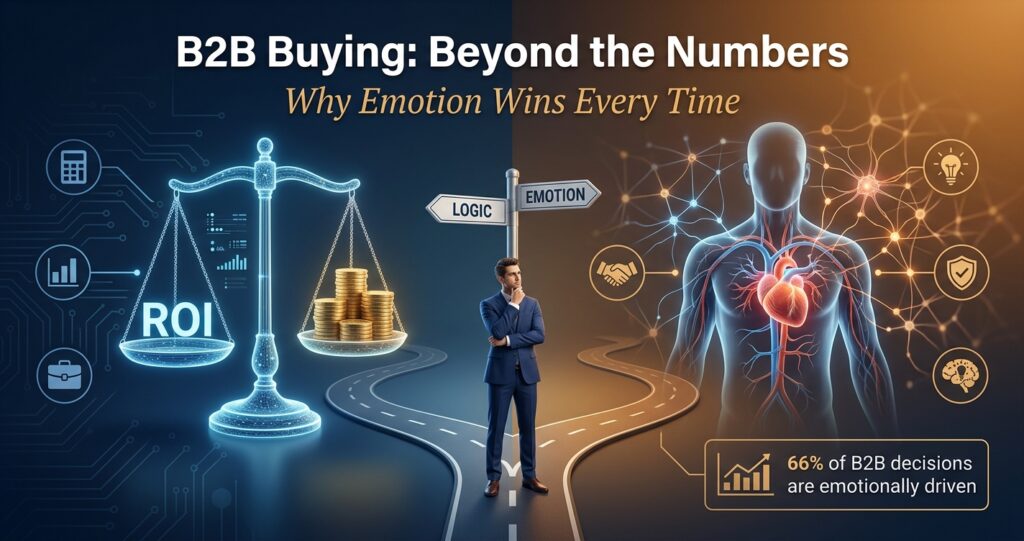
The research overwhelmingly supports the primacy of emotion in B2B decision-making. A widely cited study from Predictable Profits and the LinkedIn B2B Institute found that a remarkable 66% of B2B decisions are driven by emotion .
Furthermore, research from Google, Gartner, and Motista revealed that B2B customers are significantly more emotionally connected to their vendors than B2C consumers. While most B2C brands build emotional connections with only 10% to 40% of consumers, the majority of B2B brands surpassed the 50% mark . This suggests that the “human” element is even more critical in a business context than in a consumer one.
What does this emotional connection achieve? Buyers with strong emotional connections to a brand deliver a 306% higher lifetime value and are far more likely to recommend their vendor . They are also willing to pay a premium when they perceive personal value in their choices . This demonstrates that emotions are not a “soft” factor but a direct driver of loyalty and revenue.
The “Why” Behind the Emotion: Fear, Trust, and Identity
To effectively build a brand that resonates, it’s crucial to understand the specific emotions at play. B2B buying decisions are often driven by a complex interplay of four core emotional needs: security, ease, status, and direction .
1. Security and Risk Reduction
This is the most dominant emotional driver. In high-stakes B2B purchases, the fear of making a mistake is ever-present. A strong corporate brand serves as a powerful tool for reducing perceived risk and providing emotional security . It answers the buyer’s unspoken question: “Can I trust this company with my reputation?” This is why trust becomes the ultimate differentiator when offerings appear similar .
2. Personal Ease and Career Advancement
Beyond the functional ease of a product, there is a personal dimension. Buyers want to know if choosing your solution will make their own job simpler. Will it reduce their daily stress? Will it enable their own career advancement and professional reputation ? In the B2B world, personal impact leaves a greater lasting impression than business impact.
3. Status and Alignment of Values
B2B buyers are increasingly choosing partners that reflect their own values and those of their company. A brand that makes them feel understood and supported, rather than just offering the lowest price, is far more likely to win their business . Choosing a partner with a strong, reputable brand can also enhance the buyer’s own status within their organization.
4. Direction and Certainty
In a world of information overload and cognitive overload, strong brands offer clarity and direction . They cut through the noise, simplifying the complex decision-making process and giving buyers the confidence to say “yes.”
The Danger of ROI-Only Marketing
When marketing focuses exclusively on functional value—specs, price, ROI—it may get you on the shortlist, but it rarely wins the deal . This approach fails to address the emotional anxieties of the buyer.
As Bain & Company’s research on the “Elements of Value” suggests, functional value is simply “table stakes.” It’s expected. The true competitive advantage lies in addressing the emotional and personal rewards that the buyer seeks.
Many B2B brands make the mistake of using the same rational messaging as their competitors, leading to little differentiation . In such a scenario, a buyer faced with two technically equal options will almost always default to the one that feels safer, more trustworthy, and more aligned with their personal goals.
Bridging the Gap: A Framework for Actionable Recommendations
To succeed, B2B leaders must build a brand strategy that bridges the rational and emotional. At GRMC EdgeSphere, we advise our clients to adopt a dual-focused approach.
Recommendation 1: Build Your Brand as a Trust Signal
A brand is more than a logo. It is a promise. To build a brand that serves as a powerful trust signal and reduces buyer anxiety:
- Ensure Consistency: Your brand must be consistent, credible, and visible. Every interaction, from your website to your sales team, must reinforce the same message of reliability and trust. When companies “go quiet,” confidence fades, because visibility reinforces credibility .
- Demonstrate Security: For clients in regulated industries or those handling sensitive data, certifications like ISO 27001 and NIST standards—which GRMC actively champions—are not just technical requirements; they are powerful emotional reassurances that mitigate the fear of risk.
- Embrace Corporate Brand Management: As some experts suggest, managing the corporate brand is a strategic imperative that should be elevated beyond a simple marketing function . It is about building a reputation that protects both the buyer and the seller.
Recommendation 2: Craft Marketing with Emotional Resonance
Don’t just sell the product. Sell the outcome and the personal peace of mind it brings.
- Go Beyond Business Value: While demonstrating ROI is necessary, it is often insufficient . Your messaging must also consider the personal rewards for the buyer. How does your solution make their day easier? How does it enable their career advancement?
- Solve for Anxiety, Not Just Product Fit: Your marketing should directly address the fears of the buyer. Are you showing them that you are a safe, reliable partner? Are you telling a story of risk mitigation ? This is often a more potent motivator than a simple efficiency gain.
- Aim for the Heart: Communicate in a way that strikes an emotional chord. As one expert put it, our job is to “aim for the heart—and hit the wallet” . Emotional connections build the kind of loyalty that leads to repeat business and referrals.
Recommendation 3: Use Brand to Combat Cognitive Overload
B2B buying committees can involve 6 to 10 stakeholders, leading to information overload and a default preference for the status quo . A strong corporate brand simplifies this decision.
- Be “Top of Mind”: If your company isn’t already top of mind when a buyer is ready to purchase, you likely won’t win the sale . Invest in brand-building activities that ensure your company is the one they are thinking of first.
- Become the “Safe Choice”: A powerful brand reduces the emotional friction in a committee decision by making it easier for each member to defend their choice. Position your brand as the trusted, low-risk option that everyone can agree on.
Conclusion: The Competitive Advantage of Emotional Branding
The B2B landscape is evolving. In an era of product commoditization and digital noise, a focus on rational ROI alone is a risky strategy. The organizations that will thrive are those that understand the true nature of their buyers: human beings making high-stakes, emotional decisions.
By building a brand that fosters trust, reduces anxiety, and resonates on an emotional level, you can move beyond being just another supplier and become a valued, trusted partner. This is not about abandoning rational arguments, but about wrapping them in a powerful emotional context that wins the deal and builds lasting, profitable relationships.
At GRMC EdgeSphere, our market research and business intelligence services are designed to uncover these critical, often hidden, emotional drivers. We help you move beyond surface-level data to understand the “why” behind the decision, empowering you to build strategies that speak to both the mind and the heart.