

Introduction
Organizations across industries are under constant pressure to improve efficiency, reduce operational costs, enhance customer experiences, and remain competitive in increasingly digital markets. While traditional automation has helped businesses streamline repetitive tasks and reduce manual workloads, the next phase of digital transformation is no longer just about automation, it is about intelligence.
Intelligent Process Automation (IPA) represents the convergence of Artificial Intelligence (AI), Machine Learning (ML), Robotic Process Automation (RPA), analytics, and process orchestration. It enables organizations not only to automate tasks but also to make data-driven decisions, adapt to changing conditions, and continuously optimize business operations.
As enterprises move from rule-based workflows to intelligent decision-making systems, IPA is becoming a strategic business capability rather than a technology initiative. Organizations that successfully embrace this evolution are positioning themselves to achieve greater agility, scalability, and long-term competitive advantage.
The Business Challenge
Many organizations have already invested in automation technologies. However, traditional automation often faces limitations when dealing with:
- Unstructured data such as emails, documents, images, and customer communications
- Complex decision-making processes
- Dynamic business environments requiring adaptability
- Cross-functional workflows involving multiple systems and stakeholders
- Increasing customer expectations for speed and personalization
For example, a finance department may automate invoice processing through predefined rules. However, exceptions, incomplete documents, and changing supplier requirements still require manual intervention. Similarly, customer service teams may automate ticket routing, but understanding customer sentiment and determining the best response often demands human judgment.
As organizations scale, these limitations create operational bottlenecks, increase costs, and reduce business agility. This is where Intelligent Process Automation provides a transformative solution.
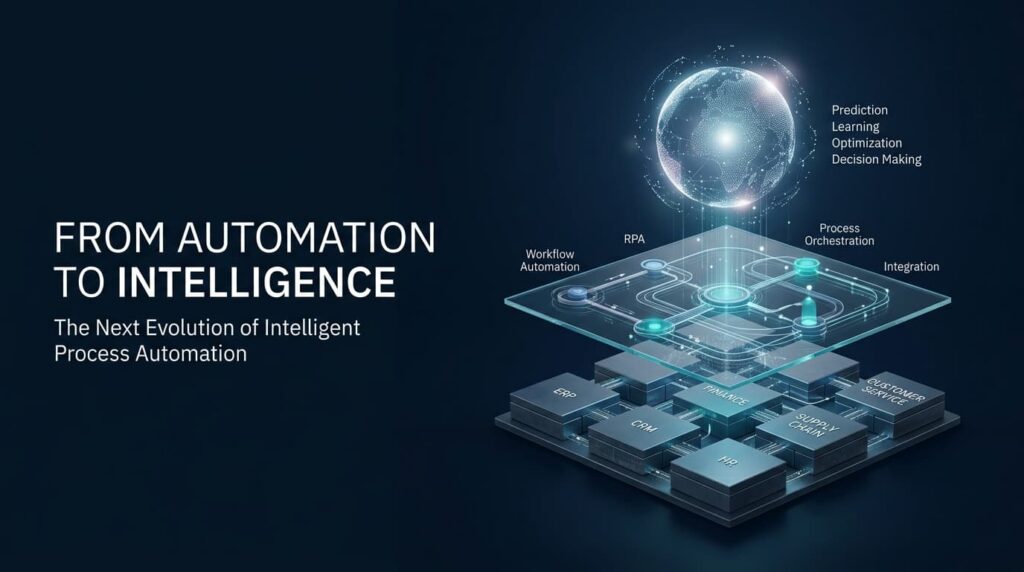
Understanding Intelligent Process Automation
Intelligent Process Automation combines traditional automation with AI-powered capabilities that enable systems to learn, analyze, predict, and make decisions.
Rather than simply executing predefined instructions, IPA systems can:
- Interpret unstructured information
- Recognize patterns in large datasets
- Predict outcomes and risks
- Recommend optimal actions
- Continuously improve through learning mechanisms
Key components of modern IPA include:
1. Robotic Process Automation (RPA)
Automates repetitive, rule-based tasks such as data entry, report generation, and transaction processing.
2. Artificial Intelligence
Enables systems to understand language, recognize patterns, classify information, and generate insights.
3. Machine Learning
Allows systems to improve performance over time by learning from historical data and outcomes.
4. Natural Language Processing (NLP)
Helps organizations process documents, emails, contracts, customer interactions, and other text-based information.
5. Process Mining and Analytics
Provides visibility into business processes, identifies inefficiencies, and uncovers opportunities for optimization.
6. Intelligent Decision Engines
Support real-time decision-making by combining business rules, analytics, and AI-driven recommendations.
Together, these technologies create a more intelligent and adaptive operating environment.
Benefits and ROI of Intelligent Process Automation
Business leaders evaluating IPA investments are increasingly focused on measurable outcomes rather than technology adoption alone. The value of IPA can be assessed across several strategic dimensions.
Increased Operational Efficiency
IPA significantly reduces the time required to complete complex business processes by eliminating manual handoffs and repetitive activities.
Organizations often experience:
- Faster processing times
- Reduced administrative workload
- Improved workflow consistency
- Greater resource utilization
Employees can focus on higher-value activities such as strategy, customer engagement, and innovation rather than routine operational tasks.
Improved Accuracy and Compliance
Manual processes are prone to errors that can result in financial losses, regulatory issues, and customer dissatisfaction.
IPA helps organizations:
- Standardize process execution
- Reduce human error
- Maintain audit trails
- Strengthen regulatory compliance
This is particularly valuable in highly regulated sectors such as finance, healthcare, telecommunications, and government services.
Enhanced Customer Experience
Modern customers expect rapid responses, personalized interactions, and seamless service experiences.
IPA enables organizations to:
- Accelerate response times
- Deliver personalized recommendations
- Improve service consistency
- Resolve customer issues more efficiently
By integrating AI-driven insights into customer-facing operations, businesses can strengthen satisfaction and loyalty.
Scalability Without Linear Cost Growth
Traditional growth often requires proportional increases in workforce and operational resources.
IPA allows organizations to scale operations while maintaining cost efficiency by:
- Handling larger transaction volumes
- Supporting business expansion
- Managing seasonal demand fluctuations
- Reducing dependency on manual labor
This creates a more sustainable growth model.
Better Decision-Making
One of the most significant advantages of IPA is its ability to transform data into actionable intelligence.
Decision-makers gain access to:
- Real-time operational insights
- Predictive analytics
- Risk assessments
- Performance forecasting
This enables faster and more informed business decisions.
Real-World Applications Across Industries
Financial Services
Banks and financial institutions use IPA for:
- Loan application processing
- Fraud detection
- Regulatory compliance monitoring
- Customer onboarding
AI-powered systems can analyze applications, verify documentation, assess risk, and accelerate approval cycles while maintaining compliance standards.
Healthcare
Healthcare organizations leverage IPA to:
- Process patient records
- Manage insurance claims
- Schedule appointments
- Support clinical decision-making
The result is improved operational efficiency and enhanced patient experiences.
Manufacturing
Manufacturers apply IPA to:
- Supply chain optimization
- Predictive maintenance
- Inventory management
- Quality control
By combining automation with predictive analytics, organizations can reduce downtime and improve production efficiency.
Government and Public Sector
Government agencies use intelligent automation to:
- Process citizen applications
- Manage public records
- Improve service delivery
- Enhance regulatory oversight
This helps reduce administrative burdens while improving citizen engagement.
Retail and E-Commerce
Retailers utilize IPA to:
- Forecast demand
- Optimize inventory levels
- Personalize customer experiences
- Automate order processing
These capabilities support both revenue growth and operational efficiency.
Implementation Roadmap for Intelligent Process Automation
Successful IPA adoption requires a structured and business-focused approach.
1. Assess Current Processes
Identify high-volume, repetitive, and resource-intensive processes that can benefit from automation and intelligence.
Focus on areas with:
- Significant manual effort
- High error rates
- Process bottlenecks
- Clear performance metrics
2. Define Business Objectives
Align automation initiatives with strategic goals such as:
- Cost reduction
- Customer experience improvement
- Compliance enhancement
- Revenue growth
Technology should support measurable business outcomes.
3. Prioritize High-Impact Use Cases
Start with projects that offer strong ROI and manageable implementation complexity.
Quick wins help build organizational confidence and stakeholder support.
4. Establish Data Foundations
AI-driven automation depends on high-quality data.
Organizations should focus on:
- Data governance
- Integration strategies
- Data quality management
- Security and compliance requirements
5. Deploy and Scale
Begin with pilot implementations, measure results, and expand successful solutions across business units.
Scalable architecture and governance frameworks are critical for long-term success.
6. Monitor and Continuously Optimize
IPA is not a one-time deployment.
Organizations should continuously evaluate:
- Process performance
- User adoption
- Business outcomes
- Emerging automation opportunities
Continuous improvement ensures sustained value creation.
How GRMC EdgeSphere Can Help
At GRMC EdgeSphere, we help organizations move beyond basic automation toward intelligent, scalable, and business-driven transformation.
Our approach combines strategic consulting, AI expertise, automation technologies, and industry best practices to deliver measurable outcomes.
Our services include:
- Intelligent Process Automation strategy development
- AI and automation readiness assessments
- Process discovery and optimization
- RPA and AI solution implementation
- Data and analytics integration
- Governance and compliance frameworks
- Change management and workforce enablement
Whether you are beginning your automation journey or scaling enterprise-wide intelligent operations, our experts work closely with stakeholders to ensure technology investments align with business objectives and deliver sustainable ROI.
Conclusion
The evolution from automation to intelligence marks a significant shift in how organizations operate, compete, and grow. While traditional automation focuses on efficiency, Intelligent Process Automation introduces adaptability, insight, and decision-making capabilities that create greater business value.
Organizations that embrace IPA are better positioned to improve operational performance, enhance customer experiences, reduce costs, and respond rapidly to changing market conditions. More importantly, they establish the foundation for a future-ready enterprise where technology and human expertise work together to drive innovation and growth.
As the digital economy continues to evolve, Intelligent Process Automation is no longer an emerging trend—it is becoming a strategic necessity for organizations seeking long-term resilience, scalability, and competitive advantage.