

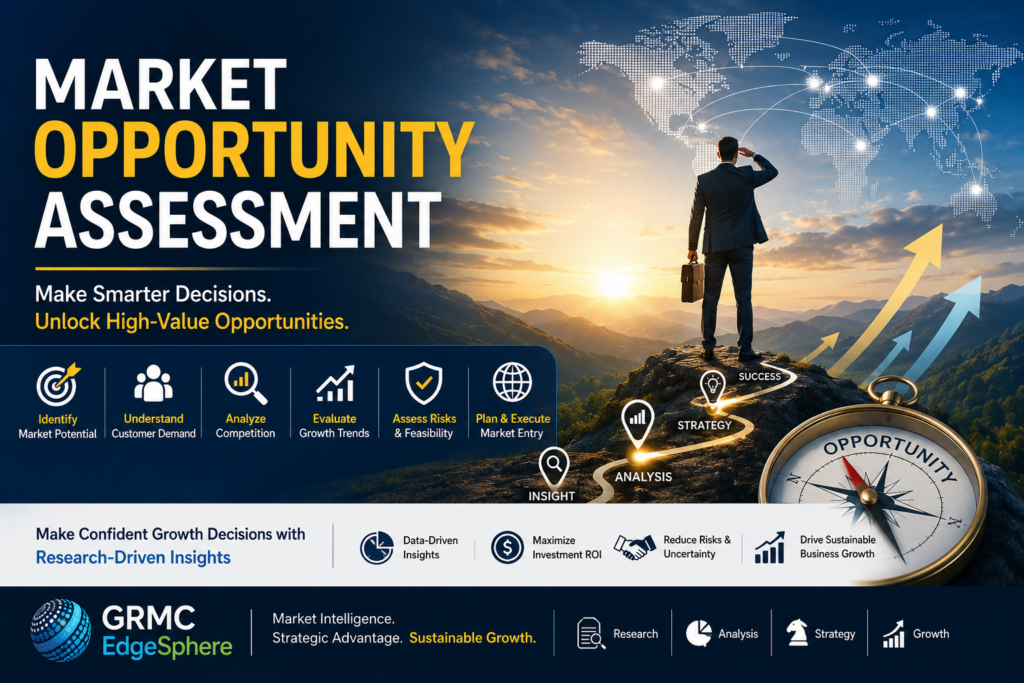
Business growth rarely happens by chance. Successful organizations identify opportunities before competitors, validate demand before investing resources, and understand market dynamics before making strategic decisions.
In today’s rapidly evolving business environment, organizations face constant pressure to expand, innovate, diversify revenue streams, and enter new markets. However, growth initiatives carry significant risks when they are based on assumptions rather than evidence.
This is why Market Opportunity Assessment has become an essential component of strategic planning.
A market opportunity assessment provides a structured evaluation of market potential, customer demand, competitive dynamics, industry trends, risks, and commercial viability. It helps decision-makers determine whether a specific opportunity is worth pursuing and how resources should be allocated for maximum return.
Whether launching a new product, expanding internationally, entering a new industry, or attracting investment, organizations that conduct thorough market opportunity assessments significantly improve their chances of success.
Industry Overview: Why Market Opportunity Assessment Is Essential in Modern Business
The global marketplace has become increasingly complex. Technological innovation, changing consumer expectations, economic uncertainty, and global competition have made strategic decision-making more challenging than ever.
Organizations are continuously exploring opportunities such as:
- Geographic expansion
- Product diversification
- New service offerings
- Digital transformation initiatives
- Industry diversification
- Strategic partnerships
- Investment opportunities
While growth opportunities are abundant, not all opportunities deliver sustainable value.
Many organizations invest heavily in promising ideas only to discover insufficient demand, intense competition, regulatory barriers, or operational challenges.
A comprehensive market opportunity assessment helps businesses separate attractive opportunities from high-risk ventures.
As organizations become more data-driven, market opportunity assessment is increasingly viewed as a strategic necessity rather than an optional research activity.
Key Challenges Organizations Face When Evaluating Growth Opportunities
Many organizations struggle to accurately evaluate market opportunities due to limited market visibility and incomplete information.
1. Overestimating Market Demand
One of the most common mistakes is assuming that customer interest automatically translates into purchasing behavior.
A product or service may appear attractive conceptually but fail to generate sufficient market demand.
Without proper research, organizations often overestimate revenue potential.
2. Entering Highly Competitive Markets
A growing market does not necessarily represent a profitable opportunity.
In many industries, dominant competitors already possess significant advantages including:
- Brand recognition
- Customer loyalty
- Distribution networks
- Pricing power
- Technology leadership
Understanding competitive intensity is critical before market entry.
3. Misunderstanding Customer Needs
Organizations frequently develop solutions based on internal assumptions rather than customer insights.
This can result in products and services that fail to address actual market requirements.
4. Ignoring Market Barriers
Regulatory restrictions, licensing requirements, cultural factors, supply chain challenges, and operational limitations can significantly affect market viability.
Failure to identify these barriers early can create costly delays and strategic setbacks.
5. Allocating Resources Inefficiently
Growth initiatives require substantial investments in:
- Personnel
- Technology
- Marketing
- Infrastructure
- Operations
Poor opportunity assessment often leads to inefficient capital allocation and reduced returns.
Market Research Insights: What Successful Organizations Evaluate Before Investing
Leading organizations use structured market opportunity assessments to evaluate opportunities from multiple perspectives.
Market Size and Growth Potential
The first step involves understanding the total addressable market.
Organizations assess:
- Current market size
- Historical growth rates
- Future growth projections
- Emerging demand patterns
- Market maturity levels
Fast-growing markets often provide greater opportunities, but sustainable demand remains the most important factor.
Customer Demand Analysis
Understanding customer demand requires more than estimating population size.
Organizations examine:
- Customer needs
- Purchasing behavior
- Buying motivations
- Budget considerations
- Pain points
- Satisfaction gaps
This helps identify whether a genuine market opportunity exists.
Competitive Landscape Evaluation
Successful organizations carefully analyze competitors before entering a market.
Key areas include:
- Market share distribution
- Competitor strengths
- Weaknesses and gaps
- Pricing strategies
- Product differentiation
- Customer experience performance
Competitive intelligence often reveals underserved market segments.
Industry Trend Assessment
Market opportunities are strongly influenced by broader industry developments.
Organizations monitor:
- Technology adoption
- Regulatory changes
- Economic conditions
- Consumer behavior trends
- Sustainability requirements
- Digital transformation initiatives
Trend analysis helps identify future opportunities rather than relying solely on current conditions.
Commercial Feasibility
A market may appear attractive but still fail to generate acceptable returns.
Organizations evaluate:
- Revenue potential
- Cost structures
- Profit margins
- Investment requirements
- Time-to-market considerations
- Operational scalability
This ensures opportunities align with business objectives.
Practical Recommendations for Decision-Makers
Organizations should adopt a disciplined approach when evaluating market opportunities.
Base Decisions on Data Rather Than Assumptions
Strategic decisions should be supported by credible research and verified market intelligence.
Avoid relying solely on anecdotal evidence or internal opinions.
Evaluate Both Demand and Competition
An attractive opportunity requires both sufficient customer demand and a realistic path to competitive differentiation.
Assessing only one factor creates incomplete insights.
Prioritize Customer-Centric Research
Customer needs should guide opportunity selection.
Organizations that deeply understand customers often identify opportunities competitors overlook.
Conduct Scenario Planning
Business environments can change rapidly.
Evaluate:
- Best-case scenarios
- Expected outcomes
- Potential risks
- Economic uncertainties
Scenario planning improves strategic resilience.
Develop Clear Market Entry Strategies
Opportunity identification is only the first step.
Organizations should establish:
- Go-to-market plans
- Customer acquisition strategies
- Pricing models
- Partnership frameworks
- Resource requirements
Execution planning is critical to realizing opportunity value.
How GRMC EdgeSphere Can Help
GRMC EdgeSphere provides comprehensive Market Opportunity Assessment services that help organizations make informed investment and growth decisions.
Our research-driven approach combines market intelligence, business analytics, competitive analysis, and strategic consulting to support evidence-based decision-making.
Our Market Opportunity Assessment Services Include:
Market Size and Demand Analysis
Identification of market potential, customer demand levels, growth projections, and commercial viability.
Competitive Intelligence Research
Comprehensive competitor analysis, market positioning evaluation, and strategic gap identification.
Industry and Sector Analysis
Assessment of market trends, industry developments, regulatory environments, and growth drivers.
Customer Research and Insights
Understanding customer needs, purchasing behavior, expectations, and unmet demands.
Feasibility Studies
Evaluation of financial, operational, commercial, and strategic feasibility before major investments.
International Market Assessment
Research and advisory support for organizations exploring regional or global expansion opportunities.
Strategic Growth Consulting
Executive-level guidance that transforms research insights into actionable growth strategies.
GRMC supports enterprises, government organizations, startups, investors, and international businesses seeking greater confidence in strategic decision-making.
Conclusion
Organizations that consistently achieve sustainable growth rarely rely on intuition alone. They invest in understanding markets, customers, competitors, and emerging trends before committing valuable resources.
A structured market opportunity assessment reduces uncertainty, improves investment decisions, identifies profitable growth paths, and strengthens competitive positioning.
As business environments continue to evolve, organizations that make research-driven decisions will be better positioned to capitalize on emerging opportunities while minimizing strategic risks.
The most successful organizations do not simply react to market changes—they identify opportunities early, validate them thoroughly, and execute with confidence.
Through comprehensive market research, business intelligence, and strategic consulting, GRMC EdgeSphere helps organizations uncover high-value opportunities and build sustainable growth strategies for the future.