

Artificial Intelligence (AI) has moved beyond experimentation and become a strategic priority for organizations worldwide. From predictive analytics and intelligent automation to customer service enhancement and operational optimization, enterprises are investing heavily in AI-driven initiatives to gain competitive advantages.
Yet despite significant investments, many organizations encounter a frustrating reality: successful AI pilots often fail to transition into enterprise-wide deployment.
According to multiple industry studies, a substantial percentage of AI initiatives never progress beyond proof-of-concept stages. While executives may witness promising early results, scaling AI across departments, processes, and business units frequently proves more challenging than anticipated.
The issue is not that AI lacks value. The problem is that many organizations approach AI as a technology project rather than a business transformation initiative.
This article explores why AI projects frequently stall after the pilot phase and outlines practical strategies enterprises can use to scale AI successfully and generate sustainable business value.
The Pilot Success Trap
Most AI pilots are intentionally designed to succeed.
Organizations typically select a limited use case, assign dedicated resources, provide clean datasets, and involve highly skilled teams. Under these controlled conditions, achieving positive results is relatively straightforward.
For example, a manufacturing company may deploy an AI model to predict machine failures within a single production line. The pilot demonstrates a 20% reduction in downtime, creating enthusiasm among stakeholders.
However, scaling that same solution across multiple factories introduces new challenges:
- Different equipment types
- Inconsistent data quality
- Integration complexities
- Operational resistance
- Regulatory requirements
- Resource limitations
The result is often a gap between pilot success and enterprise adoption.
Organizations must recognize that a successful pilot validates technical feasibility, not organizational readiness.
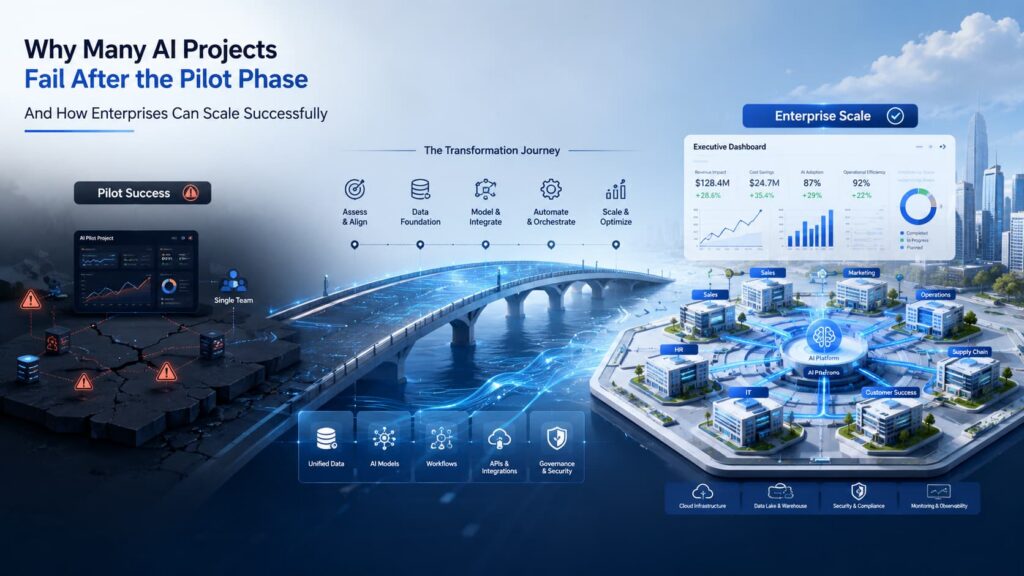
Why AI Projects Fail to Scale
1. Lack of Clear Business Objectives
One of the most common reasons AI initiatives fail is the absence of clearly defined business outcomes.
Many organizations focus on implementing AI because competitors are doing so or because leadership believes AI is strategically important. However, they fail to establish measurable business objectives tied to revenue growth, cost reduction, productivity improvement, risk mitigation, or customer experience enhancement.
Questions every AI initiative should answer include:
- What business problem are we solving?
- What KPI will improve?
- What financial value will be generated?
- How will success be measured?
Without these answers, AI projects become technology experiments rather than business investments.
2. Poor Data Foundations
AI systems are only as effective as the data that powers them.
During pilot projects, teams often spend considerable time manually cleaning and preparing datasets. While this approach may work in a controlled environment, it becomes unsustainable at enterprise scale.
Common data challenges include:
- Data silos across departments
- Inconsistent data standards
- Duplicate records
- Missing information
- Legacy system limitations
Organizations frequently discover that their biggest AI obstacle is not algorithm development but data readiness.
Successful AI scaling requires robust data governance, data quality frameworks, and enterprise-wide integration strategies.
3. Insufficient Executive Sponsorship
AI transformation impacts multiple business functions.
When AI initiatives remain confined to IT departments or innovation teams, enterprise adoption becomes difficult. Scaling often requires process redesign, workforce training, budget allocation, and organizational change management.
Without executive sponsorship, projects lose momentum when they encounter operational challenges.
Successful AI programs typically have active support from:
- CEOs driving strategic alignment
- CIOs overseeing technology integration
- CTOs ensuring technical scalability
- Business unit leaders supporting adoption
Executive leadership helps remove barriers and aligns AI investments with organizational priorities.
4. Failure to Address Change Management
Technology implementation is only one aspect of AI adoption.
Employees often fear automation will replace jobs or significantly alter established workflows. Resistance can emerge even when AI delivers measurable benefits.
Consider a customer service organization implementing AI-assisted support systems. While the technology may improve response times, agents may perceive it as a threat rather than an enhancement.
Successful organizations invest in:
- Employee engagement
- Transparent communication
- Skills development
- Change management programs
- Human-AI collaboration models
AI adoption succeeds when employees understand how technology supports rather than replaces their contributions.
5. Inadequate Technology Architecture
Many pilot projects are built quickly using isolated tools and platforms.
As organizations attempt to scale, they discover that these solutions cannot integrate effectively with existing enterprise systems.
Challenges often include:
- Legacy infrastructure limitations
- Security concerns
- Compliance requirements
- Integration complexity
- Performance bottlenecks
Enterprise-scale AI requires a scalable architecture that supports growth, governance, security, and operational reliability.
6. Absence of Governance and Risk Controls
As AI systems influence critical business decisions, governance becomes increasingly important.
Organizations must address:
- Data privacy requirements
- Regulatory compliance
- Model transparency
- Ethical AI standards
- Bias detection
- Security controls
Many pilots avoid these complexities because they operate in limited environments. However, large-scale deployment demands formal governance frameworks that ensure responsible AI usage.
The Enterprise AI Scaling Framework
Organizations that successfully scale AI generally follow a structured approach rather than relying on isolated experiments.
Start with Business Value
Every AI initiative should be linked to strategic business priorities.
Examples include:
- Reducing operational costs
- Improving customer satisfaction
- Increasing revenue opportunities
- Enhancing risk management
- Accelerating decision-making
Business outcomes must remain the primary focus throughout the project lifecycle.
Build a Strong Data Strategy
Enterprise AI requires enterprise data readiness.
Organizations should invest in:
- Data governance policies
- Master data management
- Data integration platforms
- Real-time data accessibility
- Quality assurance processes
Reliable data infrastructure creates a foundation for long-term AI success.
Establish Cross-Functional Teams
AI scaling requires collaboration across departments.
Successful teams often include:
- Business stakeholders
- Data scientists
- IT professionals
- Security experts
- Compliance specialists
- Change management leaders
Cross-functional collaboration ensures AI solutions align with operational realities and organizational goals.
Design for Scalability from Day One
Pilots should be developed with future expansion in mind.
Organizations should consider:
- Cloud-native architectures
- API-driven integration
- Modular AI components
- Security frameworks
- Monitoring systems
Building scalability into the initial design reduces future deployment challenges and costs.
Implement AI Governance Early
Governance should not be an afterthought.
Establishing clear policies for:
- Data usage
- Model management
- Risk assessment
- Compliance monitoring
- Ethical standards
helps organizations scale confidently while minimizing operational and regulatory risks.
Measure ROI Continuously
AI investments should be evaluated using measurable business outcomes.
Key metrics may include:
- Cost savings
- Productivity improvements
- Revenue growth
- Customer retention
- Process efficiency
- Risk reduction
Continuous performance measurement helps justify investments and identify opportunities for optimization.
Real-World Enterprise Example
Consider a logistics company implementing AI-powered route optimization.
The pilot phase demonstrates a 15% reduction in fuel costs across a single region. Rather than immediately expanding nationwide, the organization follows a structured scaling strategy:
- Standardizes operational data across locations.
- Integrates AI systems with transportation management platforms.
- Trains regional managers and dispatch teams.
- Establishes governance and performance monitoring.
- Gradually expands deployment region by region.
Within two years, the company achieves significant operational savings while maintaining consistency, compliance, and user adoption.
The difference is not the AI technology itself—it is the organization’s ability to scale systematically.
The Future Belongs to Scalable AI
The next wave of competitive advantage will not come from organizations that simply experiment with AI. It will come from those that successfully operationalize and scale AI across their business ecosystems.
Enterprises must move beyond isolated pilots and adopt a strategic approach that integrates technology, people, processes, and governance.
AI is not a one-time implementation project. It is a long-term capability that requires continuous refinement, alignment, and investment.
Organizations that build strong foundations today will be better positioned to improve efficiency, accelerate innovation, enhance customer experiences, and create sustainable competitive advantages in the years ahead.
Conclusion
Many AI projects fail after the pilot phase because organizations underestimate the challenges of scaling. Data limitations, weak governance, insufficient executive support, inadequate change management, and unclear business objectives frequently derail otherwise promising initiatives.
Successful enterprises take a different approach. They focus on measurable business outcomes, establish strong data foundations, invest in governance, engage stakeholders, and design scalable architectures from the outset.
The question is no longer whether AI can deliver value. The real challenge is whether organizations can scale that value across the enterprise.
Those that can will transform AI from an experimental technology into a powerful driver of growth, efficiency, resilience, and long-term business success.