

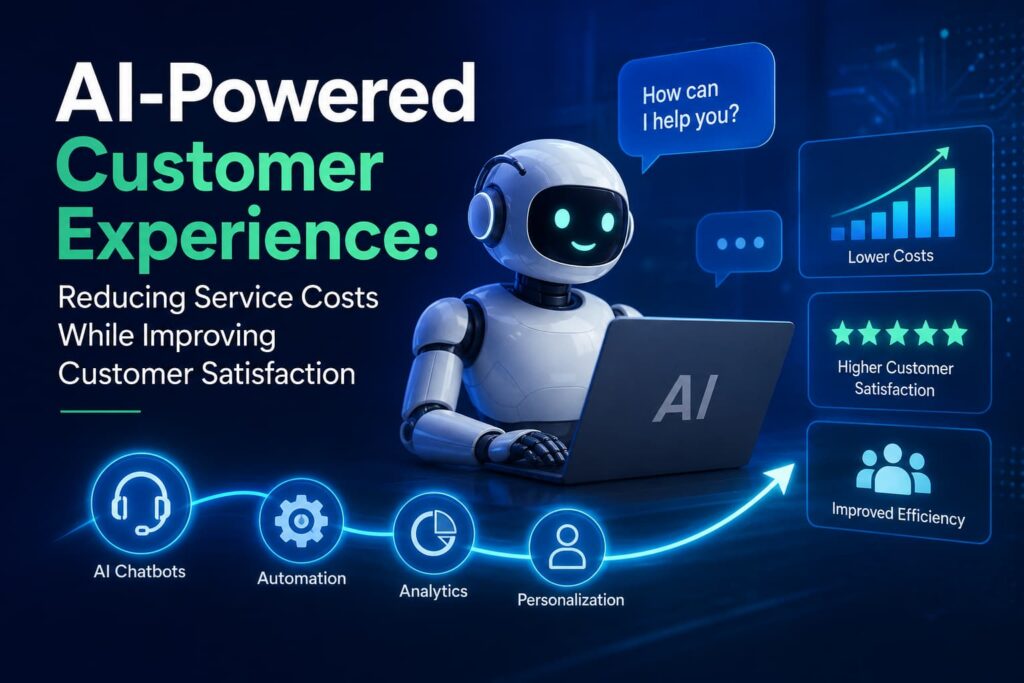
Introduction: Customer Experience is Now a Cost and Revenue Equation
Customer experience (CX) is no longer just a branding or service function—it is a core business driver directly linked to revenue retention, operational cost, and competitive differentiation. For CEOs, CIOs, and digital leaders, the challenge is no longer whether to invest in AI-powered customer experience, but how to implement it in a way that reduces cost while improving satisfaction at scale.
AI and automation are reshaping service operations by enabling organizations to handle higher volumes of customer interactions with fewer resources, faster resolution times, and improved consistency. When applied strategically, these technologies transform CX from a cost center into a measurable value generator.
The Business Case: Why AI in Customer Experience Matters
Traditional customer service models rely heavily on human agents, manual routing, and fragmented systems. This creates three major challenges:
- High operational cost per interaction
- Inconsistent customer experience across channels
- Limited scalability during demand spikes
AI-driven CX platforms address these issues by introducing intelligent automation across the entire service lifecycle.
From a business perspective, the value of AI in CX is measured in:
- Cost-to-serve reduction
- First-contact resolution improvement
- Customer retention and lifetime value increase
- Operational scalability without linear hiring growth
How AI is Transforming Customer Experience Operations
1. Intelligent Chatbots and Virtual Assistants
Modern AI chatbots go beyond scripted responses. They use Natural Language Processing (NLP) and machine learning to understand intent, context, and sentiment.
Business impact:
- Reduces call center load by handling Tier-1 queries
- Provides 24/7 support without additional staffing costs
- Improves response time from minutes to seconds
Enterprise example:
A telecom provider can automate billing inquiries, SIM activation requests, and basic troubleshooting—freeing human agents for complex cases.
2. AI-Powered Contact Center Automation
AI integrates with CRM and ticketing systems to automate routing, prioritization, and escalation.
Key capabilities:
- Predictive ticket routing based on issue type and urgency
- Sentiment analysis to detect frustrated customers
- Agent-assist tools suggesting responses in real time
Business impact:
- Reduces average handling time (AHT)
- Improves first-call resolution (FCR)
- Enhances agent productivity without increasing headcount
3. Predictive Customer Support
Instead of waiting for customers to report issues, AI analyzes usage patterns and historical data to predict problems.
Examples:
- Banks detecting potential transaction failures
- SaaS platforms identifying churn risk
- Utilities predicting service outages
Business impact:
- Proactive issue resolution reduces inbound support volume
- Strengthens customer trust and loyalty
- Minimizes churn-related revenue loss
4. Workflow Automation and Back-Office Integration
Customer experience does not end at the front desk. AI-driven automation connects front-end service with back-office systems.
Automated processes include:
- Refund approvals
- Order status updates
- Account verification
- Compliance checks
Business impact:
- Eliminates manual processing delays
- Reduces operational errors
- Improves end-to-end service speed
ROI of AI-Powered Customer Experience
For enterprise decision-makers, ROI is the most critical factor. AI in CX delivers measurable returns in three primary areas:
1. Cost Reduction
- Reduced dependency on large support teams
- Lower training and onboarding costs
- Decreased average cost per ticket
2. Revenue Protection and Growth
- Improved customer retention
- Increased upsell opportunities through personalized engagement
- Reduced churn due to faster resolution times
3. Operational Efficiency
- Higher automation rate of repetitive queries
- Improved agent productivity
- Faster service delivery across channels
A well-designed AI CX strategy typically delivers 20–40% reduction in service costs and significant improvement in customer satisfaction metrics within the first stages of adoption.
Real-World Enterprise Use Cases
Banking and Financial Services
AI is used to automate account inquiries, fraud alerts, and loan status tracking while ensuring compliance and security.
Retail and E-commerce
AI enables personalized recommendations, automated returns processing, and real-time order tracking support.
Telecommunications
High-volume support environments benefit from chatbot-driven issue resolution and predictive maintenance alerts.
Government Services
AI improves citizen engagement through automated query handling, appointment scheduling, and document processing support.
Strategic Considerations for Leadership Teams
Successful AI-powered CX transformation requires more than just technology deployment. Enterprises must focus on:
- Data readiness: Clean, structured, and integrated customer data
- Process re-engineering: Automating workflows, not just adding chatbots
- Human-AI collaboration: Redefining agent roles for complex problem-solving
- Security and compliance: Ensuring data privacy and regulatory alignment
- Scalable architecture: Cloud-native and API-driven systems
The GRMC EdgeSphere Perspective
At GRMC EdgeSphere, we view AI-powered customer experience as a strategic transformation layer rather than a standalone toolset. Organizations that succeed are those that align AI adoption with business architecture, operational goals, and customer journey design.
Our approach focuses on:
- Enterprise-grade AI integration
- Cost-to-value optimization
- Scalable automation frameworks
- Sustainable digital transformation roadmaps
Conclusion: From Service Function to Strategic Advantage
AI-powered customer experience is no longer a future concept—it is a current competitive necessity. Organizations that strategically implement AI and automation are achieving lower service costs, higher customer satisfaction, and stronger market positioning.
The real transformation lies not in replacing human interaction, but in enhancing it—making every customer touchpoint faster, smarter, and more consistent.
Enterprises that invest today are building the foundation for scalable, resilient, and customer-centric digital operations for the next decade.