

🌍 Introduction
Business leaders are making more decisions than ever before. Every day, executives evaluate market opportunities, investment proposals, operational performance, customer behavior, cybersecurity risks, supply chain disruptions, workforce planning, and digital transformation initiatives. The increasing volume and complexity of information make timely, well-informed decision-making one of the greatest competitive advantages an organization can possess.
Traditional business intelligence platforms provide valuable reports and dashboards, but they often require leaders to interpret large amounts of information before taking action. As organizations become more data-driven, there is growing demand for systems that not only analyze information but also provide intelligent recommendations that support strategic decision-making.
This evolution has led to the emergence of AI Decision Intelligence.
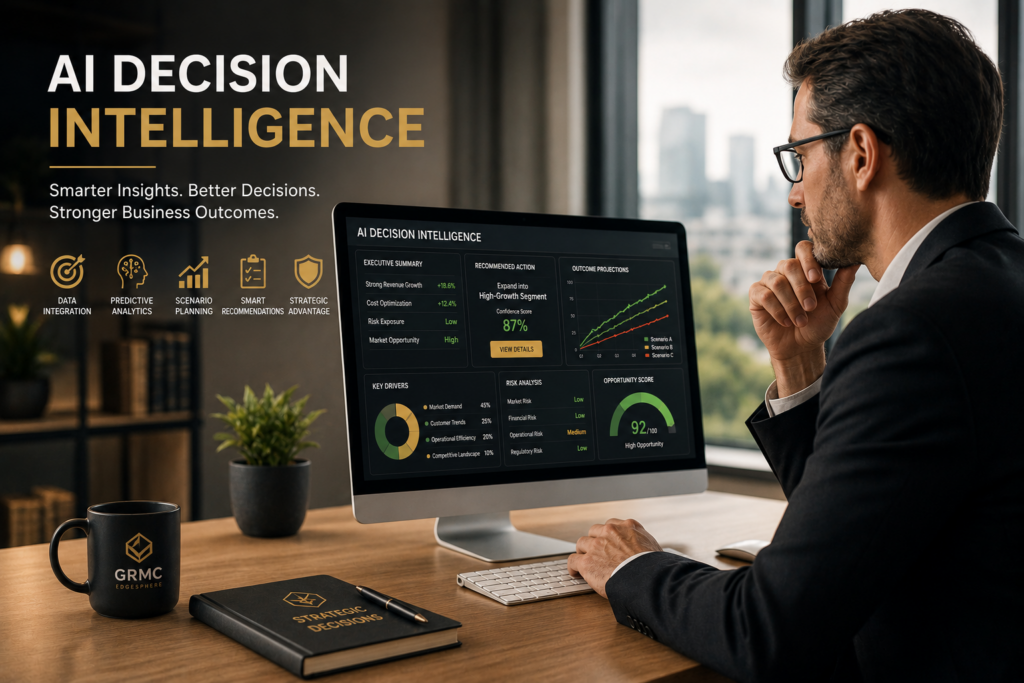
AI Decision Intelligence combines Agentic AI, advanced analytics, predictive modeling, enterprise knowledge, and business intelligence to help organizations make faster, more informed, and more consistent decisions. Rather than replacing executives, AI Decision Intelligence acts as an intelligent advisor—analyzing complex information, identifying patterns, evaluating possible outcomes, and recommending the most appropriate course of action based on organizational objectives.
Instead of asking “What happened?”, organizations begin asking:
- What is the best decision based on current information?
- Which business risks require immediate attention?
- What are the likely outcomes of each available option?
- How can AI improve strategic planning without removing human oversight?
- How can decision quality remain consistent across the organization?
For CEOs, CIOs, CTOs, Chief Digital Officers, government agencies, and enterprise leaders, AI Decision Intelligence is becoming a critical capability for improving operational agility, reducing uncertainty, and strengthening long-term business performance.
📊 Industry Overview
Organizations are investing heavily in digital transformation, cloud technologies, enterprise analytics, and artificial intelligence. While these investments generate vast amounts of business data, many organizations still struggle to transform information into timely executive decisions.
Modern enterprises collect data from customer relationship management platforms, enterprise resource planning systems, financial applications, cybersecurity platforms, supply chain systems, marketing channels, and operational technologies.
Although this information is valuable, decision-making often remains fragmented because data exists across multiple systems and departments.
AI Decision Intelligence addresses this challenge by integrating information from diverse sources, identifying meaningful relationships, forecasting potential outcomes, and presenting actionable recommendations to decision-makers.
Unlike traditional reporting systems that simply describe business performance, AI-powered decision intelligence evaluates multiple scenarios, prioritizes actions, and supports strategic planning while keeping human leaders in control.
As organizations increasingly deploy Agentic AI, Decision Intelligence is becoming the foundation for enterprise-wide intelligent operations.
⚠️ Key Challenges
📊 Information Overload
Executives often receive hundreds of reports, dashboards, and performance indicators every week.
Identifying the information that truly matters can be difficult and time-consuming.
🔍 Inconsistent Decision-Making
Different departments may interpret the same information differently, resulting in inconsistent business decisions and operational inefficiencies.
🌐 Rapidly Changing Business Conditions
Economic shifts, regulatory updates, technological innovation, cybersecurity threats, and evolving customer expectations require organizations to make decisions faster than ever before.
🤖 Limited Predictive Capabilities
Traditional reporting focuses primarily on historical performance rather than forecasting future outcomes or evaluating multiple strategic options.
⚖️ Maintaining Executive Accountability
While AI can provide recommendations, organizations must ensure final decision-making authority remains appropriately governed and aligned with business objectives.
📈 AI & Business Insights
📊 AI Enhances Executive Decision Quality
By combining historical data, predictive analytics, and real-time intelligence, AI provides leaders with more comprehensive information before strategic decisions are made.
🤝 Human Expertise Remains Essential
The most effective organizations combine AI-generated recommendations with executive experience, industry knowledge, and organizational judgment.
🌍 Scenario Planning Reduces Uncertainty
AI can evaluate multiple business scenarios simultaneously, helping leaders understand potential risks, opportunities, and likely outcomes before committing resources.
📈 Continuous Learning Improves Recommendations
As organizations gather more operational data, AI continuously refines its recommendations, improving decision accuracy over time.
🔐 Trusted Data Strengthens AI Performance
Decision Intelligence systems are only as effective as the quality of the information they analyze.
Strong data governance and enterprise knowledge management remain fundamental to successful AI adoption.
🛠️ Practical Recommendations
📋 Define Strategic Decision Frameworks
Identify which executive decisions benefit most from AI support and establish governance policies for their use.
📊 Integrate Enterprise Data Sources
Connect financial systems, customer data, operational metrics, cybersecurity platforms, and market intelligence to create a unified decision environment.
🔍 Combine Predictive Analytics with Business Intelligence
Use AI to evaluate historical performance while forecasting future business scenarios and investment outcomes.
🤖 Maintain Human Approval for High-Impact Decisions
Allow AI to automate analysis and recommendations while ensuring executives retain authority over financial, legal, regulatory, and strategic decisions.
📈 Monitor Recommendation Accuracy
Regularly measure AI performance, recommendation quality, business outcomes, and user adoption to support continuous improvement.
🔐 Strengthen Governance
Implement clear accountability, audit trails, transparency standards, and access controls that support responsible AI decision-making across the organization.
🤝 How GRMC Can Help
GRMC EdgeSphere helps organizations transform executive decision-making through advanced AI strategy, market intelligence, and digital transformation consulting.
🤖 AI Strategy & Advisory
We develop enterprise AI roadmaps that align intelligent decision support with long-term business objectives.
📊 Decision Intelligence Solutions
Our specialists design AI-powered executive dashboards and decision frameworks that integrate business intelligence, predictive analytics, and enterprise knowledge.
🔍 Business & Market Intelligence
GRMC combines internal performance data with external market research to provide comprehensive insights that strengthen strategic planning.
🔐 AI Governance
We establish governance frameworks that ensure AI recommendations remain transparent, secure, compliant, and aligned with organizational priorities.
🌍 Digital Transformation Consulting
Our consultants help organizations integrate AI Decision Intelligence into enterprise operations while maximizing operational efficiency and long-term business value.
🚀 Conclusion
As organizations continue navigating increasingly complex business environments, timely and informed decision-making has become one of the most valuable competitive advantages.
AI Decision Intelligence transforms enterprise data into actionable recommendations that help leaders evaluate opportunities, manage risk, improve operational performance, and strengthen strategic planning.
By combining Agentic AI, predictive analytics, business intelligence, and responsible governance, organizations can make smarter decisions with greater speed, confidence, and consistency while maintaining human oversight where it matters most.
GRMC EdgeSphere empowers organizations to build intelligent decision-making capabilities through AI strategy, enterprise analytics, and digital transformation—helping business leaders convert data into confident action and sustainable business growth.