

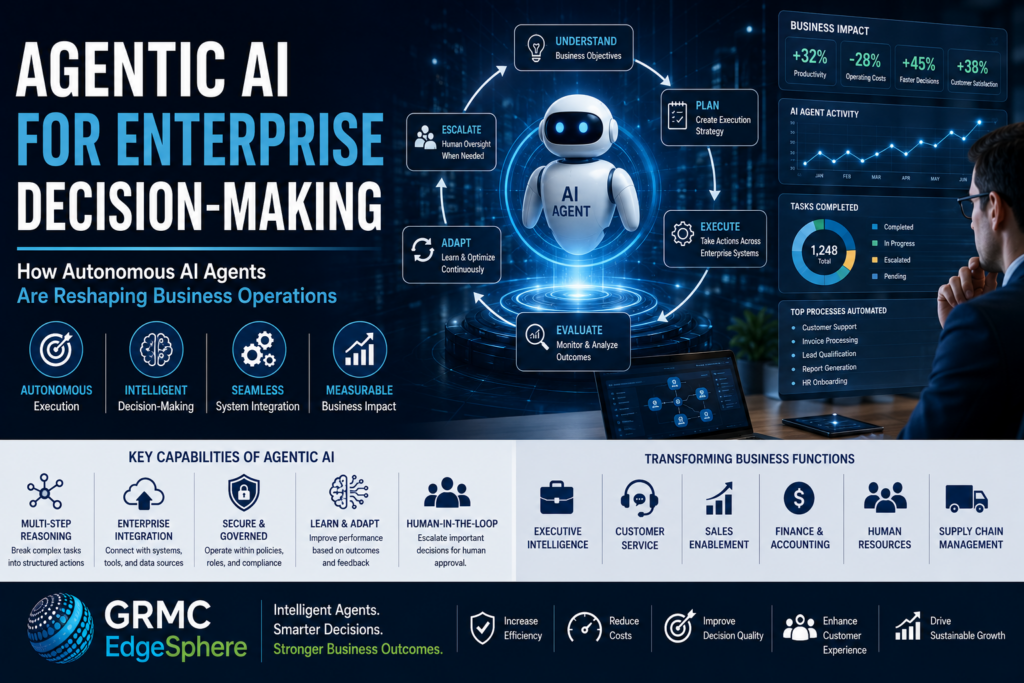
Artificial intelligence has progressed far beyond simple chatbots and predictive models. Organizations are now entering a new phase of enterprise AI adoption where intelligent software agents can plan, reason, collaborate, and execute complex business tasks with minimal human intervention. This evolution is known as Agentic AI.
Unlike traditional AI systems that respond to individual prompts or perform isolated tasks, Agentic AI solutions are designed to pursue business objectives, coordinate multiple actions, interact with enterprise systems, and continuously adapt based on changing conditions.
For business leaders, Agentic AI represents more than another technology trend. It offers a practical opportunity to increase operational efficiency, improve decision quality, reduce manual workloads, and accelerate digital transformation while maintaining governance and human oversight.
This article explores how Agentic AI is transforming enterprise operations, the business value it delivers, implementation considerations, and how organizations can successfully adopt this emerging technology.
The Enterprise Challenge
Modern organizations operate within increasingly complex business environments.
Executives face numerous operational challenges, including:
- Growing volumes of business data
- Increasing customer expectations
- Fragmented enterprise applications
- Manual coordination between departments
- Slow decision-making processes
- Rising operational costs
- Talent shortages for repetitive knowledge work
Even organizations that have adopted workflow automation often discover that many business processes still require employees to manually gather information, coordinate between systems, validate decisions, and manage exceptions.
This limits scalability and slows innovation.
Organizations need intelligent systems capable of assisting—not replacing—human professionals while autonomously managing routine business workflows.
Understanding Agentic AI
Agentic AI refers to AI systems that can independently perform multi-step tasks to achieve predefined business objectives.
Rather than responding to a single instruction, AI agents can:
- Understand objectives
- Develop execution plans
- Break complex tasks into smaller actions
- Use enterprise tools and software
- Access multiple knowledge sources
- Evaluate outcomes
- Adjust strategies when conditions change
- Escalate decisions when human approval is required
Instead of functioning as isolated AI models, Agentic AI acts as an intelligent digital workforce that collaborates with employees across business functions.
Core Components of Enterprise Agentic AI
Successful Agentic AI platforms typically combine several technologies.
Large Language Models (LLMs)
Provide advanced reasoning, language understanding, summarization, and communication capabilities.
Workflow Orchestration
Coordinates business processes across multiple applications and departments.
API Integration
Enables AI agents to securely interact with CRM systems, ERP platforms, HR software, finance applications, cloud services, and third-party business tools.
Retrieval-Augmented Generation (RAG)
Allows AI agents to retrieve current enterprise knowledge before generating responses, improving accuracy and reducing hallucinations.
Memory and Context Management
Maintains historical interactions and business context, enabling more consistent decision support.
Governance and Human Oversight
Ensures AI agents operate within defined policies, approval workflows, compliance requirements, and security controls.
Business Benefits and ROI
Organizations implementing Agentic AI can achieve measurable business outcomes.
Improved Productivity
AI agents perform repetitive knowledge work continuously without delays, enabling employees to focus on strategic initiatives.
Business Value
- Faster task completion
- Higher employee productivity
- Reduced administrative workload
Better Decision Support
AI agents collect information from multiple systems, analyze data, identify trends, and present actionable recommendations.
Business Value
- Faster executive decisions
- Improved business visibility
- Higher-quality strategic planning
Operational Cost Optimization
Automating repetitive business processes reduces dependence on manual coordination and minimizes operational inefficiencies.
Business Value
- Lower operational expenses
- Better resource allocation
- Improved process consistency
Enhanced Customer Experience
Agentic AI enables personalized, proactive customer engagement by coordinating information across multiple touchpoints.
Business Value
- Faster response times
- Improved customer satisfaction
- Higher customer retention
Greater Scalability
As business operations expand, AI agents can handle increased workloads without proportional staffing growth.
Business Value
- Support business expansion
- Improve service capacity
- Accelerate growth initiatives
Real-World Enterprise Applications
Executive Decision Intelligence
AI agents gather market trends, financial data, competitor intelligence, and operational metrics to prepare executive briefing reports before leadership meetings.
Customer Service Operations
AI agents can:
- Resolve routine customer inquiries
- Create support tickets
- Escalate complex cases
- Update CRM records
- Schedule follow-up actions
Sales Enablement
Sales teams benefit from AI agents that:
- Research prospects
- Qualify leads
- Draft personalized outreach
- Update CRM systems
- Generate meeting summaries
- Recommend next-best actions
Finance and Accounting
Agentic AI assists finance departments by:
- Monitoring invoices
- Detecting anomalies
- Preparing financial reports
- Reconciling transactions
- Supporting compliance reviews
Human Resources
HR departments use AI agents for:
- Candidate screening
- Interview scheduling
- Employee onboarding
- Policy guidance
- Learning recommendations
Supply Chain Management
AI agents continuously monitor inventory, supplier performance, logistics, and demand forecasts while recommending corrective actions.
Best Practices for Successful Adoption
Organizations should approach Agentic AI strategically.
Identify High-Impact Use Cases
Begin with repetitive, data-intensive processes that offer measurable business value.
Strengthen Data Governance
Reliable AI depends on accurate, secure, and well-managed enterprise data.
Integrate Existing Systems
Ensure seamless connectivity across ERP, CRM, HR, finance, and cloud platforms using secure APIs.
Maintain Human Oversight
Critical financial, legal, and strategic decisions should remain subject to human review and approval.
Monitor Performance
Track KPIs such as:
- Process completion time
- Cost savings
- Employee productivity
- Customer satisfaction
- AI accuracy
- Exception rates
- Return on investment
Common Challenges
While Agentic AI offers significant opportunities, organizations should proactively address:
- Legacy system integration
- Data quality issues
- Change management
- Employee adoption
- AI governance
- Cybersecurity risks
- Regulatory compliance
- Responsible AI practices
A phased implementation approach helps reduce risks while maximizing long-term value.
Implementation Roadmap
Phase 1 – Business Opportunity Assessment
Identify automation opportunities aligned with strategic business objectives.
Phase 2 – AI Readiness Assessment
Evaluate data quality, infrastructure, security posture, and integration capabilities.
Phase 3 – Pilot Deployment
Launch a limited-scope Agentic AI project with clearly defined success metrics.
Phase 4 – Enterprise Integration
Expand AI agents across departments and connect them with enterprise systems.
Phase 5 – Continuous Optimization
Continuously refine AI models, workflows, governance, and performance based on operational insights.
How GRMC EdgeSphere Can Help
GRMC EdgeSphere enables organizations to design, deploy, and scale secure Agentic AI solutions that deliver measurable business outcomes.
Our services include:
- Enterprise AI Strategy and Roadmap Development
- Agentic AI Solution Architecture
- AI Workflow Automation
- API Integration and Enterprise System Connectivity
- Business Process Optimization
- AI Governance and Responsible AI Frameworks
- Cybersecurity for AI Systems
- Data Analytics and Business Intelligence
- Change Management and User Adoption
- Performance Monitoring and Continuous Optimization
We combine business consulting with advanced technology expertise to ensure every AI initiative aligns with organizational goals, operational requirements, and long-term growth strategies.
Conclusion
Agentic AI marks a significant advancement in enterprise digital transformation. By enabling intelligent software agents to reason, plan, collaborate, and execute business workflows, organizations can improve productivity, accelerate decision-making, optimize costs, and enhance customer experiences.
However, realizing these benefits requires more than deploying AI technology. Success depends on clear business objectives, high-quality data, secure system integration, robust governance, and a thoughtful implementation strategy.
Organizations that invest in Agentic AI today will be better positioned to build resilient, intelligent, and highly scalable operations capable of adapting to tomorrow’s business challenges.
As enterprises continue their digital transformation journeys, Agentic AI is poised to become a core capability that empowers leaders to innovate with confidence and compete more effectively in an increasingly AI-driven economy.