Introduction
In today’s rapidly evolving business environment, organizations can no longer rely solely on historical data to make strategic decisions. Markets shift quickly, customer expectations change constantly, and competitive landscapes evolve faster than ever before.
This is where predictive analytics is transforming the way businesses operate.
By combining advanced analytics, artificial intelligence, machine learning, and large-scale data processing, predictive analytics helps organizations forecast future outcomes, identify emerging opportunities, and mitigate potential risks before they impact performance.
Businesses that leverage predictive analytics gain a significant advantage by moving from reactive decision-making to proactive strategic planning.
What Is Predictive Analytics?
Predictive analytics is the process of using historical data, statistical algorithms, and machine learning techniques to identify patterns and forecast future events.
Rather than simply reporting what happened in the past, predictive analytics answers questions such as:
- What is likely to happen next?
- Which customers are most likely to make a purchase?
- Which markets are expected to grow?
- What risks should organizations prepare for?
- Which products or services will generate the highest demand?
By uncovering hidden relationships within data, predictive analytics enables organizations to make informed decisions with greater confidence.
Why Predictive Analytics Matters in Modern Business
Modern businesses generate massive volumes of data every day through:
- Customer interactions
- Online transactions
- Social media engagement
- Website analytics
- Market research studies
- Operational systems
Without advanced analytical tools, much of this valuable information remains underutilized.
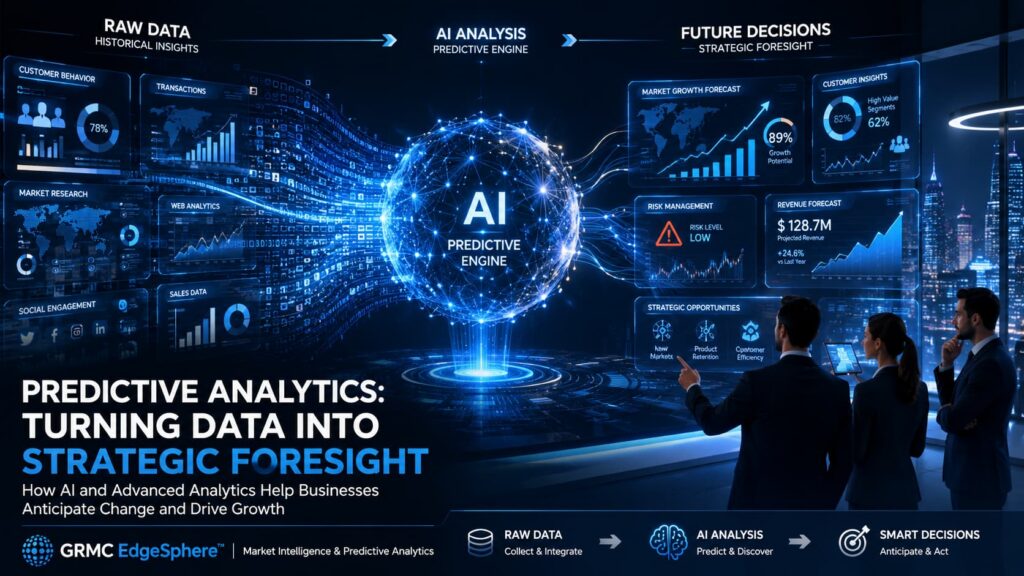
Predictive analytics transforms raw data into actionable intelligence, helping organizations:
Improve Strategic Planning
Leaders can identify future market opportunities and allocate resources more effectively.
Enhance Customer Experience
Organizations can anticipate customer needs and personalize products, services, and communications.
Reduce Business Risk
Predictive models help organizations identify potential threats before they become costly problems.
Increase Operational Efficiency
Businesses can optimize workflows, improve forecasting accuracy, and reduce unnecessary expenditures.
Key Applications of Predictive Analytics
1. Market Forecasting
Predictive analytics enables businesses to anticipate industry trends and market shifts.
Companies can evaluate:
- Future consumer demand
- Economic indicators
- Competitive developments
- Regional growth opportunities
This allows decision-makers to enter markets earlier and capitalize on emerging opportunities.
2. Customer Behavior Analysis
Understanding customer behavior is critical for sustainable growth.
Predictive models can help businesses:
- Identify high-value customers
- Predict customer churn
- Improve customer retention
- Develop targeted marketing campaigns
Organizations can deliver more personalized experiences while maximizing marketing effectiveness.
3. Sales Forecasting
Accurate sales forecasts help organizations improve budgeting and resource allocation.
Predictive analytics enables businesses to:
- Forecast future revenue
- Manage inventory efficiently
- Optimize staffing requirements
- Improve financial planning
This leads to greater operational stability and improved profitability.
4. Risk Management
Predictive analytics is increasingly used to identify and manage risk across industries.
Organizations can assess:
- Financial risk
- Operational risk
- Cybersecurity threats
- Market volatility
By identifying warning signs early, businesses can implement preventative measures before issues escalate.
The Role of Artificial Intelligence in Predictive Analytics
Artificial Intelligence (AI) has significantly enhanced predictive analytics capabilities.
Traditional forecasting models often rely on limited datasets and predefined assumptions. AI-powered systems, however, can process vast quantities of structured and unstructured data in real time.
AI enables organizations to:
- Detect complex patterns
- Generate more accurate forecasts
- Automate analytical processes
- Continuously improve prediction models
As AI technologies continue to advance, predictive analytics will become even more powerful and accessible for organizations of all sizes.
Challenges Organizations Should Consider
While predictive analytics offers substantial benefits, successful implementation requires careful planning.
Organizations should focus on:
Data Quality
Poor-quality data can lead to inaccurate predictions and ineffective decision-making.
Data Governance
Strong governance policies help ensure compliance, security, and responsible use of information.
Skilled Expertise
Analytical tools are most effective when supported by experienced researchers, analysts, and strategic consultants.
Continuous Monitoring
Predictive models should be reviewed and refined regularly to maintain accuracy as market conditions change.
How Predictive Analytics Creates Competitive Advantage
Organizations that effectively leverage predictive analytics gain the ability to make faster, smarter, and more confident decisions.
Instead of reacting to change, they can anticipate it.
This advantage allows businesses to:
- Identify new growth opportunities
- Improve customer satisfaction
- Strengthen competitive positioning
- Reduce uncertainty
- Accelerate innovation
As global markets become increasingly complex, predictive analytics is evolving from a competitive advantage into a business necessity.
Conclusion
The future of market intelligence lies in the ability to predict, adapt, and act before competitors do.
Predictive analytics empowers organizations to transform data into strategic foresight, enabling smarter decisions across marketing, operations, customer experience, and risk management.
Businesses that embrace predictive analytics today will be better positioned to navigate uncertainty, uncover new opportunities, and achieve sustainable growth in an increasingly data-driven world.
About GRMC
Global Research & Marketing Consultants (GRMC) helps organizations transform data into actionable intelligence through market research, business consulting, advanced analytics, AI-powered solutions, and digital transformation services. By combining research expertise with innovative technologies, GRMC empowers clients to make informed decisions and achieve measurable results across global markets.