

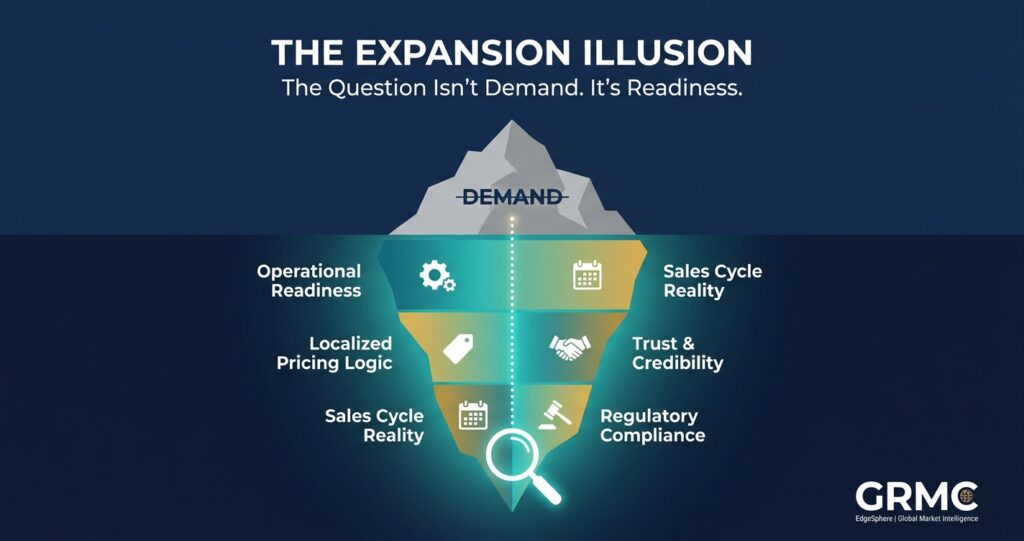
For decades, the conventional wisdom for international expansion has been deceptively simple: find a market with demand, and enter it. This logic, while intuitive, is precisely where many promising growth strategies begin to unravel. The real research question that separates successful global expansion from costly failure is not “Is there demand?” but rather, “Do we have concrete, localized evidence that this demand will translate into sustainable revenue under our specific operating conditions?”
As a senior Market Research Consultant at GRMC EdgeSphere, I’ve observed that the graveyard of failed expansions is filled with companies that correctly identified a market opportunity but fatally misjudged their own readiness and the market’s unique complexities. The problem is rarely the market itself; it is the gap between confidence in home-market success and the proof required for a new commercial environment .
The Assumption Trap: Why “Demand” is a Dangerous Starting Point
The most common error we encounter is what we term “assumption-led expansion” . This occurs when leadership teams, buoyed by domestic success, assume that their product-market fit, messaging, pricing models, and buyer behavior will seamlessly transfer to a new country. This is a critical misstep.
A recent report highlighted that 68% of founders conducted minimal or no structured market research before entering a new market, often prioritizing speed and acting on inbound customer interest or investor pressure . This “sell first, formalise later” approach might generate early activity, but it often masks deeper structural weaknesses. The key is not just to ask if there is a market, but to gather specific evidence:
- Have we spoken to potential buyers and validated our value proposition?
- Have we tested our messaging and found it resonates?
- Is there proof that this interest will convert into a sale under local pricing and purchasing logic?
This over-reliance on assumptions is a primary driver of what we call “expectation failure.” Companies choose reasonable markets, but their internal expectations for sales cycles, conversion rates, and operational costs are fundamentally misaligned with local realities .
Beyond Demand: Diagnosing Structural Readiness
A new market doesn’t just test the appeal of your product; it tests the structural readiness of your entire business . A truly robust expansion strategy must assess this readiness across several critical dimensions, which are the core of GRMC’s due diligence.
1. Capability and Operational Alignment
A common fallacy is hiring a sales lead as the first local hire . While revenue is the ultimate goal, sales are an outcome of market fit, not a substitute for it. Without a foundation of localized operational infrastructure, customer support, and marketing, sales teams are set up to fail. Our research reinforces that success in international markets depends on core capabilities like innovation, market knowledge, relational capital, and the ability to strategically adapt .
The expansion of a business is not just an export of its product but a re-establishment of its entire operational viability under new conditions . Capability failures often emerge in a cascading sequence: for example, ineffective regulatory scanning undermines localization, which then constrains overall organizational adaptation .
2. The Hidden Pitfalls: Localization and Trust
The devil is in the local details. In a new market, you aren’t just translating your website; you are translating your entire commercial logic . This includes:
- Pricing Logic: A numerical adjustment is insufficient. How do buyers in this market judge value, risk, and acceptable commitment? A pricing model that works in one region can create significant friction in another .
- Sales Cycle Realities: Founders are frequently shocked to discover that enterprise sales cycles in new markets can stretch to 12–24 months, often double or triple their expectations .
- Building Credibility from Zero: You are starting without a reputation. Building local trust, references, and visible commitment takes time and a deliberate strategy .
As one source notes, “the weakness often sits in the distance between confidence and local proof” .
3. Navigating the Macro Environment and Compliance
The era of cheap capital and geopolitical stability that allowed for “reckless market expansion” is over . Today, expansion is a question of strategic endurance. Companies face a complex web of risks, including:
- Regulatory and Compliance: Diverse regulatory regimes, tightening cross-border data compliance (like GDPR), and escalating IP disputes .
- Geopolitical Instability: Trade policies, supply chain disruptions, and political shifts can exert direct and immediate pressure on expansion strategies .
- Financial Strain: New subsidiaries often struggle with liquidity and securing local financing .
Ignoring these factors is not just an operational risk; it’s a leadership failure with significant reputational costs .
Conclusion: A New Paradigm for Strategic Expansion
The question for today’s business leaders is no longer “Which market should we enter?” but “Are we structurally prepared to succeed in this specific market?” This requires a disciplined approach that:
- Replaces Assumptions with Evidence: Validate every critical assumption about buyer behavior, sales cycles, and operational costs through direct, localized research .
- Assesses Your Organizational Readiness: Evaluate your company’s capacity for adaptation and its ability to build the necessary local infrastructure before aggressive scaling .
- Treats Each Market as a New Venture: Understand that expansion is not about exporting success but about re-establishing viability under entirely new conditions, with its own thresholds for trust, timing, and operational friction .
At GRMC EdgeSphere, our global market entry strategies are designed to guide you through this complex landscape, mitigating risks and accelerating sustainable growth. We help you move beyond the simple question of demand to develop a robust, evidence-based strategy that ensures your expansion is not just ambitious, but strategically sound.