

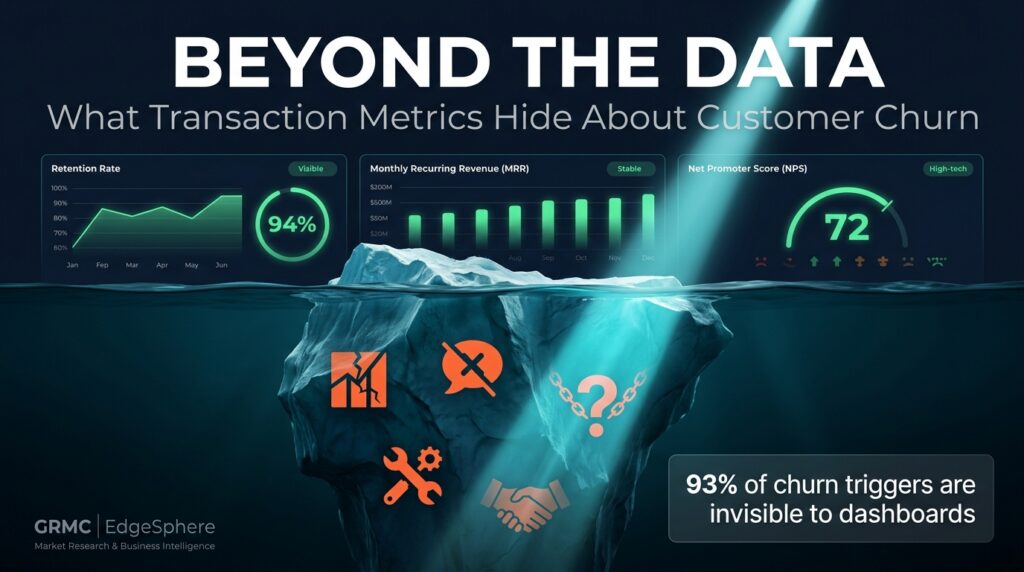
Your dashboards are green. Retention metrics look stable. And then, without warning, a high-value client departs. The exit survey is silent. The transaction data shows no red flags. What happened?
This scenario is playing out in boardrooms across the GCC, the Caribbean, and beyond. Business owners and executives are discovering a hard truth: transaction data tells you who is leaving, but it rarely tells you why. To truly prevent churn, you need to understand the customer’s story—and that requires qualitative research.
At GRMC EdgeSphere, we see this gap every day. We help organizations across North America, LATAM, Africa, and international markets move beyond the numbers to uncover the real drivers of customer loyalty. This article explores the hidden signals that quantitative data misses and how qualitative research can transform your retention strategy.
The Invisible Churn: Why Transaction Data is Only Half the Story
Recency, Frequency, and Monetary (RFM) analysis is a cornerstone of business intelligence. It segments customers based on their purchasing behavior, providing a clear picture of who is active and who is at risk . Similarly, billing data can flag payment failures or plan downgrades—powerful indicators of potential churn .
These quantitative signals are vital, but they are reactive. They tell you a customer is disengaging, but they cannot explain the context. Consider a B2B client whose spending drops. Is it due to a budget cut, a poor service experience, or a shift in their business strategy? The data points are just numbers; the reason remains a mystery.
The “Silent Churner” Conundrum
One of the most significant blind spots in transactional analysis is what researchers call “silent churn.” A classic example comes from the fitness industry, where a member stops attending but keeps paying their monthly fee for weeks or even months before formally canceling . To your transaction data, this customer appears loyal. They are, in fact, already gone.
This phenomenon underscores a critical point: a transaction is an outcome, not a feeling. You can’t fix what you don’t understand, and you can’t understand the root cause of disengagement without hearing the customer’s voice.
The Qualitative Advantage: Hearing the “Why”
Qualitative research is designed to explore the human element behind the data. It helps you understand the motivations, frustrations, and emotional drivers that influence customer behavior . When quantitative data shows what is happening, qualitative research explains why it’s happening and provides the context needed to act.
Capturing the Emotional Context of Failure
Traditional analytics can pinpoint a technical error, like a “Login Failed” message. However, they often fail to capture the emotional response it triggers . In the fintech sector, for example, a perceived mismatch between a portfolio balance and a bank balance might be a minor technical issue on paper. To the customer, it’s a “trust crisis” that immediately negates months of positive engagement .
Qualitative methods like in-depth interviews can uncover these “micro-moments of confusion, frustration, and betrayal” that occur between the transaction and the support ticket. Understanding these moments is key to preventing hard churn .
Uncovering Systemic Experience Gaps
Sometimes, the issue isn’t a single event but a flawed process. A study on a major B2B service provider found a dramatic mismatch between customer sentiment and their Net Promoter Score (NPS) . Many customers giving high scores (9s and 10s) were actually unhappy, with 63% of all customers being identified as complainers through text analysis of their verbatim comments . The NPS metric was misinforming management and diverting them from effective marketing actions.
Similarly, in digital banking, the core dimensions of customer retention are not just technical performance but also service quality, marketing communications, and the “human touch in technology”—all of which are best explored through qualitative inquiry . Customers don’t just evaluate a single transaction; they experience a “set of functional, emotional, and perceptual perceptions simultaneously” .
What You Discover with Qualitative Research
Integrating qualitative research into your business intelligence strategy allows you to identify specific, actionable insights that data alone cannot provide.
- The Real Reasons Behind the “Drop”: A customer’s decreasing engagement might be due to a poorly managed onboarding experience, a lack of proactive support, or an expectation set during the sales process that wasn’t met . One study found that customer disengagement in the fitness industry was “less linked to physical infrastructure or the app and more to gaps in the functional quality of the service” .
- The “Data Mismatch Betrayal”: As seen in fintech, a customer’s trust can be shattered not by a product’s core function, but by the jarring experience when data from different sources doesn’t sync seamlessly . This isn’t a technical issue to be solved by IT; it’s a relationship issue to be solved by understanding the customer’s expectations.
- The “Invisible Fee Anxiety”: Customers might not complain about ambiguous fees; they will simply avoid using the features or services they fear will incur them . This leads to low engagement and caps revenue potential without any visible sign of dissatisfaction in the data .
Actionable Intelligence: From Insight to Strategy
The ultimate goal of understanding churn is to prevent it. Here is how you can apply these insights:
- Segment with Purpose: Use qualitative insights to create a more robust segmentation. A “turn-away” client—one who is becoming less active—requires a different tactical approach than a low-value client. An “issue-based communication or engagement centered on specific challenges relevant to the client’s current condition” can restore these weakened relationships before they turn into permanent churn .
- Personalize Retention: General retention campaigns are often ineffective. By understanding the specific reasons for a customer’s dissatisfaction, you can personalize your outreach. One study using NLP to extract specific churn triggers from customer dialogues found that “personalized retention… improves retention by 11–12% compared to the standard approach” .
- Re-engineer the Customer Journey: Use qualitative findings to redesign your customer journey and fix the root causes of friction. This means moving beyond simple process mapping to experience-driven business process reengineering. For example, in the fitness industry, a “First Guided Workout” and an “automatic rescue rule” were proposed as practical recommendations to improve the onboarding experience and reduce silent churn .
Quantifying the Value of Understanding Your Customer
Investing in qualitative research is not an expense; it’s an investment with a measurable return. By reducing your Customer Acquisition Cost (CAC) through more targeted marketing and increasing Customer Lifetime Value (LTV) through better retention, the ROI is clear . For instance, a 5% increase in retention can significantly boost your bottom line. Qualitative research provides the insights needed to achieve that increase .
Conclusion: The Competitive Edge of Customer Understanding
In today’s data-rich environment, the organizations that win are not those with the most data, but those with the deepest understanding of it. Transactional data and business intelligence tools are indispensable for monitoring performance, but they are incomplete without the human context that only qualitative research can provide.
At GRMC EdgeSphere, we help businesses bridge this gap. By integrating our expertise in market research, business intelligence, and AI automation, we empower you to see the complete picture of your customer’s journey. We help you understand not just who is leaving, but why—and give you the strategic insights to stop them before they do.