

🌍 Introduction
Customer acquisition is often treated as one of the most important priorities in business growth. Organizations invest in advertising, sales teams, product development, promotions, and customer experience initiatives to attract new customers.
But there is another question that can have an even greater impact on long-term performance:
Why do existing customers decide to leave?
A customer may switch to a competitor because of price, service quality, product limitations, poor communication, inconvenient processes, changing expectations, or simply because another company provides a better overall experience.
The challenge is that customers rarely leave for only one reason.
A seemingly small issue—such as a delayed response from customer support—may become significant when combined with pricing concerns, limited product choices, and an increasingly attractive competitor. If organizations only examine cancellation rates or customer complaints, they may see the outcome without understanding the underlying causes.
This is where Customer Switching Behavior Analysis becomes valuable.
Customer Switching Behavior Analysis is a market research approach focused on understanding why customers change providers, brands, products, platforms, or services. It examines the motivations, experiences, expectations, competitive influences, and decision-making patterns that lead customers to switch.
Rather than asking only “How many customers did we lose?”, organizations can ask:
- Why did customers decide to leave?
- What happened immediately before the switching decision?
- Which competitor factors influenced their choice?
- Which customers are most likely to switch next?
- What changes could increase retention?
- Are customers leaving because of price, experience, product value, or competitive positioning?
For CEOs, marketing leaders, customer experience executives, investors, and enterprise decision-makers, understanding switching behavior can provide valuable intelligence for improving retention, strengthening competitive positioning, and protecting long-term revenue.
📊 Industry Overview
Customer loyalty has become increasingly difficult to maintain.
Customers today have greater access to information, alternative providers, online reviews, comparison platforms, digital marketplaces, and personalized offers. Switching between brands or service providers can be significantly easier than it was in the past.
At the same time, expectations have increased.
Customers often expect faster service, transparent pricing, personalized communication, convenient digital experiences, reliable products, and responsive support.
This creates a challenging environment for businesses.
A company may believe its product is competitive while customers perceive the overall experience differently. A pricing strategy may appear attractive internally but become less compelling when compared with competitor packages. A customer service process may appear efficient from an operational perspective but still create frustration for customers.
Customer Switching Behavior Analysis bridges this gap by examining the market from the customer’s perspective.
It combines customer research, behavioral analysis, competitor intelligence, feedback analysis, and business data to identify the factors influencing switching decisions.
⚠️ Key Challenges
👥 Customers Do Not Always Explain Their Real Reasons
When customers cancel a service or stop purchasing, the reason recorded in a database may be extremely simple.
For example, “price” may be listed as the reason for cancellation.
However, deeper research could reveal that the real issue was a combination of poor service, limited features, and a competitor offering greater perceived value.
Understanding the difference between the stated reason and the underlying motivation is essential.
💰 Price Is Not Always the Main Problem
Organizations frequently assume customers leave because competitors offer lower prices.
In reality, customers may be willing to pay more when they receive superior service, convenience, reliability, expertise, or personalization.
Reducing prices without understanding the real switching motivation can therefore damage profitability without solving the retention problem.
🌍 Competitive Offers Change Quickly
Competitors continuously introduce new products, pricing structures, loyalty programs, digital experiences, and customer engagement strategies.
A switching analysis must therefore examine the competitive environment rather than focusing exclusively on internal performance.
📊 Customer Segments Behave Differently
Not all customers have the same reasons for switching.
A price-sensitive customer may respond differently from a premium customer. A business client may prioritize reliability and service-level agreements, while an individual consumer may prioritize convenience.
Segment-level research provides a much clearer picture of switching behavior.
⏳ Organizations Often Investigate Too Late
Many businesses analyze customer churn only after significant losses have occurred.
By then, the organization may have already lost valuable customers and spent considerable resources trying to replace them.
Understanding switching signals earlier creates an opportunity for proactive intervention.
📈 Market Research Insights
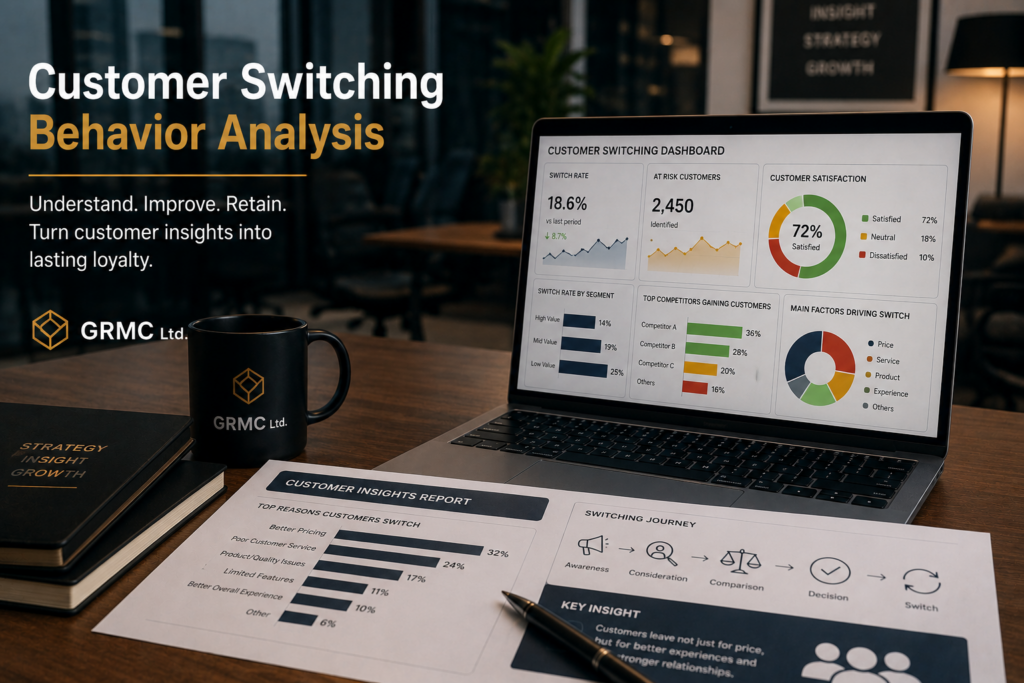
🔍 Switching Is Often a Journey, Not a Single Event
Customers rarely wake up one morning and suddenly decide to leave without any previous signals.
Dissatisfaction may develop gradually through repeated experiences.
A customer might first experience a service issue, then become less engaged, start researching alternatives, compare competitors, and eventually make the decision to switch.
Mapping this journey helps organizations identify opportunities to intervene before customers leave.
👀 Competitors Influence Perceived Value
Customers do not evaluate a product or service in isolation.
They compare what they receive with what alternatives provide.
A competitor may not necessarily offer a superior product, but if its communication, onboarding, pricing structure, or digital experience appears better, customers may perceive greater value.
📊 Customer Experience Can Become a Competitive Differentiator
Products and prices can often be copied.
Customer experience is more difficult to replicate because it is influenced by organizational processes, employee behavior, technology, communication, and service culture.
Understanding which experiences influence loyalty can help organizations build stronger competitive advantages.
🌐 Switching Motivations Vary by Market
Customer behavior can differ significantly across countries, industries, regions, and demographic groups.
Cultural expectations, economic conditions, regulatory environments, purchasing habits, and competitor availability can all influence switching decisions.
Localized market research is therefore important for organizations operating across multiple markets.
📈 Former Customers Can Provide Valuable Intelligence
Lost customers should not simply be treated as lost revenue.
They can provide valuable information about competitor strengths, product weaknesses, service problems, pricing perceptions, and unmet expectations.
Organizations that systematically study former customers can uncover insights that are difficult to obtain from existing customers alone.
🛠️ Practical Recommendations
📋 Map the Customer Switching Journey
Identify the stages customers typically experience before leaving.
Study awareness of alternatives, dissatisfaction, competitor research, comparison, decision-making, cancellation, and post-switch behavior.
This helps identify the moments where intervention may be possible.
🔍 Conduct Exit Research
Use structured surveys, interviews, follow-up conversations, and customer feedback programs to understand why customers leave.
Avoid relying exclusively on standardized cancellation categories.
👥 Segment Customers by Switching Risk
Analyze customers according to factors such as purchasing frequency, engagement, product usage, profitability, service interactions, and satisfaction.
This can help identify groups that require different retention strategies.
📊 Compare Competitor Experiences
Study competitor pricing, customer service, product features, onboarding, digital platforms, loyalty programs, and communication strategies.
The goal is not simply to copy competitors but to understand why customers perceive their offerings as attractive.
💡 Identify Preventable Switching Drivers
Separate factors that the organization can control from external factors that cannot easily be changed.
For example, a company may not be able to control economic conditions, but it can improve response times, simplify processes, enhance communication, or redesign customer support.
📈 Monitor Early Warning Indicators
Develop research and analytics programs that identify declining engagement, reduced purchasing frequency, increasing complaints, or other signals associated with future switching.
🔄 Close the Feedback Loop
Research should lead to action.
Share switching insights with marketing, product, sales, customer service, operations, and leadership teams so that identified problems can be addressed across the organization.
💡 Turning Customer Loss into Competitive Intelligence
One of the most valuable aspects of switching behavior research is that it can reveal information that traditional market research may overlook.
Imagine a company discovers that customers who leave frequently move to a competitor offering a slightly more expensive service.
At first, this may appear confusing.
Why would customers pay more?
Further research could reveal that the competitor provides faster support, easier account management, clearer communication, and a more convenient digital platform.
The insight is therefore not simply that customers prefer the competitor.
The deeper insight is that customers are willing to pay more for a better overall experience.
This can completely change the organization’s strategy.
Instead of launching a discount campaign, the company may invest in customer service improvements, digital experience, and relationship management.
That is the value of deeper market research: it transforms a visible business problem into an understandable strategic opportunity.
🤝 How GRMC Can Help
GRMC Ltd. helps organizations understand customer behavior through research-driven market intelligence and strategic advisory services.
👥 Customer Behavior Research
We investigate customer motivations, expectations, satisfaction levels, and decision-making patterns to uncover the factors influencing retention and switching.
🔍 Competitor Intelligence
Our research evaluates competitor positioning, customer experience, pricing approaches, product strategies, and market differentiation.
📊 Customer Segmentation
GRMC develops customer segments based on behavior, needs, value, and market characteristics to support more targeted business strategies.
📈 Market Intelligence
We combine customer research with broader market intelligence to help organizations understand the external factors influencing customer decisions.
🌍 Strategic Advisory
Our consultants translate research findings into practical recommendations that can improve customer retention, competitive positioning, and long-term market performance.
🚀 Conclusion
Customer switching is more than a retention problem. It is a source of strategic intelligence.
Every customer who leaves provides an opportunity to understand what the market expects, where competitors are succeeding, and which parts of the customer experience may require improvement.
Customer Switching Behavior Analysis enables organizations to move beyond basic churn statistics and investigate the deeper motivations behind customer decisions.
By examining switching journeys, competitor experiences, customer expectations, market conditions, and behavioral patterns, businesses can identify preventable sources of customer loss and develop more effective retention strategies.
The strongest organizations do not wait until customers leave to learn what went wrong. They continuously study customer behavior, monitor changing expectations, and use market intelligence to improve the experience before dissatisfaction becomes a switching decision.
GRMC Ltd. helps organizations transform customer behavior into actionable market intelligence through research, competitive analysis, customer insights, and strategic consulting—helping businesses strengthen relationships, identify market opportunities, and build sustainable competitive advantage.