

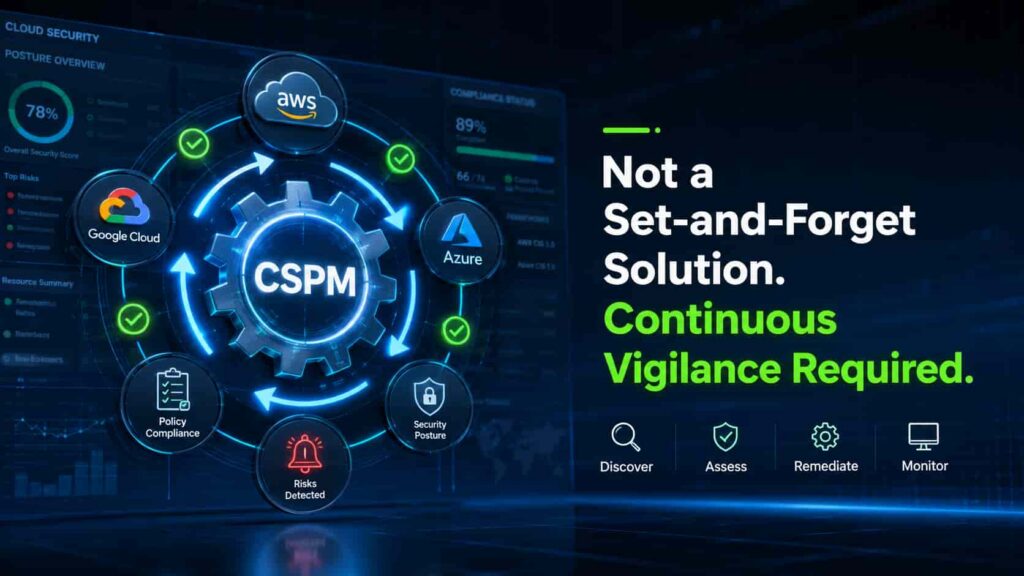
As enterprise cloud adoption accelerates, security leaders face a critical misconception: that deploying a Cloud Security Posture Management (CSPM) tool is a one-time fix. The reality is starkly different. For CEOs, CISOs, and IT Directors overseeing complex cloud environments—particularly in regulated sectors like finance, healthcare, and government—treating CSPM as a “set-and-forget” solution introduces significant business risk.
According to ISACA, most cloud security incidents today originate not from sophisticated attacks, but from misconfigurations, excessive permissions, and fragmented visibility . With 73% of cloud security incidents stemming from preventable misconfigurations and the average public cloud breach costing $5.17 million , the stakes demand continuous vigilance and strategic oversight—not passive tool deployment.
1. Understanding the True Role of CSPM in the Enterprise
CSPM tools provide automated, continuous monitoring of cloud environments to identify misconfigurations, ensure compliance with frameworks like NIST, ISO 27001, and CIS Controls, and detect configuration drift . They operate across AWS, Azure, and GCP to deliver unified visibility into security posture .
What CSPM Does Well
- Configuration Monitoring: Scans for open storage buckets, overly permissive IAM roles, and insecure network settings .
- Compliance Enforcement: Automates assessments against regulatory standards (e.g., SOC 2, HIPAA, DORA) and generates audit-ready reports .
- Drift Detection: Identifies deviations from secure baselines as cloud resources are dynamically scaled or updated .
However, CSPM is fundamentally a diagnostic tool—it identifies problems but does not solve the organizational and process gaps that allow risks to persist . As one industry analysis notes, CSPM gives you an “X-ray” of your cloud environment, but without a “doctor” to interpret and act on findings, visibility does not equate to remediation .
2. Why the Set-and-Forget Mindset Fails
2.1. The Velocity Gap: Cloud Moves Faster Than Governance
Development teams deploy infrastructure-as-code across regions in minutes, often without human intervention . Governance models, meanwhile, evolve slowly. This mismatch means that static CSPM rules quickly become outdated, allowing new misconfigurations to accumulate before they are detected .
2.2. Alert Overload and False Positives
A typical enterprise receives hundreds of cloud security alerts daily, with up to 43% being false positives . One organization deploying CSPM across 90+ AWS accounts reported 6,000 initial alerts . Without continuous tuning, security teams suffer alert fatigue, reducing their ability to prioritize genuine threats . This undermines the “set-and-forget” premise, as tools require ongoing refinement to be operationally effective.
2.3. Configuration Drift and Ephemeral Resources
Cloud environments are dynamic: auto-scaling groups, temporary test instances, and serverless functions appear and disappear constantly . A CSPM tool that takes a static snapshot misses risks introduced between scans. Continuous monitoring is required not because the tool fails, but because the cloud’s state is perpetually changing .
2.4. The Illusion of Full Coverage
CSPM tools are excellent at finding known misconfigurations, but they do not model attack paths—how a series of seemingly low-risk issues can be chained together to achieve privilege escalation or lateral movement across accounts . Real attackers exploit these pathways, which are invisible to rule-based scanners . Treating CSPM as a set-and-forget solution leaves organizations exposed to these complex, multi-step attacks .
3. Building a Continuous CSPM Strategy: From Tool to Capability
To address these limitations, enterprises must embed CSPM into a continuous risk management framework aligned with NIST CSF and Zero Trust principles.
3.1. Integrate CSPM into the Full Cloud Lifecycle
Effective CSPM is not a standalone activity. It must be operationalized across:
3.2. Tune Alerts with Context and Automation
Rather than accepting default alerting rules, mature organizations customize policies based on business context. For example, one enterprise reduced IAM-related alerts by 82% and S3 bucket alerts by 40% by refining rules to differentiate between production, sandbox, and CloudFront-origin buckets . This contextual tuning transforms CSPM from a source of noise into a precision tool.
3.3. Combine CSPM with Broader Security Capabilities
CSPM tools are most effective when integrated with:
- Cloud Infrastructure Entitlement Management (CIEM): To manage identity risks and excessive permissions .
- Data Security Posture Management (DSPM): To add data context and reduce false positives by focusing on sensitive information .
- Cloud-Native Application Protection Platforms (CNAPP): Which unify CSPM with workload and identity protection for end-to-end visibility .
3.4. Establish Accountability, Not Just Visibility
In large, regulated organizations, posture management is ultimately about accountability . Security teams must evolve from gatekeepers to “continuous assurance partners” embedded within engineering workflows . This shift requires clear ownership of cloud risk, regular executive reviews, and alignment with frameworks like NIST 2.0 for governance and risk management.
4. Conclusion: CSPM as a Journey, Not a Destination
Cloud Security Posture Management is an essential component of modern cloud security, but it is not a panacea. The most common implementation failure is treating it as a standalone, static solution . To truly reduce business risk, enterprises must view CSPM as a continuous capability that requires ongoing tuning, integration with other security controls, and alignment with engineering and governance processes.
At GRMC EdgeSphere, we help organizations navigate this complexity. Our approach goes beyond tool deployment to embed CSPM into your cloud governance framework, ensuring that your security posture evolves with your business. Contact us to learn how we can transform your cloud security from a set of alerts into a strategic business enabler.