🌍 Introduction
Business growth rarely happens by chance. Organizations that consistently outperform their competitors are often those that anticipate market shifts before they become obvious. Instead of reacting to changing customer behavior, economic conditions, or industry disruptions, successful businesses make decisions based on reliable forecasts supported by research and data.
However, predicting future demand has become increasingly challenging. Consumer expectations evolve rapidly, technology accelerates market change, global supply chains influence product availability, and economic uncertainty can affect purchasing behavior with little warning.
Relying solely on historical sales data is no longer sufficient.
This is where Market Demand Forecasting becomes an essential business capability.
Market Demand Forecasting combines market research, customer intelligence, economic analysis, competitive insights, and business data to estimate future demand for products, services, or investments. Rather than making assumptions about what customers may want, organizations use structured research and evidence-based forecasting models to identify future opportunities, reduce uncertainty, and improve strategic planning.
Instead of asking “How much can we sell?”, organizations begin asking:
- How will customer demand change over the next 12 to 24 months?
- Which markets will experience the strongest growth?
- What external factors could influence purchasing behavior?
- How should we allocate resources based on expected demand?
- Which investments will generate the greatest long-term value?
For CEOs, investors, government organizations, business owners, and enterprise leaders, Market Demand Forecasting provides the intelligence needed to make proactive decisions and build sustainable competitive advantage.
📊 Industry Overview
Organizations today operate in highly dynamic business environments where market conditions can change rapidly.
Advances in digital technologies, artificial intelligence, evolving customer expectations, regulatory developments, demographic changes, and economic fluctuations all influence future demand.
Businesses that depend solely on historical performance often struggle to respond effectively to these shifts.
Modern market forecasting integrates multiple sources of information, including:
- Customer research
- Industry reports
- Economic indicators
- Competitor intelligence
- Consumer behavior analysis
- Digital analytics
- Operational performance data
By combining internal business intelligence with external market research, organizations develop more accurate demand forecasts that support investment planning, product development, workforce management, and long-term growth strategies.
Rather than predicting the future with certainty, Market Demand Forecasting helps organizations prepare for multiple possible outcomes and respond with greater confidence.
⚠️ Key Challenges
📈 Rapidly Changing Customer Behavior
Customer preferences evolve due to technological innovation, economic conditions, social trends, and changing lifestyles.
Forecasting demand requires continuous research rather than one-time analysis.
🌍 External Market Uncertainty
Inflation, geopolitical developments, regulatory changes, supply chain disruptions, and competitive activity can significantly influence future demand.
Organizations must evaluate these external factors alongside internal performance.
📊 Incomplete Business Intelligence
Forecasts based solely on internal sales figures may overlook broader market opportunities or emerging risks.
A comprehensive forecasting strategy requires both internal and external intelligence.
🏢 Resource Allocation Decisions
Accurate forecasts influence hiring, production planning, technology investments, marketing budgets, and operational expansion.
Poor forecasting can result in unnecessary costs or missed growth opportunities.
⏳ Delayed Strategic Response
Organizations that identify market changes too late often lose competitive advantage to businesses that anticipate demand earlier.
📈 Market Research Insights
📊 Customer Intelligence Improves Forecast Accuracy
Understanding evolving customer expectations provides valuable insight into future purchasing behavior and emerging market opportunities.
🌐 Multiple Data Sources Produce Better Forecasts
Combining market research, operational analytics, competitive intelligence, and economic indicators creates more reliable forecasting models than relying on historical sales alone.
👥 Regional Markets Behave Differently
Demand patterns often vary across industries, countries, customer segments, and demographic groups.
Localized research enables organizations to develop market-specific growth strategies.
📈 Continuous Forecasting Supports Better Planning
Market forecasting should be treated as an ongoing business capability rather than an annual planning exercise.
Regular updates improve responsiveness as conditions change.
🤝 Forecasting Reduces Strategic Risk
Organizations that evaluate multiple future scenarios are generally better prepared to manage uncertainty and capitalize on emerging opportunities.
🛠️ Practical Recommendations
📋 Establish a Continuous Research Program
Monitor customer behavior, industry developments, economic conditions, and competitor activity throughout the year to maintain current market intelligence.
🔍 Combine Quantitative and Qualitative Research
Use surveys, interviews, focus groups, observational studies, and business analytics together to gain a balanced understanding of future demand.
📊 Develop Scenario-Based Forecasts
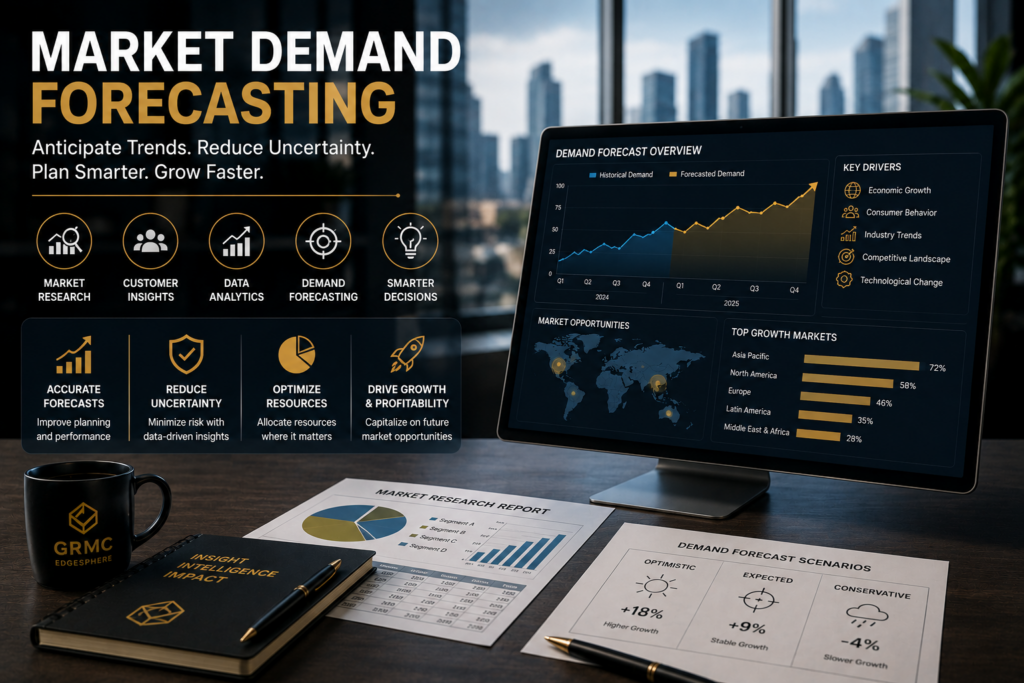
Prepare for multiple business scenarios—including optimistic, expected, and conservative outcomes—to improve strategic flexibility.
🌍 Monitor External Influences
Track regulatory changes, technological innovation, demographic shifts, and macroeconomic indicators that may affect market demand.
🤝 Align Forecasts with Business Strategy
Ensure demand forecasts directly support product development, investment planning, workforce management, and market expansion initiatives.
📈 Review Forecast Performance Regularly
Compare projected demand with actual market performance to improve forecasting accuracy and refine future planning models.
🤝 How GRMC Can Help
GRMC EdgeSphere provides advanced market research, business intelligence, and strategic advisory services that help organizations forecast demand with greater confidence and precision.
📊 Market Demand Analysis
We evaluate customer behavior, market trends, industry developments, and economic indicators to identify future growth opportunities.
🔍 Customer & Industry Research
Our specialists conduct evidence-based research that explains evolving customer expectations and market dynamics.
📈 Business Intelligence
GRMC combines internal operational data with external market intelligence to deliver accurate forecasting insights for executive decision-making.
🌍 Strategic Growth Advisory
We support organizations in transforming forecasting insights into practical business strategies that improve investment planning and long-term competitiveness.
🤝 Executive Consulting
Our consultants help leadership teams strengthen strategic planning through reliable market intelligence, forecasting methodologies, and data-driven decision support.
🚀 Conclusion
In an increasingly competitive and rapidly changing business environment, organizations can no longer rely solely on historical performance to guide future decisions.
Market Demand Forecasting enables businesses to anticipate customer needs, identify emerging opportunities, reduce uncertainty, and make confident strategic investments based on evidence rather than assumptions.
By combining comprehensive market research, business intelligence, competitive analysis, and continuous forecasting, organizations strengthen their ability to adapt, innovate, and achieve sustainable growth.
GRMC EdgeSphere empowers organizations to transform market uncertainty into strategic opportunity through advanced forecasting, business intelligence, and research-driven consulting—helping leaders make informed decisions that support long-term business success.