

🌍 Introduction
Every organization faces a common challenge: there are always more opportunities than available resources.
Businesses can expand into new regions, launch innovative products, invest in emerging technologies, enter new customer segments, develop strategic partnerships, or strengthen existing operations. While each opportunity may appear promising, attempting to pursue all of them simultaneously often leads to diluted investments, operational complexity, and slower business growth.
The organizations that consistently outperform their competitors are not necessarily those that pursue the greatest number of opportunities—they are the ones that invest in the right opportunities at the right time.
This is where Market Opportunity Prioritization becomes a critical component of strategic planning.
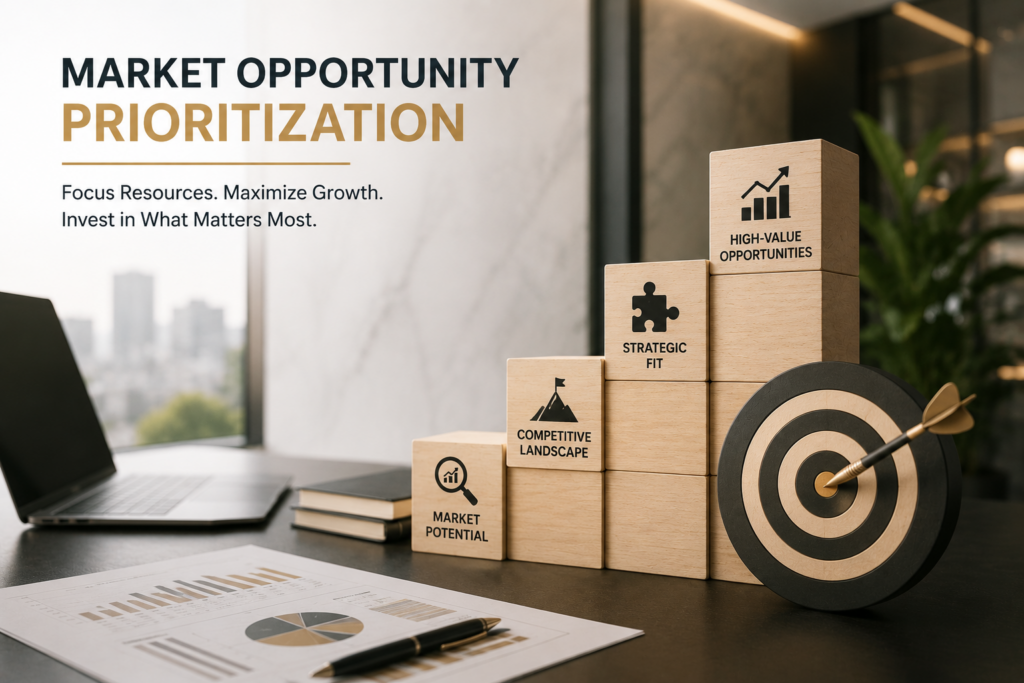
Market Opportunity Prioritization is an advanced market research methodology that evaluates, ranks, and compares growth opportunities using objective business intelligence rather than assumptions. By combining customer insights, competitive intelligence, market demand, financial feasibility, operational readiness, and long-term strategic alignment, organizations can confidently determine which opportunities deserve immediate investment and which should be postponed or monitored.
Instead of asking “Which opportunity looks attractive?”, successful organizations ask:
- Which market offers the highest long-term return?
- Which opportunity aligns with our capabilities?
- Where can we achieve sustainable competitive advantage?
- Which investment presents the lowest strategic risk?
- How should opportunities be prioritized across different markets?
For CEOs, investors, government organizations, enterprise leaders, and business owners, Market Opportunity Prioritization provides a structured framework for maximizing business growth while reducing uncertainty.
📊 Industry Overview
Today’s business environment is defined by constant change.
Emerging technologies, digital transformation, evolving customer expectations, geopolitical developments, sustainability initiatives, and economic uncertainty continually reshape markets across every industry.
Organizations have access to more potential opportunities than ever before. However, increased opportunity also creates greater complexity.
Businesses must decide whether to:
- Expand internationally
- Enter adjacent industries
- Launch new products
- Invest in AI and automation
- Strengthen customer experience
- Acquire competitors
- Build strategic partnerships
- Diversify revenue streams
Without structured evaluation, investment decisions often rely on intuition, internal opinions, or incomplete market information.
Market Opportunity Prioritization replaces subjective decision-making with evidence-based analysis, helping organizations identify opportunities that deliver the greatest long-term value while remaining aligned with business objectives.
⚠️ Key Challenges
📉 Every Opportunity Competes for Limited Resources
Capital, talent, technology, and executive attention are limited.
Investing in one opportunity often means delaying another.
Organizations must allocate resources where they generate the highest strategic return.
🔍 Opportunities Often Appear Equally Attractive
Several markets may demonstrate strong growth potential.
Without objective evaluation criteria, distinguishing the best investment becomes difficult.
🌐 External Conditions Change Rapidly
Economic shifts, regulatory developments, customer behavior, and competitive activity can significantly alter the attractiveness of an opportunity.
Regular market assessment is essential.
👥 Internal Bias Influences Decision-Making
Leadership teams may favor familiar markets or historical successes.
Comprehensive market research introduces objective evidence that balances internal perspectives.
⏳ Delayed Decisions Can Reduce Competitive Advantage
High-value opportunities rarely remain available indefinitely.
Organizations that evaluate markets efficiently are better positioned to establish leadership before competitors.
📈 Market Research Insights
📊 Market Size Alone Does Not Define Opportunity
Large markets may have intense competition, regulatory complexity, or high customer acquisition costs.
Organizations should evaluate opportunity quality rather than market size alone.
👥 Customer Demand Must Be Validated
Understanding customer expectations, purchasing behavior, and unmet needs provides stronger investment confidence than relying solely on industry forecasts.
🌍 Competitive Intelligence Strengthens Investment Decisions
Analyzing competitor capabilities, pricing strategies, market positioning, and expansion plans helps organizations identify realistic opportunities for differentiation.
📈 Business Capability Influences Success
The most attractive market may not be the best strategic choice if organizational capabilities, infrastructure, or expertise are insufficient.
Opportunity evaluation should always include internal readiness.
🤝 Continuous Intelligence Improves Strategic Agility
Market opportunities evolve continuously.
Organizations that monitor trends, customer behavior, regulatory changes, and economic indicators are better equipped to adjust investment priorities proactively.
🛠️ Practical Recommendations
📋 Establish Standard Evaluation Criteria
Create consistent assessment frameworks covering market demand, profitability, competition, implementation complexity, operational readiness, regulatory requirements, and long-term strategic fit.
🔍 Validate Market Demand Through Research
Conduct customer interviews, executive surveys, industry analysis, competitor benchmarking, and feasibility studies before making major investment decisions.
📊 Develop an Opportunity Scoring Model
Assign weighted scores to each opportunity using measurable criteria rather than subjective opinions.
This enables leadership teams to compare opportunities objectively.
🌐 Assess Strategic Alignment
Evaluate whether each opportunity supports organizational vision, available resources, technological capabilities, and long-term growth objectives.
👥 Review Risks Alongside Rewards
Consider regulatory uncertainty, market volatility, operational complexity, cybersecurity implications, and competitive pressure before finalizing investment priorities.
📈 Continuously Reassess Market Conditions
Update opportunity rankings regularly as market intelligence evolves.
A lower-priority opportunity today may become a strategic priority in the future.
🤝 How GRMC Can Help
GRMC EdgeSphere enables organizations to prioritize business investments through advanced market research, strategic consulting, and business intelligence solutions.
📊 Opportunity Assessment
We evaluate market potential, customer demand, industry dynamics, and commercial feasibility to identify the most promising growth opportunities.
🔍 Competitive Intelligence
Our analysts monitor competitors, emerging trends, and market developments to support evidence-based investment planning.
👥 Customer Insight Programs
GRMC delivers in-depth research into customer expectations, purchasing behavior, and unmet market needs that influence opportunity selection.
🌍 Business Intelligence & Analytics
We combine internal operational data with external market intelligence to create objective opportunity prioritization frameworks for executive decision-making.
📈 Strategic Growth Advisory
Our consultants help organizations translate research into actionable investment strategies that improve profitability, reduce uncertainty, and strengthen long-term competitiveness.
🚀 Conclusion
Business success is not determined by pursuing every opportunity—it is achieved by selecting the opportunities that create the greatest long-term value.
Market Opportunity Prioritization provides organizations with a structured, evidence-based framework for evaluating investment decisions using comprehensive market research, customer insights, competitive intelligence, and business analytics.
By prioritizing opportunities objectively, organizations can allocate resources more effectively, reduce strategic risk, accelerate growth, and strengthen competitive positioning.
GRMC EdgeSphere empowers organizations to make smarter investment decisions through data-driven market intelligence, strategic consulting, and executive advisory services—helping business leaders invest confidently in the opportunities that matter most.