
🌍 Introduction
Artificial Intelligence has entered a new era. Rather than simply responding to prompts or automating isolated tasks, modern AI systems are capable of planning workflows, interacting with enterprise applications, making informed decisions, and collaborating with both humans and other AI agents. These autonomous systems are transforming how organizations operate by improving efficiency, accelerating decision-making, and reducing repetitive manual work.
However, deploying an AI agent is only the first step. Like any mission-critical enterprise system, AI requires continuous oversight to ensure it remains accurate, secure, compliant, and aligned with evolving business objectives.
As organizations expand their use of Agentic AI across departments such as finance, human resources, cybersecurity, customer service, procurement, and operations, the challenge shifts from implementation to long-term management.
This is where AI Agent Lifecycle Management becomes essential.
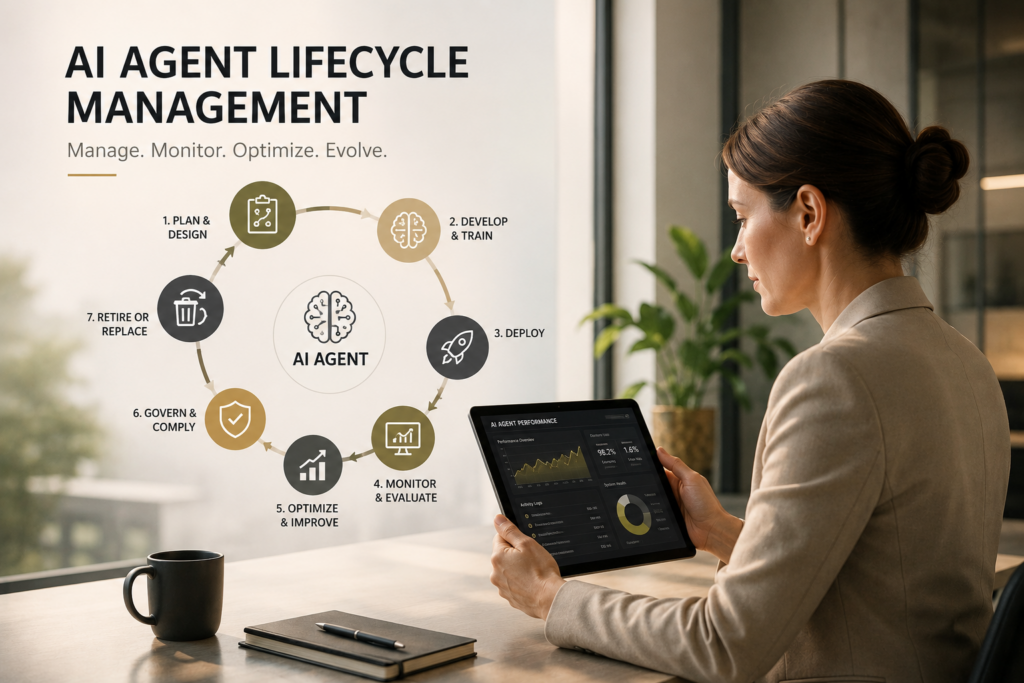
AI Agent Lifecycle Management is a structured approach to planning, deploying, monitoring, improving, governing, and retiring AI agents throughout their operational life. It ensures autonomous systems continue delivering measurable business value while maintaining transparency, accountability, security, and compliance.
Instead of asking “How do we deploy AI?”, forward-thinking organizations ask:
- How do we ensure AI agents remain reliable over time?
- How should AI performance be measured?
- When should an AI agent be updated or retrained?
- How can organizations govern hundreds of AI agents across multiple departments?
- What controls are needed to maintain trust and accountability?
For CEOs, CIOs, CTOs, Chief Digital Officers, government agencies, and enterprise leaders, AI Agent Lifecycle Management has become a critical foundation for responsible AI adoption.
📊 Industry Overview
Organizations worldwide are investing heavily in Agentic AI to improve operational efficiency, reduce costs, enhance customer experiences, and support strategic decision-making.
Unlike traditional automation systems, autonomous AI agents continuously interact with changing data, enterprise software, APIs, cloud platforms, and business workflows. They often make recommendations, execute approved actions, coordinate with other AI agents, and adapt to new information.
These capabilities create tremendous business opportunities but also introduce new operational challenges.
An AI agent deployed today may gradually become less effective if regulations change, business policies evolve, customer expectations shift, or enterprise data becomes outdated.
Without structured lifecycle management, organizations risk:
- Declining AI performance
- Inconsistent decision-making
- Security vulnerabilities
- Compliance failures
- Operational inefficiencies
- Reduced stakeholder trust
Leading enterprises therefore manage AI systems as continuously evolving business assets rather than one-time technology projects.
AI Agent Lifecycle Management integrates governance, monitoring, cybersecurity, performance analytics, and continuous improvement into a single enterprise framework that supports long-term success.
⚠️ Key Challenges
🤖 Managing AI at Enterprise Scale
As organizations deploy AI agents across multiple business functions, maintaining consistency becomes increasingly difficult.
Different departments may use different AI models, workflows, governance policies, and data sources, making centralized oversight essential.
🔐 Maintaining Security Throughout the Lifecycle
AI agents frequently access enterprise systems, confidential documents, customer information, and financial data.
Without strong identity management, authentication, encryption, and access controls, these systems can become attractive targets for cyber threats.
📊 Preventing Model Drift
Business environments constantly evolve.
Changes in customer behavior, regulations, operational processes, or market conditions can reduce the accuracy and effectiveness of AI systems if they are not regularly reviewed and updated.
⚖️ Meeting Regulatory Requirements
Governments and regulatory authorities are introducing new standards for responsible AI, transparency, privacy, and accountability.
Organizations must ensure AI systems remain compliant throughout their lifecycle rather than only during deployment.
👥 Maintaining Human Trust
Employees, customers, investors, and regulators increasingly expect organizations to explain how AI systems reach conclusions and make decisions.
Transparent governance strengthens confidence in autonomous technologies.
📈 AI & Business Insights
📊 AI Requires Continuous Governance
Unlike conventional software, AI continuously interacts with new information and changing business environments.
Regular governance reviews ensure AI systems remain aligned with organizational objectives and ethical standards.
🤝 Human Oversight Improves Business Outcomes
The most successful organizations combine AI autonomy with strategic human supervision.
Critical financial, legal, compliance, and executive decisions should include appropriate human review.
🌍 Performance Monitoring Enables Continuous Improvement
Organizations that continuously measure AI accuracy, response quality, workflow efficiency, and business outcomes can identify optimization opportunities before problems affect operations.
🔍 High-Quality Data Determines AI Success
Even advanced AI agents perform poorly when trained or operated using incomplete, inconsistent, or outdated information.
Strong data governance is fundamental to successful lifecycle management.
📈 Lifecycle Management Supports Scalable AI
Organizations with standardized lifecycle processes can confidently deploy AI across multiple departments while maintaining consistency, security, and governance.
🛠️ Practical Recommendations
📋 Establish an Enterprise AI Governance Framework
Develop clear policies covering AI approval, deployment, monitoring, maintenance, auditing, and retirement.
Assign responsibilities across technology, security, legal, compliance, and business leadership teams.
🔍 Continuously Monitor AI Performance
Measure key performance indicators such as response accuracy, task completion rates, decision quality, user satisfaction, and operational efficiency.
Regular monitoring helps identify performance degradation before it affects business operations.
🔐 Strengthen AI Security Controls
Implement Zero Trust principles, role-based access controls, encryption, secure API management, and continuous security monitoring to protect AI environments.
📊 Schedule Regular Model Reviews
Evaluate AI models periodically to ensure they reflect current business policies, regulatory requirements, and customer expectations.
Retrain or update AI agents whenever significant business changes occur.
👥 Maintain Human Accountability
Clearly define situations where AI can operate autonomously and where human approval is required.
Executive oversight remains particularly important for strategic, financial, legal, and regulatory decisions.
📈 Build Scalable AI Operations
Create modular AI architectures that allow organizations to introduce new AI agents without disrupting governance or operational consistency.
Standardized deployment and monitoring processes simplify enterprise-wide AI expansion.
🤝 How GRMC Can Help
GRMC EdgeSphere helps organizations implement and manage enterprise AI through strategic consulting, governance frameworks, and digital transformation services.
🤖 AI Strategy & Roadmap Development
We help organizations develop long-term AI strategies aligned with business goals, operational priorities, and digital transformation initiatives.
📊 AI Lifecycle Governance
Our specialists design governance frameworks covering AI deployment, monitoring, compliance, performance measurement, and continuous improvement.
🔐 AI Security & Risk Management
GRMC supports organizations with identity management, cybersecurity assessments, secure AI architecture, and risk mitigation strategies for autonomous systems.
📈 Enterprise AI Integration
We integrate AI agents with enterprise applications, cloud platforms, APIs, business intelligence systems, and operational workflows while maintaining governance and scalability.
🌍 Executive Advisory
Our consultants work with leadership teams to maximize AI investments through responsible adoption, continuous optimization, and evidence-based decision-making.
🚀 Conclusion
As organizations increasingly rely on autonomous AI systems, long-term success depends on more than simply deploying intelligent agents.
AI Agent Lifecycle Management provides the structure needed to ensure AI remains secure, reliable, transparent, and aligned with evolving business objectives throughout its operational life.
By combining governance, cybersecurity, continuous monitoring, performance optimization, and human oversight, organizations can confidently scale Agentic AI while reducing operational risk and maintaining stakeholder trust.
Organizations that invest in effective lifecycle management will be better positioned to unlock the full value of enterprise AI, improve operational efficiency, strengthen decision-making, and accelerate sustainable digital transformation.
GRMC EdgeSphere empowers organizations to build, govern, and optimize intelligent AI ecosystems through strategic consulting, enterprise AI governance, and digital transformation solutions—helping businesses create resilient, future-ready operations powered by trusted autonomous AI.