

🌍 Introduction
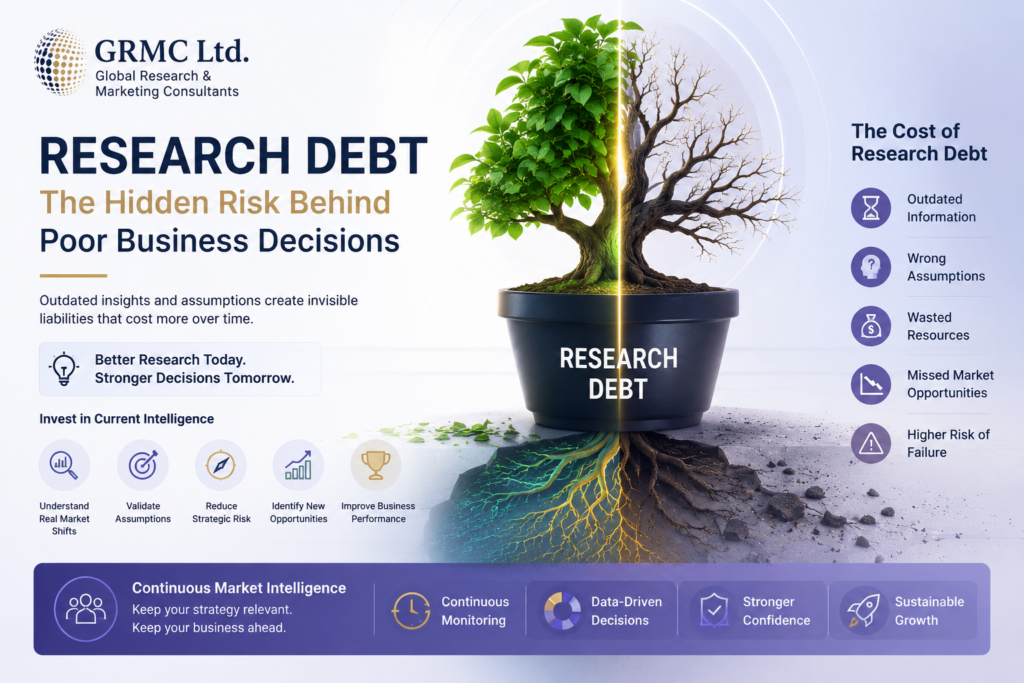
Organizations invest significant resources in strategic planning, product development, market expansion, customer acquisition, and operational improvement. Yet many of these initiatives rely on research that is incomplete, outdated, or no longer reflects current market conditions.
This growing gap between business decisions and current market intelligence creates what can be described as Research Debt.
Similar to technical debt in software development, Research Debt accumulates when organizations delay updating market intelligence, continue relying on historical assumptions, or make strategic decisions without validating changing market conditions.
While the consequences may not be immediately visible, Research Debt gradually increases uncertainty, weakens competitive positioning, and raises the likelihood of costly business decisions.
For business leaders, investors, government agencies, and enterprise decision-makers, recognizing and reducing Research Debt is becoming essential for sustainable growth and long-term competitiveness.
📊 Industry Overview
Markets today evolve at an unprecedented pace.
Organizations face continuous change driven by:
- Digital transformation
- Changing customer expectations
- Economic volatility
- Regulatory developments
- Technological innovation
- Global competition
- Supply chain disruption
- Workforce transformation
In this environment, market intelligence has a limited shelf life.
Research conducted several years ago may no longer accurately represent customer preferences, competitive dynamics, pricing expectations, or industry conditions.
Leading organizations are increasingly treating market research as an ongoing strategic capability rather than a one-time project.
⚠️ Key Challenges
📅 Relying on Outdated Research
Business decisions are often based on reports produced months—or even years—earlier.
As markets evolve, the relevance of those insights gradually declines.
🧩 Decisions Based on Internal Assumptions
Organizations frequently rely on institutional knowledge instead of validating assumptions with current market evidence.
This can lead to products, services, or investments that no longer align with customer needs.
🌍 Rapid Market Evolution
Consumer behavior, competitor strategies, technology adoption, and economic conditions are changing faster than traditional planning cycles.
Research must evolve at the same pace.
📉 Hidden Strategic Risk
Unlike financial risks, Research Debt often remains invisible until business performance begins to decline.
By the time warning signs appear, corrective action may become more expensive.
💰 Cost of Poor Decisions
Launching products into the wrong market, selecting unsuitable expansion locations, investing in declining sectors, or misjudging customer demand often results from insufficient or outdated research.
📈 Market Research Insights
🔍 Continuous Intelligence Creates Better Decisions
Organizations that regularly update market intelligence respond more effectively to changing conditions and identify opportunities earlier.
👥 Customer Expectations Change Faster Than Internal Planning
Customer needs, purchasing behavior, and decision criteria continue to evolve.
Organizations that fail to monitor these shifts risk losing relevance.
📊 Competitive Landscapes Never Stand Still
Competitors continuously adjust pricing, products, partnerships, and market positioning.
Regular competitive research helps organizations maintain strategic awareness.
🌐 External Intelligence Complements Internal Data
Operational metrics explain what is happening inside the business.
Market research explains why it is happening and how external forces are shaping future outcomes.
🛠️ Practical Recommendations
📑 Audit Existing Research
Evaluate the age, relevance, and quality of research currently supporting strategic decisions.
Identify knowledge gaps before launching major initiatives.
🔄 Replace One-Time Studies with Continuous Research
Develop an ongoing market intelligence program that tracks customer behavior, competitors, industry developments, and economic conditions throughout the year.
📊 Integrate Research into Executive Decision-Making
Ensure market research becomes a standard input for investment planning, product development, expansion strategies, and operational improvements.
🎯 Prioritize High-Impact Research
Focus research efforts on decisions involving significant financial investment, strategic change, or market expansion.
📈 Measure Research Impact
Evaluate how research influences business outcomes such as revenue growth, customer acquisition, operational efficiency, and investment performance.
🤝 How GRMC Can Help
GRMC EdgeSphere helps organizations reduce Research Debt through comprehensive market research and business intelligence services.
📊 Continuous Market Intelligence
We provide ongoing research programs that keep organizations informed about changing market conditions.
🔍 Industry & Competitive Analysis
Our experts monitor competitors, emerging trends, regulatory developments, and market dynamics to support informed strategic planning.
👥 Customer Research
We help organizations understand evolving customer needs, preferences, and purchasing behavior.
🌍 Market Validation
GRMC validates assumptions before organizations commit to expansion, investment, product development, or strategic transformation.
📈 Executive Decision Support
We deliver evidence-based insights that improve confidence, reduce uncertainty, and strengthen long-term business performance.
🚀 Conclusion
The quality of business decisions depends on the quality of the information supporting them.
As markets evolve more rapidly, organizations that continue relying on outdated assumptions accumulate Research Debt that increases strategic risk and limits future growth.
By investing in continuous market intelligence, validating assumptions regularly, and integrating research into executive decision-making, organizations can reduce uncertainty and respond more effectively to changing market conditions.
GRMC EdgeSphere helps organizations replace outdated assumptions with actionable intelligence, enabling leaders to make confident decisions based on current market realities rather than historical perceptions.