Every organization generates enormous volumes of data through customer interactions, sales transactions, operational processes, supply chains, financial systems, connected devices, and digital platforms. While this data contains valuable business insights, many organizations struggle to transform it into actionable intelligence that supports strategic decision-making.
Traditional reporting explains what happened in the past. Predictive analytics goes further by using Artificial Intelligence (AI), machine learning, and advanced statistical models to forecast future outcomes, identify emerging risks, anticipate customer behavior, and uncover growth opportunities before they become visible through conventional reporting.
For CEOs, CIOs, CTOs, and business leaders, AI-powered predictive analytics has become a strategic capability that improves decision quality, reduces uncertainty, and enables proactive rather than reactive management.
The Business Challenge
Modern enterprises face increasingly complex decisions in an environment characterized by rapid market changes, economic uncertainty, supply chain disruptions, evolving customer expectations, and growing competition.
Common challenges include:
- Making decisions based on incomplete information
- Identifying business risks too late
- Inaccurate demand forecasting
- Customer churn without early warning indicators
- Inefficient inventory management
- Unexpected equipment failures
- Rising operational costs
- Limited visibility into future business performance
Without predictive capabilities, organizations often respond to problems after they occur rather than preventing them.
What is AI-Powered Predictive Analytics?
AI-powered predictive analytics combines machine learning, statistical modeling, historical data analysis, and real-time information to forecast future events and recommend actions.
Instead of only answering:
- What happened?
- Why did it happen?
Predictive analytics also answers:
- What is likely to happen next?
- What risks should we prepare for?
- Which customers may leave?
- Which products will experience higher demand?
- Where should resources be allocated?
- Which opportunities should receive priority?
The result is faster, more informed, and more confident business decision-making.
Core Technologies Behind Predictive Analytics
Machine Learning
Machine learning algorithms continuously learn from historical and real-time data to improve prediction accuracy over time.
Big Data Processing
Predictive models analyze structured and unstructured data from multiple enterprise systems, including ERP, CRM, IoT platforms, finance applications, and cloud services.
Artificial Intelligence
AI identifies hidden relationships, detects anomalies, recognizes patterns, and supports automated decision recommendations.
Business Intelligence Platforms
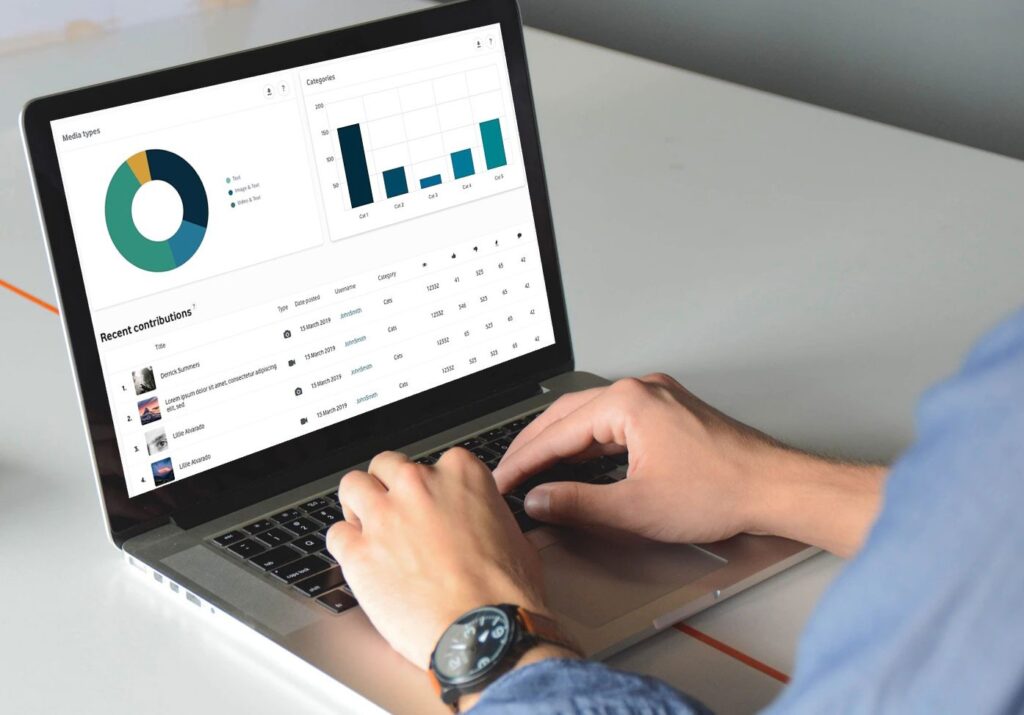
Interactive dashboards transform predictive insights into clear visualizations that executives can use for strategic planning.
API Integration
Secure API connectivity enables predictive models to consume data from multiple internal and external systems without disrupting existing workflows.
Business Benefits and ROI
Smarter Executive Decision-Making
Executives gain forward-looking insights that support strategic planning, investment decisions, and resource allocation.
Business Value
- Reduced uncertainty
- Better planning accuracy
- Improved business agility
Revenue Growth
Predictive models identify high-value customers, cross-selling opportunities, pricing optimization strategies, and emerging market trends.
Business Value
- Increased sales
- Higher customer lifetime value
- Better marketing performance
Operational Efficiency
Organizations can optimize staffing, inventory, production schedules, logistics, and procurement based on expected future demand.
Business Value
- Lower operating costs
- Reduced waste
- Improved productivity
Risk Reduction
Predictive analytics identifies operational, financial, cybersecurity, and compliance risks before they escalate into major business issues.
Business Value
- Improved resilience
- Fewer disruptions
- Better governance
Customer Retention
AI models detect behavioral changes that may indicate declining customer engagement or increased churn risk.
Business Value
- Higher customer satisfaction
- Stronger loyalty
- Lower acquisition costs
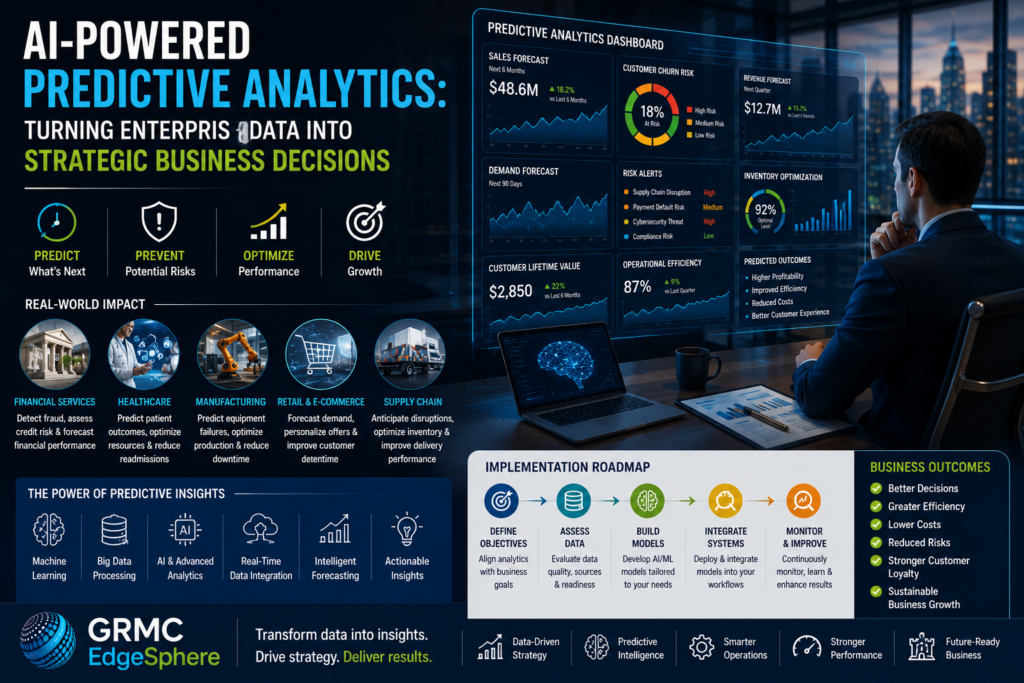
Real-World Enterprise Applications
Financial Services
Banks use predictive analytics to:
- Detect fraudulent transactions
- Assess credit risk
- Forecast loan defaults
- Improve investment strategies
Healthcare
Healthcare providers leverage predictive models to:
- Forecast patient demand
- Improve treatment planning
- Reduce hospital readmissions
- Optimize resource allocation
Manufacturing
Manufacturers apply predictive analytics for:
- Predictive maintenance
- Production optimization
- Equipment performance monitoring
- Supply chain forecasting
Retail and E-Commerce
Retail organizations use AI to:
- Forecast product demand
- Personalize customer recommendations
- Optimize pricing strategies
- Improve inventory management
Telecommunications
Telecom providers predict:
- Customer churn
- Network capacity requirements
- Service disruptions
- Equipment failures
Government and Public Sector
Government agencies utilize predictive analytics to improve:
- Public service planning
- Infrastructure maintenance
- Budget forecasting
- Emergency response preparedness
Implementation Roadmap
Phase 1: Business Objective Definition
Clearly define the business problems predictive analytics should solve, such as improving demand forecasting, reducing customer churn, or optimizing operations.
Phase 2: Data Readiness Assessment
Evaluate the availability, quality, consistency, and governance of enterprise data sources.
Phase 3: Model Development
Develop AI and machine learning models using historical and real-time datasets aligned with business objectives.
Phase 4: Enterprise Integration
Integrate predictive models into existing ERP, CRM, BI, and operational systems through secure APIs and automated workflows.
Phase 5: Continuous Monitoring
Monitor model performance, prediction accuracy, business outcomes, and evolving data patterns to ensure long-term effectiveness.
Best Practices for Success
Organizations should adopt several best practices to maximize predictive analytics initiatives:
- Establish strong data governance policies
- Ensure executive sponsorship
- Prioritize high-value business use cases
- Maintain data privacy and cybersecurity controls
- Validate model accuracy regularly
- Encourage cross-functional collaboration
- Train employees to interpret predictive insights
- Continuously refine models using new business data
How GRMC EdgeSphere Can Help
GRMC EdgeSphere helps organizations transform enterprise data into actionable intelligence through advanced predictive analytics solutions.
Our services include:
- Predictive Analytics Strategy
- AI and Machine Learning Consulting
- Business Intelligence Dashboard Development
- Data Integration and API Connectivity
- Enterprise Data Analytics
- Forecasting Model Development
- Customer Analytics
- Risk Analytics
- Operational Performance Analytics
- Executive Decision Support Solutions
- Digital Transformation Consulting
Our team combines expertise in AI, business intelligence, data engineering, cybersecurity, and digital transformation to deliver predictive analytics solutions that generate measurable business value.
Conclusion
In today’s data-driven economy, organizations that rely solely on historical reporting risk falling behind competitors that leverage predictive insights to anticipate change and respond proactively.
AI-powered predictive analytics enables enterprises to forecast outcomes, reduce uncertainty, optimize operations, strengthen customer relationships, and make faster, evidence-based decisions.
When supported by high-quality data, effective governance, and a well-defined implementation strategy, predictive analytics becomes a powerful competitive advantage that drives sustainable growth and operational excellence.
As digital transformation continues to accelerate, predictive analytics will play an increasingly central role in helping organizations navigate complexity, seize new opportunities, and build resilient, future-ready enterprises.